Why Does My Budgie Regurgitate Food? Explained
If you have just watched your budgie bring up a mouthful of seed and offer it to you, a toy, or a mirror, you are probably asking, why does my budgie regurgitate food, and whether your bird is sick. It looks alarming. Food coming back up usually means illness in people and in dogs and cats, so it is natural to worry.
Take a breath. In most cases, a budgie that regurgitates is a healthy bird showing affection, not a sick one. Regurgitation is one of the most normal things a budgie does, and it is also one of the most misunderstood. The trick is knowing the difference between the normal, loving kind and the kind that means illness.
This guide explains both kinds in plain language. You will learn why budgies regurgitate, how to tell regurgitation apart from vomiting in seconds, what to do when your budgie regurgitates on you, and the warning signs that mean a vet visit today, not next week.
Direct answer: A budgie regurgitates food because it is showing affection or courtship behaviour, feeding a mate or a chick, or — much less often — because it is ill.
Most regurgitation is normal. A healthy budgie bobs its head, brings up a small amount of undigested seed, and offers it to a person, a mirror, a toy, or another budgie. It stays bright, active, and hungry afterwards. Vomiting is different: the bird flicks its head, sprays food around the cage, and looks ill. If you see that, call an avian vet the same day.
Why Does My Budgie Regurgitate Food? The Two Kinds
There are two kinds of bringing food back up in a budgie, and they look similar from across the room. That is why so many owners panic over the harmless one and miss the dangerous one. Learning to tell them apart is the single most useful skill in this guide.
Regurgitation is a controlled, deliberate act. The budgie stretches its neck, bobs its head up and down in a smooth rhythm, and brings up a small amount of food from its crop. The crop is a pouch in the throat where food sits before it reaches the stomach. No digestion happens there, so the food comes back up looking almost exactly like the seed that went in.
Vomiting is a reflex, not a choice. The bird flicks or shakes its head quickly, and half-digested food sprays out in all directions. It lands on the cage bars, on the bird’s own head feathers, and on the floor. The bird looks distressed while it happens, and it often looks unwell afterwards.
The difference matters because the two have opposite meanings. Regurgitation is usually a sign of a healthy, bonded bird. Vomiting is always a sign that something is wrong, and it needs a vet. A budgie that vomits is a bird that needs help within hours, because small birds go downhill fast.
Most of what owners see is regurgitation. A budgie may do it two or three times a day, and a bird that is very bonded to its owner may do it every time it comes out of the cage. That is normal for the species, and it is not something you need to cure. What you need to manage is how often it happens and who it is aimed at.
Courtship Regurgitation: Your Budgie Is Telling You It Loves You
The most common reason a budgie regurgitates is courtship. In the wild, budgies feed each other during courtship, and a male that can offer food proves he is a good provider. A female that accepts the food is accepting the male. The behaviour is built into the species, and pet budgies do it with whoever they have bonded to.
That bonded partner is often you. A single budgie in a home bonds to its owner the way a wild budgie bonds to a mate. When it bobs its head at your hand, your finger, or your shoulder and brings up a little seed, it is offering you food. It is the highest compliment a budgie can pay.
Male budgies do this most, and they do it most in spring, when the days get longer and breeding hormones rise. Females do it too, though usually less often and less dramatically. A young budgie that has just been weaned may also bob and regurgitate at a person, but that is begging, not courtship. The chick is asking to be fed, the way it would ask its parents.
Courtship regurgitation follows a clear pattern. It is aimed at a specific target — you, a mirror, a favourite toy, or another budgie. It happens at the same times of day, usually in the morning or when you first come into the room. The bird is bright, alert, and active before and after. It eats normally, sings, plays, and drops normal droppings.
If that is what you are seeing, your bird is not ill. It is a healthy bird doing a healthy behaviour in the wrong setting. The problem is not the regurgitation itself. The problem is that a bird that regurgitates at a person all day can become frustrated, hormonal, and even aggressive, because a human can never be a real mate. The answer is not to punish the behaviour, but to manage it calmly, as the steps later in this guide explain.
Regurgitation to a Mirror, a Toy, or a Cage Mate
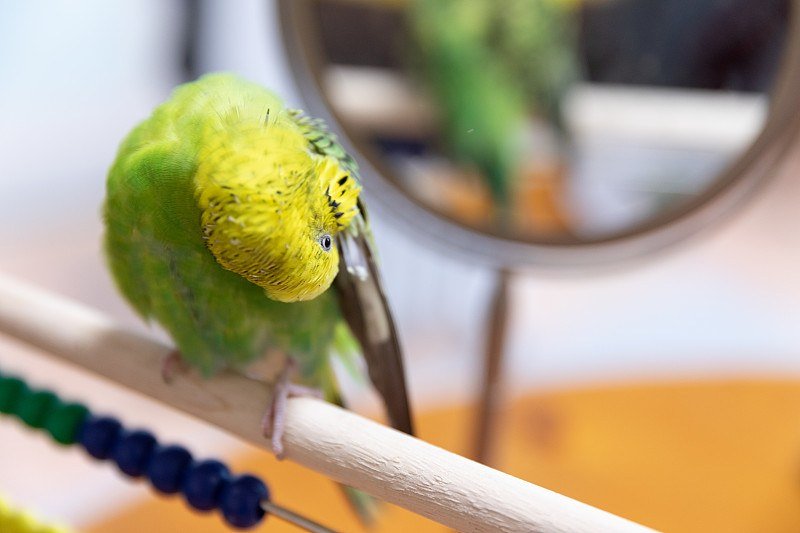
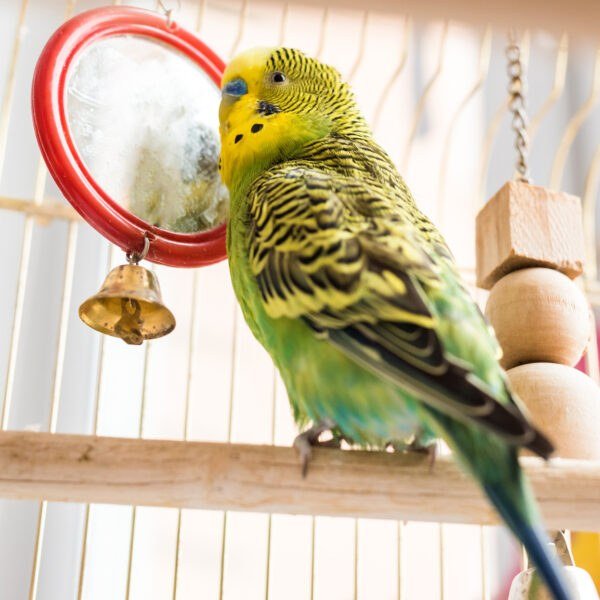
A budgie that regurgitates at a mirror is one of the most common sights in pet bird keeping, and one of the saddest. The bird sees another budgie in the glass, and it tries to feed it. The reflection never answers, never feeds back, and never leaves. The bird tries harder, and the behaviour grows stronger.
Mirrors are the single biggest trigger for constant regurgitation in single budgies. A bird with a mirror can spend hours a day bobbing and offering food to a bird that does not exist. It eats less for itself, because so much of its food goes to the mirror. It can lose weight, become obsessed, and turn aggressive when anyone comes near its mirror.
Toys can trigger the same behaviour. A budgie may pick a favourite bell, a swing, or a small plastic bird and feed it every day. This is less harmful than a mirror, because the toy does not look like a living bird, but it still keeps the bird in a hormonal loop. A budgie that feeds its toy all day is a budgie that is not playing, not foraging, and not resting properly.
Regurgitation between two real budgies is different, and it is usually fine. A bonded pair feeds each other as part of normal life, and a parent feeds its chicks. A male feeding a female during breeding season is doing exactly what nature designed him to do. As long as both birds eat enough, stay in good weight, and behave normally, there is nothing to fix.
The line is crossed when the behaviour takes over the bird’s day. A budgie that regurgitates ten times a day, that ignores its food dish, that loses weight, or that attacks anyone who comes near its chosen target needs help. The first step is almost always the same: remove the mirror, rotate the favourite toy out of the cage, and give the bird something else to do with its beak.
Our guide to how much millet a budgie can eat per day explains how to use millet spray as a training treat instead of a constant cage food, and that small change alone can break the regurgitation loop for many birds.
Regurgitation vs Vomiting: The Decoder Table
The fastest way to tell the two apart is to watch three things: the head movement, where the food lands, and how the bird looks afterwards. The table below puts the differences side by side, so you can check your bird against it in under a minute.
| What you see | Regurgitation (usually normal) | Vomiting (always a vet visit) |
|---|---|---|
| Head movement | Smooth, rhythmic bobbing up and down | Fast flicking or shaking side to side |
| Where the food lands | Neatly on a target: hand, mirror, toy, mate | Sprayed around the cage and on the head feathers |
| What the food looks like | Whole, undigested seed, no smell | Half-digested, slimy, sour or foul-smelling |
| How often it happens | A few times a day, at set times, aimed at something | Repeatedly through the day, at random, with no target |
| How the bird looks after | Bright, active, eating and singing normally | Fluffed up, quiet, sleepy, or sitting on the cage floor |
| Other signs | None — droppings normal, weight steady | Weight loss, changed droppings, less appetite, tail bobbing |
Use the table like a checklist. If your bird matches the left column on every row, you are looking at normal regurgitation. If it matches even two rows on the right, treat it as vomiting and call an avian vet the same day. Do not wait to see if it gets better, because a budgie that is vomiting is often much sicker than it looks.
One warning: a bird can do both. A budgie that normally regurgitates at its mirror can also develop a crop infection and start vomiting. The history does not protect it. If the pattern changes — more often, messier, with a sick-looking bird — trust the new pattern, not the old one.
When Regurgitation Means Illness
Illness-related regurgitation is less common than the courtship kind, but it is the kind that matters most. A budgie that brings up food because it is sick is not showing affection. It is showing you that something in its digestive system is not working, and the cause needs to be found.
The most common medical cause is a crop infection. The crop is warm, moist, and full of food, which makes it a good home for yeast and bacteria. Candida, a yeast, is the usual culprit, and it slows the crop so food sits there too long. The food ferments, smells sour, and comes back up. A budgie with a crop infection often has a crop that still feels full hours after eating, and its breath may smell sweet or sour.
Avian gastric yeast, once called megabacteria, is another cause. It lives in the stomach of many budgies without causing trouble, then flares up when the bird is stressed, young, or run down. Affected birds regurgitate, lose weight slowly, and pass undigested seed in their droppings. It is diagnosed with a faecal test and treated with medicine from a vet.
Trichomoniasis, a parasite, affects the throat and crop of budgies and canaries. It causes regurgitation, difficulty swallowing, and sometimes a visible swelling in the throat. It spreads between birds through shared food and water, so a new bird in the house should always be quarantined for 30 days before it meets your other birds.
Proventricular dilatation disease, often called PDD, is a viral disease that damages the nerves of the digestive tract. The stomach stops moving food through properly, and the bird regurgitates, passes whole seed in its droppings, and loses weight over weeks. It is serious, and it is one of the reasons a vet will ask for a full work-up rather than just a quick look.
Heavy metal poisoning is a cause owners often miss. A budgie that chews on galvanised wire, old paint, a cheap metal toy, or a curtain weight can swallow zinc or lead. The metal irritates the gut, and the bird regurgitates again and again, often with weakness, strange behaviour, or seizures. Check every toy and every cage bar for chipped paint or shiny, soft metal.
None of these can be diagnosed at home, and none should be treated at home. A vet will weigh the bird, feel the crop, look at the droppings under a microscope, and may take blood or an X-ray. That sounds like a lot for a small bird, but a budgie weighs only 30 to 40 grams, and it can lose 10 percent of its body weight in a day or two of not eating. Speed matters.
What to Do When Your Budgie Regurgitates on You
Most owners ask this question the first time it happens, usually with a mouthful of seed on their hand. The answer is simple, but it feels wrong: do nothing dramatic. Do not scold the bird, do not shout, and do not throw it back in its cage in anger. The bird was being loving, and punishment only teaches it that you are frightening.
Instead, stay calm and end the interaction quietly. Put the bird back on its perch or in its cage without fuss, wash your hands, and carry on with your day. If you react strongly every time, the bird learns that regurgitation gets a big reaction, and that can make the behaviour stronger, not weaker.
Then change the conditions that are driving it. The single most effective step is to remove the mirror. A budgie that feeds a mirror all day is a budgie stuck in a hormonal loop, and no amount of training will fix it while the mirror stays. Take it out, and most birds settle within a week or two.
Next, look at the light. Budgies breed when the days are long, so a bird that gets 14 or 15 hours of light a day is a bird in breeding mode all year. Give your budgie 10 to 12 hours of dark, quiet sleep every night, and cover the cage so the light is truly dark. Our guide to how many hours of sleep a budgie needs explains the full night routine.
Stop petting the bird’s back and wings. Stroking the back is a mating signal in budgies, and it tells the bird’s hormones that breeding season has arrived. Head scratches are fine, and most budgies love them. Anything below the neck is not.
Move the cage if it sits in a dark, quiet corner with a nest-like box or a happy hut. Dark, enclosed spaces tell a budgie it has found a nest site, and the hormones follow. A cage in a bright, social part of the room, with no nest box and no cosy tent, keeps the bird in pet mode rather than breeding mode.
Finally, give the bird work to do. A budgie that spends its day foraging for food hidden in paper, shredding safe toys, and learning to step up on cue has less time and less energy for constant courtship. A bored budgie regurgitates. A busy budgie plays.
How to Help a Budgie That Keeps Regurgitating
Food plays a bigger part than most owners realise. A budgie on an all-seed diet is a budgie with a poor diet, and a poor diet makes every problem worse. Seeds are high in fat and low in the vitamins a bird needs for a healthy gut and a strong immune system. A bird that eats mostly pellets, with fresh vegetables every day and seed as a treat, is a bird whose crop works better.
The budgie food calculator helps you work out the right daily amounts for your bird’s weight, and the bird water intake calculator checks that your bird is drinking enough. A budgie that is even slightly dehydrated has a slower crop, and a slow crop is more likely to bring food back up.
Watch the weight. A healthy budgie weighs between 30 and 40 grams, and a small kitchen scale that reads in grams is one of the best tools a budgie owner can own. Weigh your bird at the same time each morning, before breakfast. A steady weight is a good sign. A loss of 3 or 4 grams in a week is a warning, and a bird that keeps losing weight while it regurgitates needs a vet, even if it still looks bright.
Watch the droppings. Normal budgie droppings have a firm dark centre, a white chalky part, and a little clear liquid. Droppings that are all liquid, that contain whole undigested seed, or that smell worse than usual are signs the gut is not working. Take a photo of the droppings and show it to the vet. It is not a pleasant photo to take, but it is one of the most useful things you can bring to an appointment.
Know the age of your bird. A young budgie that regurgitates after weaning is often just begging, and it usually settles as the bird grows up. An older bird that suddenly starts regurgitating after years of never doing it is a different story. Sudden change is always worth a vet check, and the budgie age calculator helps you work out where your bird is in its life.
Frequently Asked Questions
Why does my budgie bob its head?
Head bobbing is how a budgie talks with its body, and it means different things at different times. A young budgie bobs its head when it is excited, when it hears music, or when it wants attention. An adult male bobs his head as part of courtship, often just before he regurgitates for a mate or for you.
The bobbing itself is not a problem. It is the same rhythmic neck movement that powers regurgitation, so the two often appear together. Watch what comes with it: a bobbing bird that is singing, playing, and eating well is a happy bird. A bird that bobs its head constantly, brings up food all day, and ignores its toys may be stuck in a hormonal loop, and the mirror and light changes in this guide will help.
Do female budgies regurgitate more than males?
No, males regurgitate more often than females, and they do it more dramatically. Courtship feeding is mainly a male behaviour in wild budgies, because the male proves he can provide food for a mate and her chicks. A male may feed a female several times a day during breeding season.
Females do regurgitate, but usually in different situations. A female may regurgitate when she is feeding chicks, when she is unwell, or when she is very bonded to a person or a toy. If your female budgie suddenly starts regurgitating a lot, pay closer attention than you would with a male, because illness is a more likely cause. A vet check is a good idea if it comes with any other change, such as eating less or sitting fluffed up.
Can regurgitation make my budgie lose weight?
Yes, it can, and this is the main reason constant regurgitation needs to be managed rather than ignored. Every mouthful of seed your budgie brings up and offers to a mirror or a toy is a mouthful it does not swallow. A bird that regurgitates ten times a day is throwing away a real part of its daily food.
The risk is highest in small birds, because a budgie only weighs 30 to 40 grams and has very little reserve. A loss of just 3 grams is 10 percent of its body weight. Weigh your bird weekly on a gram scale, and if the weight is falling while the regurgitation continues, remove the mirror, shorten the daylight hours, and call an avian vet if the weight does not stabilise within a week.
Why does my budgie regurgitate on its food dish?
A budgie that regurgitates onto its food dish is usually treating the dish the way it would treat a mate or a favourite toy. The dish is a fixed, familiar object in the cage, and the bird has bonded to it. This is common in single budgies that spend long hours alone, and it is more likely if the dish is the same colour or shape as a toy the bird likes.
It is not dangerous on its own, but it is a sign the bird needs more to do. Move the dish to a different spot in the cage, change its colour or shape, and add foraging toys that make the bird work for its food. If the bird regurgitates on the dish and then eats the regurgitated food again, watch for weight loss and sour-smelling breath, because re-eating spoiled food can upset the crop. Fresh food and clean dishes every day are the fix.
For more on budgie health and behaviour, Lafeber’s budgie species profile covers daily care and body language, and the Merck Veterinary Manual’s pet bird section explains the digestive diseases that can cause vomiting in small parrots.