Why Is My Fish Tank Water Evaporating So Fast?
If you are wondering why is my fish tank water evaporating so fast, you are not imagining it. You topped the tank up on Sunday, and by Thursday the water line has dropped an inch. The filter outlet is starting to gurgle. The heater is peeking out of the water. It feels like the tank is leaking, but the floor is dry.
Most of the time, the answer is simple physics, not a leak. Warm water, dry room air, an open top and a rippling surface all pull water out of your tank and into the air. A heated tropical tank in a dry winter room can lose a surprising amount of water every single week.
The good news is that fast evaporation is almost always normal, and it is almost always fixable. The bad news is that ignoring it quietly changes your water chemistry. Only pure water leaves the tank. Everything dissolved in it — minerals, salts, nitrate — stays behind and gets more concentrated.
Direct answer: Your fish tank water is evaporating fast because warm water, dry room air, an open top and strong surface movement all speed up evaporation. A heated open-top tank in a dry room can easily lose 1 to 2 inches of water a week, and small tanks lose a bigger share of their water than large ones. A fitted glass lid is the single best fix, cutting evaporation by 70 to 90 percent. Top up with plain dechlorinated water only, never with salt or mineral treatments, because only pure water evaporates and the minerals stay behind.
Why Is My Fish Tank Water Evaporating So Fast? The 7 Real Causes
Evaporation happens at the water surface. Water molecules with enough energy escape into the air as vapour. The rate depends on a handful of factors, and most of them are under your control. Here are the seven that matter most, in rough order of impact.
1. An open top. This is the biggest single factor. A tank with no lid, or a lid with a big feeding hole, exposes the whole surface to dry room air. A tight-fitting glass or polycarbonate lid is the single most effective fix you can buy. Keepers who fit a lid often see their weekly top-up drop by 70 to 90 percent overnight.
2. Warm water. Evaporation roughly doubles for every 10 degrees Celsius the water warms up. A discus tank at 28 degrees loses water far faster than a goldfish tank at 20 degrees.
3. Dry room air. Evaporation is driven by the gap between the moist air just above the water and the air in your room. Heated rooms in winter are very dry, often 30 percent humidity or less. Air conditioning dries the air too. That is why many keepers notice the water level dropping fastest in winter, even though the house feels warm.
4. Surface agitation. A thin layer of humid air sits just above still water and acts like a natural lid. Anything that breaks that layer speeds evaporation up. Spray bars, strong filter outflows, air stones, surface skimmers and cooling fans all churn the surface and let dry room air in.
5. Cooling fans. Fans cool a tank by speeding up evaporation on purpose. That is how they work. If you run a fan across the surface in summer, expect to top up much more often. It is the price of the cooling, and it is worth knowing before you blame a leak.
6. A wide, shallow tank. Evaporation depends on surface area, not on volume. A long, low tank loses proportionally more water than a tall, narrow tank holding the same amount of water.
7. Hot lights. Older metal halide lights and some T5 tube arrays throw a lot of heat onto the water surface. LED lights run much cooler. If your tank sits in direct sunlight from a window, that adds heat too, and sunlight is one of the fastest ways to push evaporation up.
Most fast-evaporating tanks have three or four of these working together. A warm, open-top tank in a dry heated room is the perfect recipe for a fast-dropping water line.
Is It a Leak or Evaporation? The Paper Towel Test
Before you fix anything, rule out a leak. A leak and fast evaporation look the same from the front of the glass: the water level drops. The difference is where the water goes. Evaporated water goes into the air. Leaked water goes onto your floor, your stand, or your carpet.
Start with the simplest check. Run your hand along the bottom edge of the tank, under the stand, and around every seam. Look for damp spots, water stains, or a musty smell. Check the filter, the heater cable, and any hoses.
Then do the paper towel test. Dry the outside of the tank completely. Press dry paper towels along the bottom seam and the corners, and leave them for an hour.
Another good test is the mark-and-wait test. Mark the water line with a small piece of tape. Do not top up for 48 hours. Measure how far the level has dropped, then work out the volume. Multiply the length of the tank by the width by the drop in inches, then divide by 231. That gives you gallons lost.
Here is an example. A tank 24 inches long and 12 inches wide that drops half an inch has lost 24 times 12 times 0.5, divided by 231. That is about 0.6 gallons. Do the same test with a lid on for 48 hours. If the loss collapses, evaporation was the cause, and the lid is your answer.
One more clue helps. Evaporation speeds up when the room is warm and dry, and slows down on humid days. A leak does not care about the weather.
How Much Water Loss Is Normal? A Week-by-Week Table
There is no single normal number, because every room is different. But these rough figures, gathered from keeper reports and evaporation calculators, give you a sense of what to expect. Use them as a guide, not a rule.
| Tank size | Open top, warm dry room | Open top, average room | Fitted glass lid |
|---|---|---|---|
| 5 gallons (betta / nano) | About 1 quart every 3 days | About 1 quart a week | A few tablespoons a week |
| 10 gallons | About 1 gallon a week | About half a gallon a week | About a cup a week |
| 20 gallons | About 1.5 to 2 gallons a week | About 1 gallon a week | About 2 cups a week |
| 40 gallons | About 3.5 gallons a week | About 2 gallons a week | About half a gallon a week |
| 55 gallons | About 4 to 5 gallons a week | About 2.5 gallons a week | About 1 gallon a week |
| 75 gallons and up | About 1 percent of volume a day | About half a percent a day | About a tenth of a percent a day |
The pattern to notice is the share of the tank, not just the gallons. A 5-gallon tank that loses a quart in three days has lost 5 percent of its water. A 55-gallon tank losing the same quart has lost less than half a percent. Small tanks are far more sensitive to evaporation, because the same loss is a much bigger slice of their water.
That is why small tanks need more attention. In a nano tank, a week of heavy evaporation can push the heater out of the water, concentrate minerals fast, and swing the water chemistry. In a big tank, the same loss barely registers. If you keep a small tank, check the level every two or three days, not once a week.
Season matters too. In winter, heated indoor air is dry, and evaporation climbs. In summer, humid air slows it down, unless you run a cooling fan. Many keepers lose twice as much water in January as in July.
Why Fast Evaporation Is Not Harmless
Evaporation looks harmless because the water just disappears. The problem is what it leaves behind. Only pure water evaporates. Minerals, salts, dissolved waste and nitrate stay in the tank. As the water volume shrinks, everything dissolved in it becomes more concentrated.
In a freshwater tank, that means general hardness (GH) and carbonate hardness (KH) creep up. Nitrate readings can look worse than they really are, because the same amount of nitrate is now dissolved in less water. Fish that prefer soft water, like tetras and discus, feel the change first. Plants can suffer too, as the mineral balance shifts.
In a saltwater or reef tank, the effect is much more serious. The salt stays behind, so salinity climbs every day the tank is not topped up. A 200-litre reef tank losing 3.6 litres a day can climb from 35 parts per thousand to 40 in a week. That is dangerous for corals and invertebrates. Reef keepers treat an auto top-off system as near-essential, not a luxury.
There is also a hardware risk. As the water level drops, the filter outlet starts to splash and gurgle, which makes more noise and more evaporation. Worse, a submersible heater can end up partly exposed to air. A heater running in air overheats, cracks, or fails. Always keep the heater fully underwater, and top up before the level gets near it.
Finally, fast evaporation makes your water changes less effective. If you change 20 percent of the water but the tank has already lost 10 percent to evaporation, the maths of your maintenance shifts. Keeping the level topped up between changes keeps your routine honest.
How to Slow Evaporation: 7 Fixes That Work
Work through these fixes in order. The first one does most of the work, and the rest are small wins that add up. You do not need all seven. Most keepers only need the first two or three.
1. Fit a lid. A tight glass or polycarbonate lid is the single best fix. It traps the humid air above the water and cuts evaporation by 70 to 90 percent. Make sure it fits well, with small gaps only where the filter and heater cables pass through. A mesh lid helps with gas exchange but does far less for evaporation than solid glass.
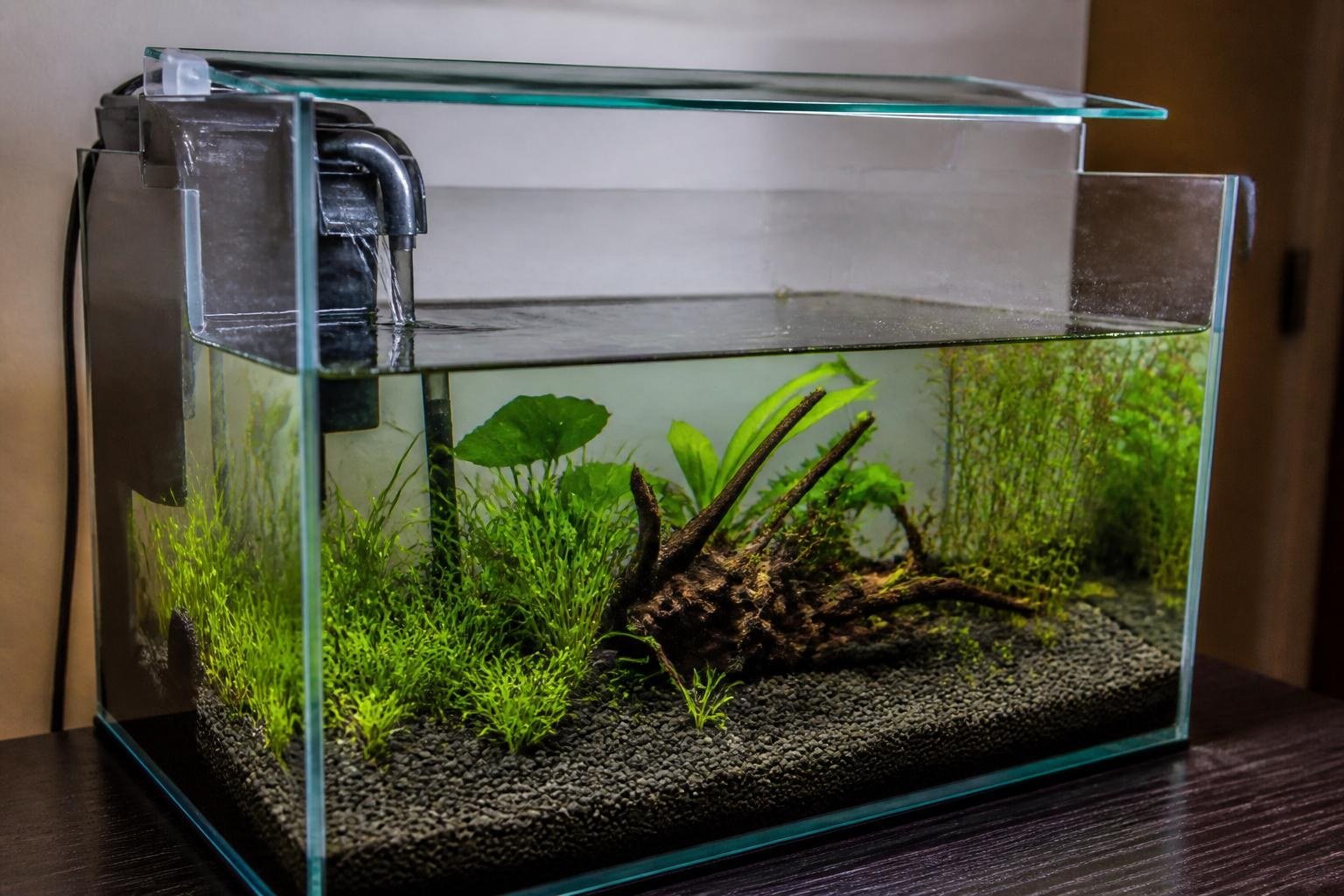
2. Raise the water level. If your tank has a hang-on-back filter, a low water level makes the outflow fall further and splash more. Topping up so the water meets the filter spillway turns a noisy waterfall into a gentle ripple. It also keeps the heater safely underwater. Mark a top-off line on the glass with a small sticker so you can see at a glance when it is time.
3. Calm the surface. Aim the filter outflow slightly downward, or fit a spray bar, so the water moves without churning the surface into a froth. You want a gentle ripple, not white water. Good gas exchange needs surface movement, but a violent ripple evaporates far more water than a calm one. Find the middle ground.
4. Turn the cooling fan down. If you use a fan, run it on the lowest setting that keeps the temperature safe, and only on the hottest days. A fan works by evaporating water, so every extra hour of fan time is extra top-up water.
5. Move the tank away from heat and sun. A tank next to a radiator, a heating vent, or a sunny window evaporates much faster than the same tank in a cool corner. If you cannot move the tank, close the curtains during the hottest part of the day. Even a few hours of direct sun can add a surprising amount of water loss.
6. Switch to LED lighting. If you still run metal halide or old T5 lights, the heat they throw onto the surface is doing real damage to your water level. Modern LEDs run far cooler and use less power. The saving on top-up water alone will not pay for the light, but the cooler tank and lower bills will.
7. Add a humidifier to the room. Raising the room humidity from 30 percent to 50 percent cuts evaporation sharply. It also helps your skin and your sinuses. It is the most expensive fix on this list, so try the lid first.
If you run a reef tank, add an eighth fix: an auto top-off (ATO) system. A small pump and a float sensor add fresh water automatically as the level drops. It keeps salinity rock steady and removes the daily chore entirely. For freshwater keepers, an ATO is nice but not essential. For reef keepers, it is close to a must-have.
How to Top Off the Right Way
Topping off is not the same as a water change, and the rules are different. A water change removes old water and replaces it. A top-off only replaces the water that evaporated. That difference matters, because the two jobs use different water.
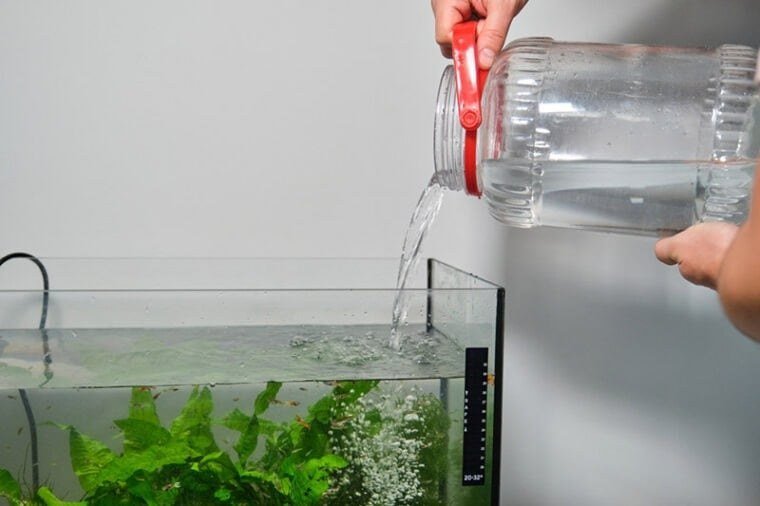
Always top off with plain dechlorinated water. Use tap water treated with a dechlorinator, or reverse osmosis (RO) water if your tap water is very hard. Never add salt, mineral treatments, or water-change chemicals to top-off water. Only pure water left the tank, so only pure water should go back in. Adding minerals on top of the minerals already left behind makes the concentration climb even faster.
Match the temperature roughly to the tank. Top-off water does not need to be perfect, because you are adding a small amount, but ice-cold water poured straight in can chill the fish near the surface. Let the bucket sit in the room for an hour, or mix in a little warm water first.
Top off little and often, not in one big splash. A small top-up every two or three days keeps the level steady and the chemistry stable. Waiting a week and then pouring in two gallons at once swings the water level, the temperature, and the mineral concentration all at the same time. Fish prefer small, boring changes.
Keep a dedicated top-off bucket or jug next to the tank. Fill it when you do your weekly water change, treat it, and leave it ready. That way topping up takes thirty seconds, and you are far more likely to actually do it. If you want to be precise, work out how much water your tank loses in a week with the fish tank volume calculator, and keep that amount on hand.
One more habit helps. Do your top-off at the same time as your weekly water change, and use the aquarium water change calculator to work out the right change size. When the level is steady and the changes are regular, the whole tank runs more smoothly. If your tank keeps going cloudy after changes, our guide to why your fish tank is cloudy after a water change explains the three causes and the fix for each.
A Simple Weekly Routine That Keeps the Level Steady
Here is a routine that takes five minutes a week and removes almost all evaporation stress. It works for tropical community tanks, goldfish tanks, and betta tanks alike.
On Sunday, check the water line against your top-off mark. Top up with treated water to the mark. Test ammonia and nitrite while you are there. Both should read zero.
Midweek, glance at the level again. In a dry winter week, a small tank may need a second top-up. That is normal. Do not wait for the filter to start gurgling. By the time it gurgles, the level has already dropped too far and the heater may be close to the surface.
Once a month, check your lid fit. Glass lids shift, condensation builds up, and gaps appear around cables. A lid that fitted perfectly in November may have a new gap by February. Wipe the condensation off the underside and reseat the lid. It takes a minute and it matters.
Once a season, re-check your evaporation rate. Mark the line, wait a week without topping up, and measure the drop. If the rate has jumped suddenly, something changed. A new fan, a moved tank, a broken lid, or a heater stuck on can all push the rate up. A sudden jump is worth investigating, even if the tank still looks fine.
If you are setting up a new tank and want to plan ahead, the fish tank size calculator helps you match tank size to your space, and the fish tank heater calculator helps you pick a heater that will not overwork in a dry room. For more on keeping the tank clean between top-ups, see our guide on how often to clean your fish tank gravel.
When Fast Evaporation Means Something Else Is Wrong
Fast evaporation is usually just physics. But a sudden change in the rate is a signal worth listening to. If your tank suddenly starts losing water twice as fast as it did last month, look for a cause before you shrug it off.
A heater stuck in the on position is the most common culprit. The water gets warmer than the thermostat says, evaporation climbs, and the fish get stressed by the heat at the same time. Check the water with a separate thermometer, not just the heater dial. Heater dials drift, and a cheap glass thermometer is the most honest tool in the hobby.
A cracked lid or a lid left ajar after feeding is another common cause. So is a new piece of equipment: a stronger filter, a new air stone, or a cooling fan you added for summer. Each one adds surface movement, and surface movement is evaporation fuel. If the rate jumped the week you changed something, that change is your answer.
Finally, remember that evaporation and leaks can happen together. A tank can evaporate fast and leak slowly at the same time. If the paper towel test comes back dry but the level keeps dropping faster than the table above suggests, test again in a different spot. Check the filter housing, the seals around the heater, and the floor under the stand with a dry hand. Slow leaks hide in the places you do not look.
For a deeper look at fish health and water quality problems, the Merck Veterinary Manual has a clear guide to disorders and diseases of fish. The RSPCA also publishes practical fish care advice for home aquariums. Both are worth bookmarking for the day something looks off and you want a trusted second opinion.
Frequently Asked Questions
Does evaporation lower oxygen levels in a fish tank? Yes, it can. As the water level drops, the filter outflow falls further and splashes more, which actually adds oxygen, but the smaller volume of water holds less oxygen in total. In a small tank with a big drop, the oxygen reserve shrinks. Keeping the level topped up and the surface gently rippling keeps oxygen stable.
Does evaporation change the pH of my tank? It can, slowly. As water leaves and minerals concentrate, carbonate hardness (KH) rises, and KH is what holds pH steady. In most tanks the shift is small. In soft-water tanks and small tanks, a week of heavy evaporation can push pH up by a few tenths. Regular top-ups with plain water keep it steady.
Can I use an auto top-off system on a freshwater tank? Yes. Auto top-off systems are not just for reef tanks. A simple float sensor and a small pump in a reservoir of treated water will keep a freshwater tank at a constant level. It is most useful for small tanks, tanks in dry rooms, and anyone who travels. Just keep the reservoir filled with plain dechlorinated water, and clean the sensor monthly so it does not stick.
Can evaporation crack my heater? Yes, if the water level drops far enough to expose the heater. A submersible heater running in air overheats very fast. The glass can crack, and the heater can fail or, in rare cases, melt its casing. Never let the water drop below the heater’s minimum water line. Top up before the level gets near it, and switch the heater off before a big water change.
Why does my tank lose more water at night? It usually does not. What you notice in the morning is a full night of evaporation with no top-up. If the tank sits near a radiator that runs at night, or the room heating dries the air overnight, the loss can look worse by morning. A lid flattens the difference almost completely.