Can I Turn Off My Fish Tank Filter at Night? Risks
The filter hums, the bedroom is quiet, and the question feels reasonable: can I turn off my fish tank filter at night and simply switch it back on in the morning? Almost every keeper with a tank near a bed has asked it. The honest answer is no — not as a routine — and the reason is timing. Night is not a neutral pause for an aquarium. It is the exact stretch of the day when dissolved oxygen naturally falls to its lowest point, just as your filter bacteria most need oxygenated water flowing past them. Turning the filter off at night does not give the tank a rest. It removes life support at the hardest hour, every single night.
Direct answer: No — a fish tank filter should run 24 hours a day, 7 days a week. Within 1–2 hours of switching off, the water trapped inside the filter goes stagnant and its nitrifying bacteria begin to suffocate; by 6–8 hours — one full night — a meaningful share of the colony is dead or dormant, ammonia can start rising from 0 ppm toward 0.25 ppm in a stocked tank, and dissolved oxygen bottoms out just before dawn. Brief off-periods of 5–10 minutes for feeding, and up to about 30 minutes for maintenance, are fine. A nightly 8-hour shutdown is not.
What the Filter Is Doing While You Sleep
A filter does three jobs, and two of them never clock off. Mechanical filtration traps particles — that one can wait until morning. Chemical filtration, such as activated carbon, can also wait. Biological filtration cannot. Your filter media is housing for the nitrifying bacteria of the nitrogen cycle: Nitrosomonas and relatives convert toxic ammonia into nitrite, and Nitrospira convert nitrite into far safer nitrate. Those bacteria are aerobic — they breathe oxygen — and they only receive it from water flowing through the media. Stop the flow and they are sealed in a small, still volume of water with a finite oxygen supply, alongside trapped waste that keeps consuming it.
Meanwhile the tank itself changes at night. In daylight, live plants and algae photosynthesise and release oxygen. After lights-out they respire instead, consuming oxygen and releasing carbon dioxide, joining your fish, snails, and bacteria as oxygen consumers. Gas exchange at the surface — driven mainly by the filter’s outflow rippling the water — is what replaces that oxygen. The daily dissolved-oxygen low point in a planted aquarium arrives in the last hour or two before the lights come back on. That is the moment a switched-off filter hurts most, and it is why keepers who do lose fish to a stopped filter usually find them in the morning, not the evening.
Can I Turn Off My Fish Tank Filter at Night? The Hour-by-Hour Timeline
Advice on this question contradicts itself online — bacteria supposedly die in an hour, or survive a week — because the timeline depends on stocking, temperature, and filter type. This table is the realistic middle case: a moderately stocked tropical community tank at 76–79°F (24–26°C), filter switched off at 11 p.m.
| Time off | Inside the filter | In the tank |
|---|---|---|
| 5–10 minutes | No effect — safe window for feeding shy fish | No measurable change |
| 30–60 minutes | Flow stopped; bacteria use trapped oxygen | Oxygen begins a slow fall; fish unaffected |
| 1–2 hours | Water in canister / hang-on-back goes stagnant; bacteria stressed | Surface stills; gas exchange drops sharply |
| 4 hours | Measurable die-off begins in sealed filter bodies | Oxygen nearing its nightly low; heavy stocking shows first gasping |
| 6–8 hours (one night) | Significant colony loss; stagnant water turns anaerobic | Ammonia may reach 0.25 ppm in stocked tanks; weakest fish at risk |
| Nightly, repeated | Colony never recovers between shutdowns | Chronic low-level ammonia, stressed fish, disease outbreaks follow |
Two details decide where your tank sits on this table. Filter type: a sealed canister holds its bacteria in a closed, oxygen-starved box and suffers fastest — and when it restarts, it can push that stagnant, sometimes sulphurous water straight into the tank. An air-driven sponge filter in the tank itself fares better, because its media sits in the main water volume. Temperature: warm water holds less oxygen and speeds bacterial metabolism, so a tropical tank at 82°F (28°C) runs through its oxygen far faster than a goldfish tank at 68°F (20°C). Either way, the direction is the same — the colony you spent 4 to 8 weeks cycling into existence is being starved on a schedule.
If your filter has already been off all night by accident, restart it, test ammonia and nitrite that day and for the next two days, and change 25% of the water if either reads above 0 ppm. Our aquarium water change calculator gives the exact gallons or litres for that change in your tank size.
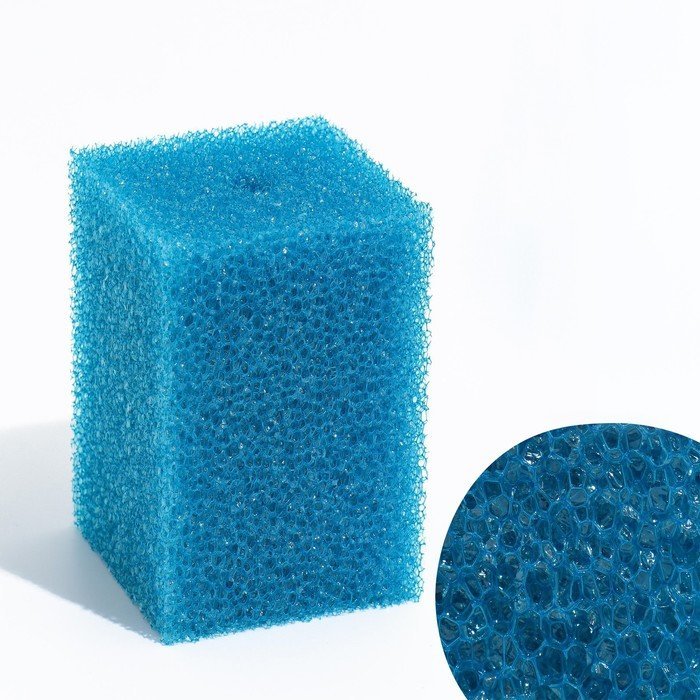
The Real Problem Is Noise — So Fix the Noise
Almost nobody turns a filter off to save the fish. They turn it off to sleep. The good news is that filter noise is almost always fixable, and every fix below costs less than the fish a nightly shutdown eventually kills. The question can I turn off my fish tank filter at night comes up because the filter is loud, not because the fish need a break.
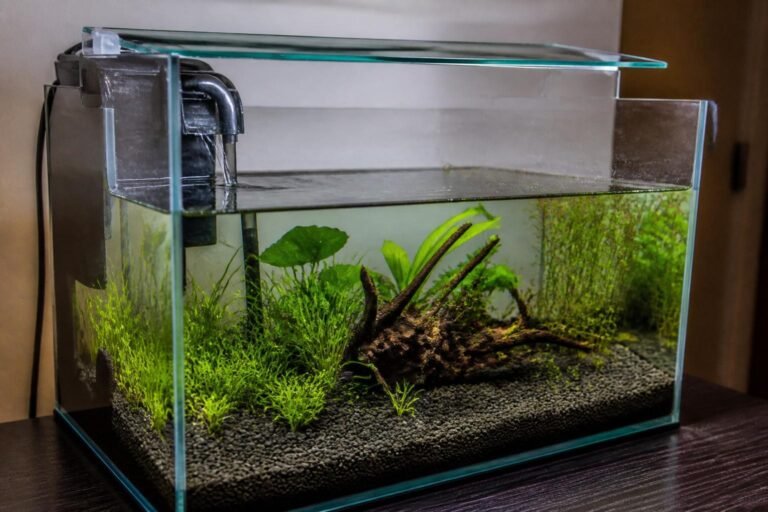
Find the actual noise source first. A rattling hang-on-back filter is usually a worn impeller, a low tank water level making the outflow splash, or the lid vibrating against the filter body. A humming internal filter is often just touching the glass, transmitting vibration. A gurgling canister usually has air trapped in the hoses. Ten minutes of diagnosis beats a nightly shutdown forever. Fix the rattle instead of asking can I turn off my fish tank filter at night.
Then apply the cheap fixes, in this order. Top the tank up so the outflow returns below or just at the waterline — this alone silences most hang-on-back filters. Sit the filter or its motor on a piece of filter foam or a silicone mat to break vibration. Clean the impeller and its shaft with a soft brush; grit on the impeller is the classic rattle. Replace a scored impeller — it is a small, inexpensive part. Keep décor and airline tubing from touching the filter body. Each of these beats asking can I turn off my fish tank filter at night.
If the filter is still too loud, change filter type, not filter schedule. Air-driven sponge filters and modern internal filters are near-silent, and canisters sit inside a closed cabinet that muffles them. Our fish tank heater calculator is a reminder that the heater, too, is a 24-hour device — nobody suggests switching heating off at night, and filtration deserves the same status. And if electricity cost is the real worry, do the maths before reaching for the switch: a typical small filter draws 5–10 watts, which running around the clock for a full month uses roughly 4–7 kWh — a trivial sum next to the cost of replacing fish.
The one genuine exception to the 24/7 rule is the deliberately filterless planted tank — a heavily planted, very lightly stocked setup designed from day one to run without filtration, in the style discussed in our guide to how often to change water in a betta tank without a filter. That is a different system with a punishing water-change schedule, not a filtered tank with the filter switched off at night.
A related misunderstanding appears after outages and cleaning days: a cloudy tank the morning after is usually a bacterial bloom responding to disturbed bacteria, exactly as explained in our article on why a fish tank goes cloudy after a water change — and the cure is a running filter, not a stopped one. The Merck Veterinary Manual’s chapter on disorders and diseases of fish identifies poor water quality, led by ammonia, as the most common environmental cause of disease in aquarium fish — and a filter switched off nightly is a slow, scheduled way of manufacturing exactly that water quality.
Frequently Asked Questions
How long can a fish tank filter safely stay off?
About 30 minutes for routine maintenance is harmless, and 5–10 minutes at feeding time is a common trick for shy fish. Past 1–2 hours the water inside a sealed filter goes stagnant and its bacteria begin to suffocate. A full night of 6–8 hours causes real colony loss, and restarting a canister after that long deserves care — rinse its media in removed tank water first if it smells stagnant. As a rule, can I turn off my fish tank filter at night is a question with a one-word answer: no.
Will my fish die if the filter is off for one night?
Usually not in a lightly stocked, mature tank — one accidental night is a stress event, not a guaranteed loss, though heavily stocked or warm tanks can lose sensitive fish by morning. The danger is repetition: switching off every night never lets the bacterial colony recover, so ammonia creeps up chronically and fish sicken over weeks. After one accidental night, restart the filter and test ammonia and nitrite for two days. One accidental night is survivable; asking can I turn off my fish tank filter at night every night is a different story.
Can I turn off the air pump at night instead of the filter?
An air pump is a supplement, not the life-support core — if your filter keeps running and keeps the surface rippling, switching a noisy air pump off overnight is far less risky than stopping the filter. That said, night is when oxygen is scarcest, so the better fix is a quieter pump on a foam pad, or a check valve and softer air stone, rather than a nightly shutdown. The air pump is optional, but can I turn off my fish tank filter at night is the question that matters, and the answer stays no.
Does turning the filter off at night save much electricity?
Very little. A typical hang-on-back or internal filter draws about 5–10 watts. Run continuously for a month that is roughly 4–7 kWh — pennies to a small amount on most tariffs. The heater, at 50–200 watts cycling on and off, dominates an aquarium’s electricity use; the filter is one of the cheapest devices in the hobby to run. Saving a few pennies is not worth asking can I turn off my fish tank filter at night in the first place.
Why are my fish gasping in the morning even though the filter runs?
Morning gasping points to the pre-dawn oxygen low: plants and algae consume oxygen all night, and if the tank is heavily stocked, warm, or the surface is too still, oxygen bottoms out before the lights return. Raise surface agitation, aim the filter outflow at the surface, check the temperature is not above the species’ range, and test ammonia and nitrite — gasping plus a reading above 0 ppm means a 25–50% water change that day. If the filter runs and fish still gasp, can I turn off my fish tank filter at night is not the question — oxygen and ammonia are.