Why Are My Guppies Dying One by One?
If you are asking why are my guppies dying one by one, you are watching the worst kind of pattern. One fish dies on Monday. Another dies on Thursday. A third is gone by the weekend. The rest look fine, and then another one goes.
It feels random, but it almost never is. When fish die one at a time over days or weeks, something in the tank is slowly hurting them. The pattern itself is the clue. It tells you whether the problem is sudden or slow, whether it hits every fish or only some of them, and how fast you need to act.
Guppies are famous as beginner fish. They are small, bright, cheap, and they breed fast. That reputation hides a real weakness. Most shop guppies are bred in huge numbers for colour, not for health. They arrive in home tanks already stressed, and small mistakes in water, food, or stocking can pick them off one by one.
Direct answer: Guppies usually die one by one because of a slow, ongoing problem, not a single disaster. The most common causes are ammonia or nitrite in the water, water that is too soft or too cold for guppies, a tank that was never cycled, weak mass-bred stock, or a disease spreading slowly through the group. Test ammonia and nitrite first. Both must read zero. If either one is above zero, do a 50% water change with dechlorinated water at the same temperature today, then test again tomorrow.
Do not start by buying medicine. Most guppy deaths are water deaths, and medicine will not fix water. The fix that saves the rest of your fish is almost always the same: find the water problem, change the water, and stop the slow damage before the next fish goes.
Why Are My Guppies Dying One by One?
The first thing to work out is the pattern. A tank where every fish dies in one night has a different problem from a tank where one fish dies every few days. Write down what you see. Note the date each fish dies, whether it was male or female, young or old, and whether it showed any signs first.
This sounds fussy, but it saves fish. A pattern that takes a week to see can point straight at the cause. A keeper who guesses usually treats the wrong thing, and the deaths keep coming while the real problem stays untouched.
Guppies, or Poecilia reticulata, are livebearers from warm streams in South America. In the wild they live in hard, warm, slightly alkaline water. In a shop they are bred in huge numbers, often in crowded tanks, and shipped while still young. That history matters, because a guppy that looks healthy in the shop can already be carrying the damage that kills it two weeks later.
The Pattern Is the Clue
Deaths that come one by one are called drip deaths by many keepers. They are the most common kind of guppy loss, and they are also the most fixable, because the tank is still stable enough for the survivors. The table below matches the pattern you see to the most likely cause.
| What you see | Most likely cause | Check this first |
|---|---|---|
| One fish dies every few days, the rest look fine | Chronic nitrate, weak stock, or a slow-spreading disease | Nitrate, age of the fish, white spots or frayed fins |
| Every fish dies within a day or two | Ammonia or nitrite spike, chlorine, or a heater failure | Ammonia, nitrite, temperature, conditioner use |
| Only new fish die, old fish are fine | Weak shop stock, bad acclimation, or a new disease | How the fish were added, quarantine, supplier |
| Only females die, often after giving birth | Birth stress, overcrowding, or poor water | Number of females, hiding spots, nitrate |
| Only one sex or one colour strain dies | Inbreeding weakness in that strain | Where the fish came from, their age |
| Fish die after months of looking healthy | Old age, or a slow build-up of nitrate | Age of the fish, nitrate history |
Use the table as a starting point, not a diagnosis. Two causes often work together. A guppy weakened by soft water is more likely to catch ich. A guppy stressed by crowding is more likely to die from a nitrate level that a healthy fish would tolerate. Fix the water first, and the other problems often shrink on their own.
Start With the Water Tests
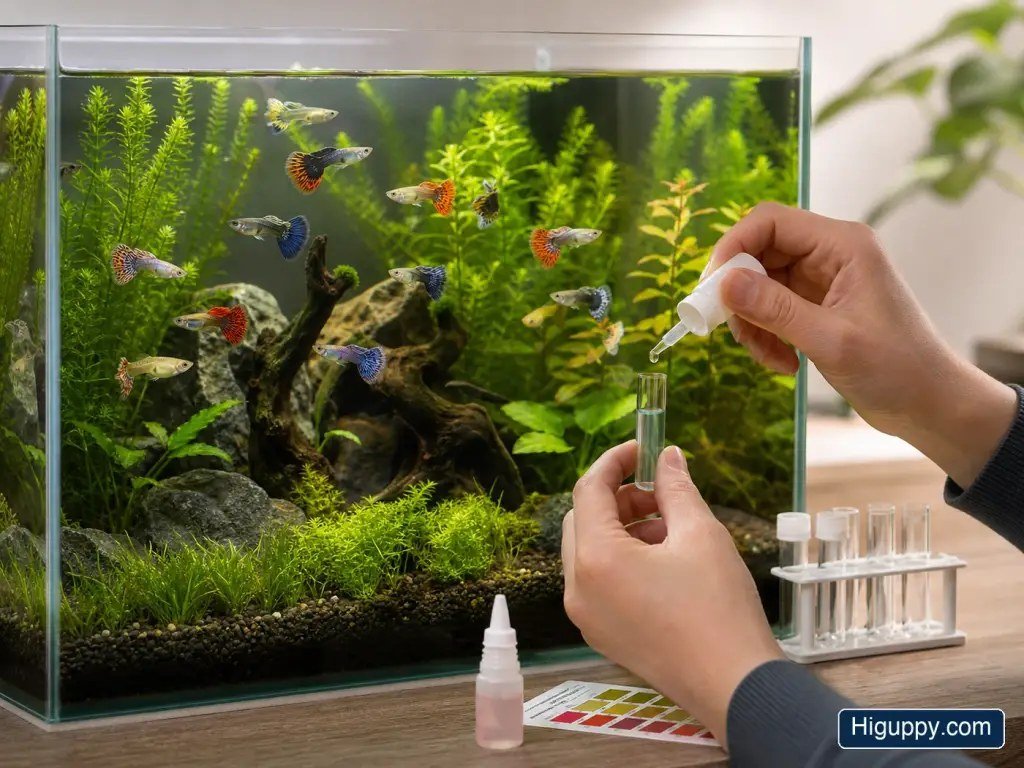
Every guppy investigation starts the same way: test the water. Buy a liquid test kit if you do not own one. Test strips are better than nothing, but they are less accurate, and they go stale. A liquid kit gives you real numbers, and real numbers tell you what to do next.
Test ammonia first. It must read zero. Any reading above zero is an emergency, even 0.25 parts per million. Ammonia burns gills, and burned gills cannot take in oxygen. A guppy with ammonia damage often gasps at the surface, clamps its fins, and stops eating before it dies.
Test nitrite next. It must also read zero. Nitrite stops blood from carrying oxygen, so fish suffocate even in water that looks clear and well-aerated. A guppy with nitrite poisoning often hangs near the surface, breathes fast, and may show brown or darkened gills.
Test nitrate last. Keep it under 20 parts per million for guppies. Nitrate is far less toxic than ammonia or nitrite, but high nitrate over weeks weakens fish slowly. It stunts growth, dulls colour, and makes disease more likely. That slow weakening is exactly what drip deaths look like.
Test pH and temperature at the same time. Guppies do best at a pH of 7.0 to 8.5, and a temperature of 74 to 78 degrees Fahrenheit (23 to 26 degrees Celsius). Write the numbers down with the date. A single test tells you today. A log over a week tells you the story.
If ammonia or nitrite is above zero, change 50% of the water right away. Use water treated with a dechlorinator, matched to the tank temperature. Test again the next day. Keep changing water daily until both read zero. Do not add more fish until the numbers have stayed at zero for a week.
The Hard-Water Trap
Guppies are hard-water fish, and this is the cause most keepers miss. They come from streams rich in minerals, and their bodies expect hard, alkaline water. In soft, acidic water, guppies slowly fail. They clamp their fins, lose colour, get sick more often, and die younger.
Soft water is common in many homes. If your tap water is soft, or if you use a water softener, your guppies may be living in water that is wrong for them from day one. The deaths look mysterious, because the water is clear and the tests for ammonia and nitrite read zero. The problem is the minerals, not the toxins.
Test your general hardness (GH) and carbonate hardness (KH). Guppies do best with a GH of 8 to 12 degrees and a KH of 4 to 8 degrees. If your GH is below 6, your water is too soft for guppies. Crushed coral in the filter, or a small bag of limestone chips, will raise hardness slowly and safely.
Do not chase a perfect number. Stability matters more than the exact reading. A steady GH of 7 is better than a GH that swings between 5 and 12. Add minerals slowly, test weekly, and let the tank settle. Sudden changes in hardness stress fish just as much as the wrong hardness does.
Acidic water makes the problem worse. Below a pH of 6.5, guppies struggle to keep their bodies working properly. Their fins fray, their immune systems weaken, and common diseases take hold. If your pH keeps dropping, check your KH first. Low KH means the water has no buffer, and the pH will keep sliding down.
New Tank, Old Tank, and the Cycle
A new tank kills more guppies than any disease. The problem is called new tank syndrome, and it works like this. Fish waste and uneaten food break down into ammonia. Helpful bacteria turn ammonia into nitrite, and then into nitrate. That chain is called the nitrogen cycle, and it takes weeks to build.
A brand-new tank has no helpful bacteria yet. Add a group of guppies on day one, and ammonia climbs fast. The fish gasp, clamp up, and die one by one over the first two or three weeks. The owner changes the water, the deaths slow down, and then nitrite spikes as the first bacteria grow. More fish die. It feels like a curse. It is just a cycle that was never finished.
Always cycle a tank before adding fish. That means running the filter with an ammonia source for two to six weeks, testing until ammonia and nitrite both read zero, and only then adding a few fish at a time. Fishless cycling is kinder and safer than cycling with live fish in the tank.
Old tanks can fail too. A filter that has not been cleaned in months can clog, and a clogged filter stops moving water. The bacteria inside it die back, ammonia rises, and fish start dying. Clean filter sponges in old tank water, never under the tap. Tap water contains chlorine, and chlorine kills the very bacteria you need.
Another old-tank trap is the filter media swap. Some keepers replace all their filter media at once, throwing away the whole bacterial colony with it. Replace media in stages, one piece at a time, weeks apart. The bacteria need a home, and a brand-new sponge has none.
Weak Stock: Why Shop Guppies Die Young
Not every guppy death is your fault. Many shop guppies are bred for colour in huge farm ponds, and the breeding is so intense that the fish are fragile. Fancy strains with huge tails, bright reds, and long flowing fins are the weakest of all. They are beautiful, and they are often short-lived.
A guppy bought at four months old may already be halfway through its life if it was raised in poor conditions. Some mass-bred guppies live only a year, even in a good tank. When one of these fish dies for no clear reason, and the water tests are perfect, weak stock is the honest answer.
You can lower the risk by choosing your fish well. Pick active fish that swim in the middle of the tank, not ones sitting on the bottom or hiding in a corner. Look for clear eyes, full fins, and bright colour. Avoid fish with clamped fins, white spots, or ragged tails, even if they are the prettiest ones in the shop.
Buy from a breeder or a good local shop when you can. Ask how long the fish have been in the shop. Fish that arrived yesterday are still stressed from shipping, and stressed fish die more easily. Fish that have been in the shop for two weeks and still look strong are a safer buy.
Quarantine new fish for two weeks in a separate tank before adding them to your main tank. This is the single best habit a guppy keeper can build. A sick new fish in quarantine is a small problem. The same fish added straight to the main tank can infect every guppy you own.
Disease: Ich, Fin Rot, and the Rest
Disease is the third most common cause of drip deaths, after water and weak stock. The good news is that most guppy diseases are easy to spot if you look closely. The bad news is that by the time the signs are obvious, the disease has often been spreading for days.
Ich, or white spot disease, is the most common guppy illness. It looks like tiny grains of salt sprinkled over the body and fins. The fish may rub against plants and gravel, clamp its fins, and stop eating. Ich spreads fast in a warm tank, but it is very treatable if caught early. Raise the temperature slowly to 82 degrees Fahrenheit and treat with a proper ich medicine.
Fin rot is next. The fins look ragged, torn, or milky at the edges, and they get shorter over days. Fin rot is almost always a water problem first and a germ problem second. Clean water, with ammonia and nitrite at zero, is the real treatment. Medicine helps, but it will not work in dirty water.
Columnaris looks like white or grey patches on the mouth, body, or fins, sometimes like cotton wool. It moves fast and kills fast, especially in warm, crowded tanks. A fish with columnaris needs to be separated at once, and the main tank needs a large water change and better flow.
Dropsy is the hardest to face. The belly swells, and the scales stick out like a pinecone. By the time a guppy looks like a pinecone, its organs are already failing. Dropsy is a sign of a serious internal infection, not a disease on its own. Most dropsy cases do not recover, and the kindest choice is often to separate the fish so it does not infect the others.
Watch for the early signs, not the late ones. A guppy that hides, stops eating, clamps its fins, or swims oddly is already telling you something is wrong. Check the water first, then look closely at the fish. A magnifying glass and a good light help. Many diseases are visible days before they become deadly.
Food, Crowding, and the Breeding Explosion
Overfeeding is a quiet killer. Guppies beg for food every time you walk past the tank, and it is tempting to feed them again. Uneaten food sinks, rots, and turns into ammonia. The water looks fine, but the ammonia is climbing, and the weakest fish dies first.
Feed adult guppies once or twice a day, only what they finish in one or two minutes. Skip one day a week. A hungry guppy is a healthy guppy. A guppy fed three times a day in a small tank is a guppy living in its own waste.
Food quality matters too. Guppies fed only one food, usually cheap flakes, can end up short on nutrients. Mix it up. Good quality flakes or micro pellets as the staple, plus frozen daphnia, brine shrimp, or bloodworms once or twice a week. A varied diet builds a stronger immune system.
Crowding is the other slow killer, and guppies are experts at creating it. A single female can give birth to 20 to 100 fry every month. Start with six guppies in a 10-gallon tank, and within a few months you can have fifty. The filter cannot keep up, nitrate climbs, and fish start dying one by one.
Plan for the babies before they arrive. Keep only males if you do not want fry. Or keep a separate grow-out tank, and rehome the young fish through your local shop or fish club. A tank that is overstocked is a tank where the weakest fish always pays the price.
Use the aquarium stocking density calculator to check how many fish your tank can really hold. It is easy to overestimate, because a 10-gallon tank looks big when it is empty. Once it is full of plants, gravel, and fifty guppies, it is a very small world.
The 48-Hour Rescue Plan
If fish are dying now, do not wait for a perfect diagnosis. Work through these steps in order, and do them today. They fix the most common causes, and they buy your surviving fish time.
First, test the water. Ammonia, nitrite, nitrate, pH, and temperature. Write the numbers down. If ammonia or nitrite is above zero, do a 50% water change with dechlorinated water at the same temperature. Test again tomorrow, and repeat the water change until both read zero.
Second, stop feeding for a day. Hungry fish are fine for 24 hours. Uneaten food in a struggling tank only adds ammonia. When you start feeding again, feed half as much as before, once a day, until the deaths stop.
Third, check the heater and the filter. Is the heater working? Is the filter running properly? A filter that stopped overnight can crash a tank in hours. A heater stuck on can cook it. Touch the filter to feel the flow, and check the temperature with a separate thermometer, not the heater dial.
Fourth, look at every fish closely. Separate any fish with white spots, ragged fins, swelling, or cotton-like patches into a quarantine tank. Treating the whole tank is sometimes needed, but separating the sick fish first stops the disease from spreading while you work out what it is.
Fifth, add surface movement. An air stone or a filter outlet aimed at the surface helps oxygen get into the water. Fish that are struggling to breathe need oxygen now, not after the next water change. This one step has saved more guppies than most medicines.
How to Stop It Happening Again
Once the deaths stop, build a routine that keeps them stopped. A healthy guppy tank is not an accident. It is the result of small, regular habits that take minutes a week.
Change 25 to 30% of the water every week, without fail. Use a gravel vacuum to pull waste out of the substrate. Treat the new water with dechlorinator, and match the temperature before it goes in. A weekly water change is the cheapest insurance in the hobby.
Test the water every week too, at least until you know your tank well. Ammonia and nitrite should always be zero. Nitrate should stay under 20 parts per million. If nitrate keeps climbing between changes, you are overfeeding, overstocked, or changing too little water.
Keep the temperature steady. Guppies handle a stable 74 degrees far better than a tank that swings between 72 and 80 every day. A reliable heater and a separate thermometer are worth every cent. Check the temperature at the same time each day, and notice changes early.
Feed less than you think. Most guppy keepers feed twice as much as their fish need. A small pinch, once or twice a day, is enough. Watch the fish eat. If food is still floating after two minutes, you fed too much. Net it out, and feed less next time.
Plan the population. Decide how many guppies your tank can hold, and stick to it. Use the fish tank size calculator when you are thinking about a bigger tank, and the aquarium water change calculator to work out how much water to change each week. Numbers beat guesses.
Buy fish slowly. Add three or four at a time, never a whole school at once. Each new fish adds waste, and the filter bacteria need time to catch up. Wait two weeks between additions, and quarantine every new fish first.
Keep a simple log. Date, water test numbers, water changes, new fish, deaths. A log turns a mystery into a pattern, and a pattern into a fix. Most keepers who log their tanks stop losing fish, because they spot the slow climb in nitrate or the slow drop in temperature before it kills anything.
Finally, know when to ask for help. If fish keep dying and your tests are perfect, take a water sample to your local fish shop and ask them to test it. Or talk to an aquatic vet. The Merck Veterinary Manual page on fish diseases is a solid, vet-written reference for the common illnesses, and the RSPCA fish care guide covers the basics of good fishkeeping in plain language.
Guppies are not hard fish to keep. They are just honest fish. When something is wrong in the tank, they show it quickly, one by one. Listen to what the pattern is telling you, fix the water first, and the rest of your guppies will usually reward you by living long, bright, busy lives.
For more on the signs that come before a fish stops eating, read our guide to why fish stop eating. And if your guppies are losing colour as well as dying, our article on why fish lose their colour covers the causes that overlap with this one.
Frequently Asked Questions
Why did my guppy die after a water change? The most common reasons are chlorine or chloramine in the new water, or a temperature difference between the new water and the tank. Both shock the fish, and the weakest ones die within a day. Always treat tap water with a dechlorinator before it touches the tank, and match the new water to the tank temperature within one or two degrees. A large water change of more than 50% can also swing the pH, so change 25 to 30% at a time in a healthy tank.
Can guppies live alone? Yes, a single guppy can live alone, but it is not ideal. Guppies are social fish, and a lone guppy often hides, eats less, and shows duller colours. A small group of three or more, with at least two females per male, is a much better setup. If you keep one guppy alone, give it plants, hiding spots, and a calm tank, and watch for signs of stress.
How many guppies should I keep in a 10-gallon tank? A good rule is one guppy per two gallons of water, so about five guppies in a 10-gallon tank. That number assumes a cycled filter, weekly water changes, and no fry. Because females give birth every month, a mixed-sex group will outgrow a 10-gallon tank fast. Keep an all-male group if you want the number to stay put.
Do guppies eat their babies? Yes, adult guppies will eat their own fry, and so will most other fish in the tank. In the wild this is normal, and it keeps the population in check. If you want the fry to survive, give them dense floating plants or a breeding box, or move the pregnant female to a separate tank before she gives birth and move her back once the fry are born.
What do guppies eat besides flakes? Guppies are omnivores, and they do best on a varied diet. Good options are frozen daphnia, brine shrimp, and bloodworms, plus blanched vegetables like zucchini and spinach. Daphnia is especially useful, because it also helps with digestion. Feed treats once or twice a week, and keep flakes or micro pellets as the daily staple.