How to Tell If Your Budgie Is Happy: A Decoder
Budgies cannot tell you how they feel, but they show it all day long. A happy budgie chirps, plays, preens, and comes to you. An unhappy budgie goes quiet, sits still, and stops eating. If you want to know how to tell if your budgie is happy, you do not need to guess. You need to know which signs to look for and how to read them together.
This guide works like a decoder. It gives you ten signs of a happy budgie, a simple scoring system, and a lookalike table that shows when a “happy” sign actually means your bird is sick. By the end, you will be able to read your budgie’s mood in about a minute.
A happy budgie is active, vocal, and relaxed: it chirps and chatters through the day, eats and drinks well, preens its feathers, plays with toys, grinds its beak before sleep, and comes to you willingly. If your budgie shows most of these signs, it is content. If it shows few of them, something in its routine or health needs attention.
How to Tell If Your Budgie Is Happy: The Decoder
The decoder is simple. Watch your budgie for one normal day and tick off every sign below that you see. Each sign is worth one point. A score of 8 to 10 means a very happy bird. A score of 5 to 7 means a mostly content bird with room to improve. A score of 4 or less means your budgie is telling you something is wrong, and the later sections of this guide will help you work out what.
Score your bird on a normal day, not on a vet-visit day or the day you brought it home. New budgies need a week or two to settle in, and they will score low while they are still nervous. That is normal. Judge the score once your bird has had time to learn that your home is safe.
Remember that every budgie has its own personality. Some birds are loud singers, and others are quiet chatterers. Some love toys, and others prefer sitting near you. The score matters more than any single sign. A quiet budgie that eats well, preens, and plays is still a happy budgie.
The 10 Signs of a Happy Budgie
1. It chirps, chatters, and sings through the day
Sound is the clearest happiness sign in a budgie. A content budgie fills the day with soft chirps, cheerful chatter, and whistles. Males often sing little songs, and some budgies learn words. The noise is steady and relaxed, not sharp or panicked.
Chattering is the sound to listen for. It is a soft, mumbling conversation a budgie makes when it is alone and comfortable, almost like talking to itself. A budgie that chatters to itself feels safe. A budgie that has gone completely silent for a whole day is a budgie worth watching closely.
2. It grinds its beak before sleep
Beak grinding is a soft, rhythmic clicking sound a budgie makes by sliding its beak back and forth. It usually happens in the evening, just before sleep, and it means the bird feels safe and content. It is one of the most reliable happiness signs there is.
Do not confuse grinding with beak clicking during the day, which can mean excitement or warning. Evening grinding, with the bird settled on its perch and its eyes half closed, is pure contentment. Many owners say it is their favourite sound in the house.
3. It preens itself and preens you
A happy budgie spends a good part of the day looking after its feathers. Preening means running the beak through the feathers to clean and smooth them. It is a relaxed, focused activity, and a bird only does it when it feels safe enough to let its guard down.
Preening you is an even stronger sign. If your budgie gently nibbles your hair, your fingers, or your clothes, it is treating you like a flock mate. In the wild, budgies preen each other to build trust. A budgie that preens you trusts you completely.
4. It plays with toys and explores
Play is a luxury. A scared or sick bird does not play. A happy budgie climbs, swings, rings bells, shreds paper, and tosses small toys around the cage. It investigates new toys instead of hiding from them.
Watch how your budgie plays, not just whether it plays. A bird that attacks a toy with energy and then rests is healthy and engaged. A bird that ignores every toy for days may be bored, lonely, or unwell. Rotate toys every week so there is always something new to explore.
5. It eats and drinks well in front of you
A budgie that eats and drinks normally while you are in the room trusts you and feels safe. Eating is a vulnerable act for a small prey bird. A frightened budgie waits until the room is empty before it eats. A happy one crunches its seeds right in front of you.
Good appetite also means the diet is right. A happy budgie eats a mix of seeds or pellets, fresh vegetables, and the occasional treat, and it drinks clean water every day. Use our budgie food calculator to check daily portions, and our bird water intake calculator to make sure the water supply is enough.
6. It comes to you willingly
A happy budgie flies to you, hops onto your finger, or lands on your shoulder without being chased. It may follow you around the room or sit near you while you work. This is the bird choosing your company, and it is one of the strongest trust signals there is.
Do not force this sign. A budgie that comes to you because it wants to is happy. A budgie that sits on you because it has nowhere else to go is just stuck. Give your bird the choice, and the choice it makes will tell you the truth about how it feels.
7. It bobs its head and wags its tail
Head bobbing is a quick up-and-down movement that budgies make when they are excited or pleased to see you. It often comes with chirping and is a greeting, like a wave. Tail wagging works the same way: a happy budgie flicks its tail up and down when it sees a favourite person or toy.
Both signs are easy to miss if you are not looking for them. Next time you walk into the room, watch your budgie’s head and tail for the first five seconds. A bob and a wag mean your bird is glad you are there.
8. It stands on one leg and looks relaxed
A budgie standing on one leg with the other foot tucked into its belly feathers is deeply relaxed. The posture means the bird feels so safe that it can rest half its body. You will often see it with half-closed eyes and slightly fluffed feathers.
This is a rest posture, not a sleep posture. A budgie on one leg is awake and aware, just comfortable. If your bird does this near you, it is telling you it feels at home. It is one of the most charming signs in the whole decoder.
9. It stretches, flaps, and shakes out its wings
A happy budgie stretches its wings and legs when it wakes up, flaps in place to exercise, and shakes its feathers out after preening. These are the movements of a bird with energy to spare. A bird that never stretches or flaps may be too cold, too cramped, or too unwell to bother.
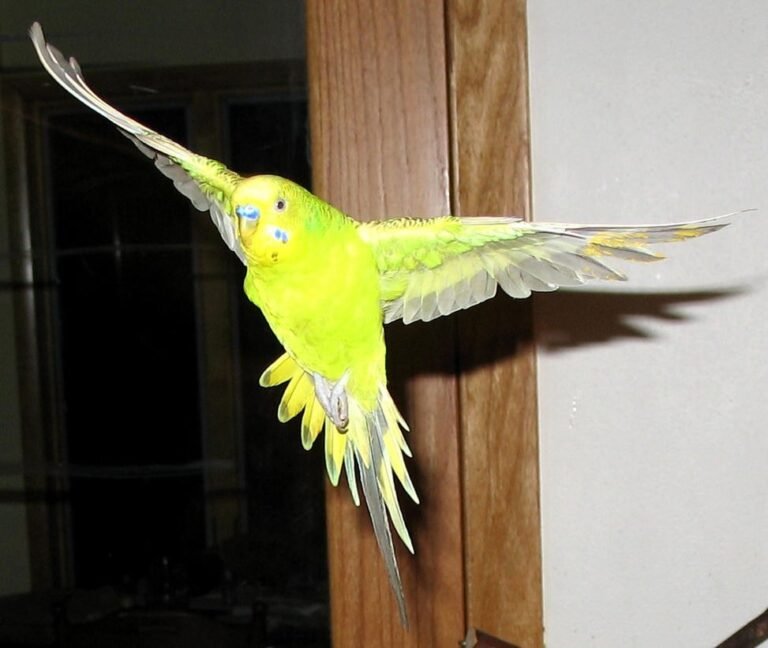
Wing flapping while staying on the perch is a good sign, especially in the morning. It is the bird’s way of warming up and shaking off sleep. Give your budgie out-of-cage time every day so it can fly properly, because a bird that never flies cannot stay truly happy.
10. It has bright eyes, smooth feathers, and a clean cere
The body tells the story too. A happy budgie has bright, clear eyes with no discharge, smooth feathers that lie neatly, and a clean, smooth cere, the soft patch above the beak. The droppings are firm and regular. The bird looks well kept, because it is spending time on itself.
Feather condition is a slow happiness signal. It takes weeks of good food, good sleep, and low stress to grow bright, smooth feathers. If your budgie’s feathers look dull or ragged, the cause is usually diet or stress, not a single bad day. Fix the routine and the feathers will follow.
Happy or Sick? The Lookalike Table
Here is the trap that catches many owners: several happiness signs look almost the same as illness signs. A puffed-up budgie can be relaxed or sick. A quiet budgie can be content or in pain. The difference is always in the context. This table shows how to tell them apart.
| What you see | Happy version | Worried version |
|---|---|---|
| Puffed-up feathers | Relaxed, on one leg, eyes half closed, preening | Fluffed up for hours, sitting low, eyes closed, not eating |
| Beak grinding | Soft clicking in the evening before sleep | Hard clicking or grinding all day with tail bobbing |
| Quiet and still | Resting after play, then active again soon | Silent all day, not eating, not moving from one perch |
| Head bobbing | Quick bobs with chirping when you arrive | Constant bobbing with regurgitation or breathing trouble |
| Closed eyes | Half closed while resting on one leg | Eyes shut tight for long periods during the day |
| Flapping wings | Morning stretch, then settles happily | Frantic flapping, falling off the perch, or night fright |
The rule is simple. A happy sign comes with eating, playing, and normal droppings. A sick lookalike comes with two or more problems at once: not eating, not drinking, sleeping too much, or changed droppings. If your budgie shows a worried version of any row in this table, call an avian vet. Our guide to why a canary puffs up explains the same happy-versus-sick problem in a different species, and the logic is identical.
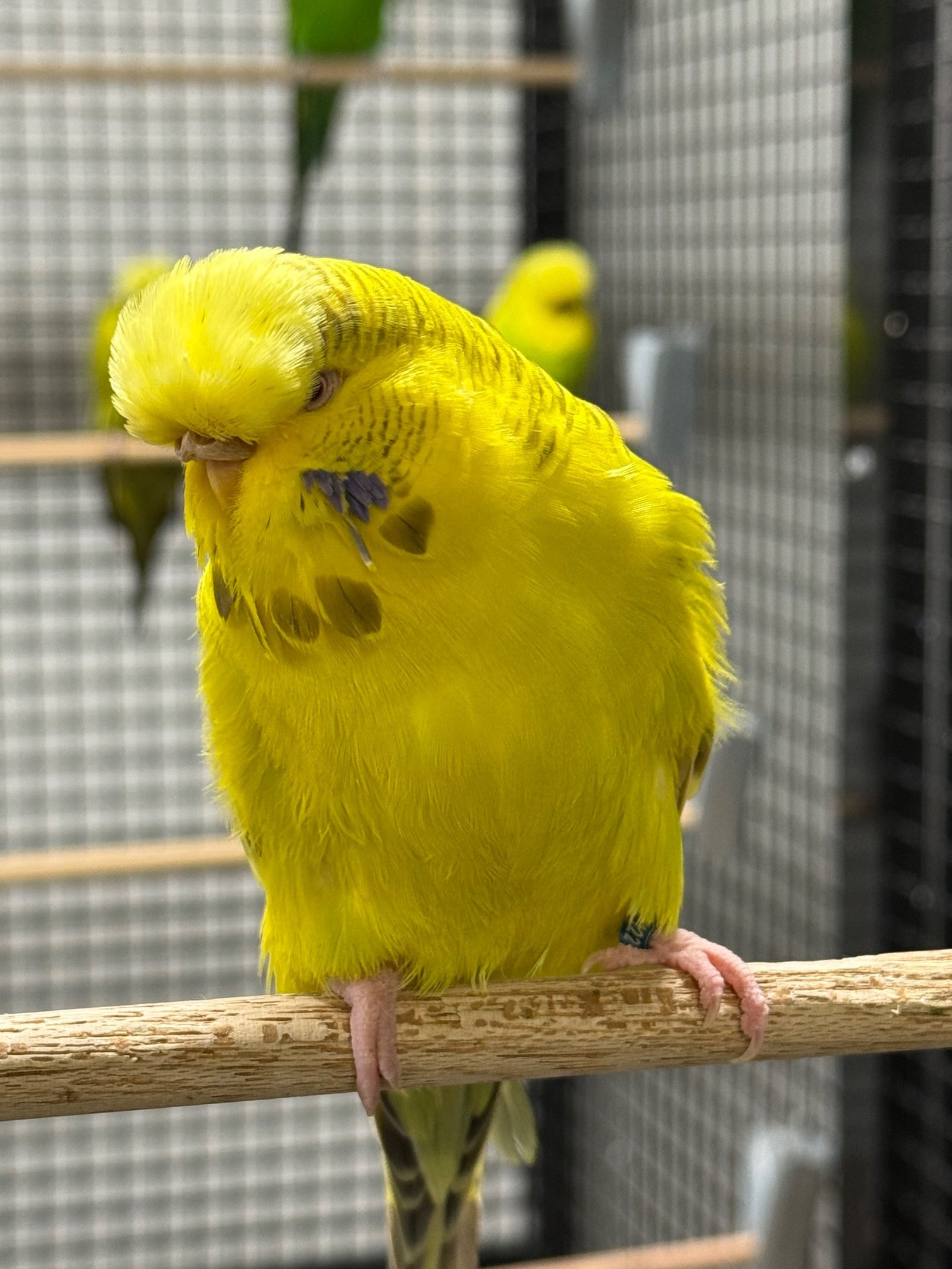
What a Happy Budgie’s Day Looks Like
A happy budgie’s day has a rhythm. It wakes at dawn, stretches, flaps, and eats a big breakfast of seeds or pellets with some fresh vegetables. The morning is the busy time: singing, playing, exploring, and flying around the room. This is when most of the decoder signs show up at once.
Midday is quieter. The bird naps, preens, and chatters softly to itself. It may sit on one leg and grind its beak. Then the afternoon brings a second burst of activity, with more play and a second meal. In the evening, the bird winds down, eats a little more, and settles on its sleeping perch as the light fades.
Sleep is the foundation of all of it. Budgies need 10 to 12 hours of dark, quiet sleep every night. A bird that sleeps badly is grumpy, nippy, and quiet the next day, and no amount of toys will fix that. Our guide to how many hours of sleep a budgie needs explains how to set up a proper sleep routine.
Food and water matter just as much as sleep. Fresh water every day, clean food dishes, and a mix of seeds or pellets with vegetables keep a budgie’s energy and mood steady. A bird that only gets seeds will slowly lose its shine. Our budgie water guide explains how much a budgie should drink and how to tell if it is drinking enough.
What to Do If Your Budgie Scores Low
A low score is not a verdict. It is a clue. Work through the basics first, because most low scores come from routine problems, not illness. Check sleep first: is the cage covered for 10 to 12 hours in a quiet, dark room? Check food next: is the diet mostly seeds, and is the water fresh every day?
Then check the social side. Budgies are flock birds, and a single budgie that is alone all day will often score low on play, sound, and coming to you. If you are out for most of the day, your budgie needs more of your time in the morning and evening, or the company of another budgie. Loneliness is the most common cause of a quiet, still budgie in a healthy home.
Check the cage and the room too. A cage that is too small, a room that is too cold or draughty, or a cage placed where a cat stares at it all day will keep any budgie stressed. The cage should be in a bright, social part of the home, away from the kitchen fumes and away from direct sun. Add new toys, a swing, and things to shred, and see whether the score moves.
If the basics are right and the score stays low for more than a few days, look for illness. A budgie that has stopped singing, stopped playing, and stopped eating at the same time needs a vet, not a new toy.
Age matters here too: older budgies slow down naturally, and what looks like unhappiness may just be age. Use our budgie age calculator to work out your bird’s age in human years and set your expectations fairly. The Merck Veterinary Manual’s pet bird guide is a good reference for the signs that mean a vet visit.
5 Quick Wins to Lift Your Budgie’s Mood
If your budgie’s score is in the middle range, these five changes often lift it within a week. None of them costs much, and all of them work on the same idea: a budgie is happy when its days are full of small, good things.
1. Talk to your budgie every day
Budgies are built for conversation. Talk to your bird when you pass the cage, read aloud for a few minutes, or whistle a simple tune. Your budgie may answer with chirps, and over time it may copy words and sounds.
Talking does two jobs at once. It keeps a single budgie from feeling alone, and it builds the trust that makes every other sign in the decoder stronger. A bird that hears your voice every day is a bird that feels part of a flock.
2. Rotate the toys every week
A toy that has sat in the same spot for a month is furniture, not fun. Swap two or three toys every week, and keep a small box of spares. A “new” toy that has been in the cupboard for a month feels brand new to a budgie.
Mix up the types too. Offer one toy to shred, like paper or balsa wood, one to climb on, like a rope or ladder, and one that makes noise, like a bell. Different toys wake up different kinds of play, and play is one of the clearest signs of a happy bird.
3. Give out-of-cage time every day
A budgie that never leaves its cage cannot fly, and a bird that cannot fly cannot stay truly happy. Give your budgie at least an hour or two outside the cage each day, in a safe room with the windows shut and other pets out.
Let the bird fly to you, land on a play stand, and explore. Flying burns energy, builds muscle, and lifts mood in a way no toy can match. A bird that flies every day is a bird that sleeps well and sings more.
4. Offer a bath twice a week
Most budgies love to bathe, and a good bath is pure joy for them. Offer a shallow dish of lukewarm water, or mist the bird lightly with a spray bottle. Many budgies will splash, shake, and chirp with excitement.
Bathing also keeps feathers in good shape, which matters for the decoder’s feather sign. A bird that bathes regularly has brighter, smoother feathers. Let the bird dry in a warm room, away from draughts, and never use soap or shampoo.
5. Keep the same routine every day
Budgies feel safe when each day looks the same. Feed at the same times, uncover the cage at the same hour, and cover it at the same hour each night. Train and play at roughly the same time each day.
A steady routine lowers stress, and lower stress shows up fast in the decoder score. The bird sings more, plays more, and comes to you more, because it knows what comes next and it knows that what comes next is good.
Frequently Asked Questions
Do budgies have a favorite person?
Yes, budgies often pick a favourite person, usually the one who feeds them, trains them, and spends the most calm time with them. The favourite gets the head bobs, the singing, and the shoulder landings, while other family members may get ignored or even nipped.
This is normal flock behaviour, not rudeness. If you want to become the favourite, be the person who offers the treats and the millet, and keep your sessions short and calm. It can take a few weeks, but most budgies will warm up to a second person who is patient and predictable.
Why does my budgie stretch when it sees me?
A budgie that stretches its wings and legs when you walk into the room is greeting you. In the wild, mates stretch toward each other as a sign of affection and trust, a bit like a person stretching out their arms for a hug. It is a warm, positive signal, and it usually comes with chirping or a head bob.
Do not confuse it with the big wing stretch a budgie does after waking up, which is just a morning warm-up. The greeting stretch is aimed at you, and it means your bird is glad you are there.
Can budgies be happy alone?
A single budgie can be happy, but only if its owner acts as its flock. Budgies are social birds that live in large flocks in the wild, and a lone bird needs several hours of human company every day, plus talking, play, and out-of-cage time.
A single budgie left alone in a quiet room for ten hours a day will usually become quiet, bored, and sometimes depressed. If you are away most of the day, a second budgie is often the kindest choice, because the two birds keep each other company. If you do keep one budgie, be honest about the time you can give it, and make that time count.
Do budgies like music?
Most budgies love music, and many will chirp, bob their heads, and even dance a little when a favourite song plays. Gentle music, soft singing, and calm talking are all good for a budgie, and they help a single bird feel less alone during the day.
Loud, bass-heavy music is a different story: it can stress a small bird, just like a vacuum cleaner does. Keep the volume low, choose calm tunes, and watch your bird’s reaction. If it chirps along and bobs its head, you have found a favourite. If it goes quiet and flattens its feathers, turn it off.
Reading your budgie is a skill that grows with time. Score your bird once a week, watch for changes, and trust the pattern more than any single day.
If you want to keep learning your bird’s language, read our guide to why budgies fly into walls for more on fear signals, and Lafeber’s budgie species guide for the full picture of budgie behaviour. A budgie that scores 8 or higher is a bird that is doing well, and a bird that is doing well is a joy to live with.