How Often Do Bearded Dragons Shed? Age Guide
If you are wondering how often do bearded dragons shed, you are usually asking because something changed: a baby who seemed to peel every week has slowed down, or an adult has gone grey and dull and you are not sure if that is normal. Shedding — called ecdysis — is how a bearded dragon (Pogona vitticeps) replaces skin that cannot stretch. Because a dragon’s outer skin is made of keratin and does not grow with the body underneath it, growth, wear, and repair all have to happen by building a new layer below the old one and casting the old one off.
Direct answer: A healthy bearded dragon sheds every 1–2 weeks as a hatchling, every 3–6 weeks as a juvenile, and only 2–4 times a year as an adult — usually in patches rather than one full-body peel. A single shed takes 1–3 days in babies and up to 1–2 weeks in adults. Shedding much more often, much less often, or shed that stays stuck for more than two weeks usually points to a husbandry problem — most often temperature, humidity, or UVB — rather than to the shed itself.
That pattern is the macro context for everything else in this guide. Frequency follows growth rate, growth rate follows age, temperature, and nutrition, and problems with shedding almost always trace back to the enclosure before they trace back to disease.
How often do bearded dragons shed at each age?
Age is the single best predictor of shedding frequency, because shedding in a young dragon is driven by growth and shedding in an adult is driven by maintenance.
| Life stage | Age | Typical frequency | Pattern | Typical duration |
|---|---|---|---|---|
| Hatchling | 0–4 months | Every 1–2 weeks | Full body | 1–3 days |
| Juvenile | 4–12 months | Every 3–6 weeks | Full body or large sections | 3–7 days |
| Sub-adult | 12–18 months | Every 6–10 weeks | Large patches | 5–10 days |
| Adult | 18+ months | 2–4 times a year | Small patches — head, tail, limbs, beard | 1–2 weeks |
A hatchling can add close to an inch of length in a good week, fuelled by daily feeder insects such as dubia roaches, black soldier fly larvae, and small crickets, dusted with calcium powder. Its skin simply cannot keep up, so ecdysis is almost continuous in the first months. By six months the growth curve flattens, meals space out, and so do sheds. An adult central bearded dragon of 18–24 inches is barely growing at all, so it sheds to replace UV-damaged, scratched, and worn scales — which is why adult sheds arrive as a grey tail one month and a dull head the next, not as a dramatic whole-body peel.
Individual variation is normal. Two clutch-mates fed the same diet can be a week apart, and a dragon recovering from a period of poor appetite may shed twice in quick succession as growth resumes. Judge the trend over two or three sheds, not a single event.
Signs a shed is coming: the pre-shed phase
A shed starts days before any skin lifts. Lymph-like fluid builds between the old epidermis and the new skin forming underneath, and that separation changes how the dragon looks and behaves.
The classic pre-shed signs are:
- Dull, grey, or milky colour over the back, head, tail, or beard — sometimes described as the dragon looking “faded” or ashy
- Reduced appetite for one to several days, including refusing favourite feeders
- Irritability and hiding — more time in the hide, less interest in handling, occasional puffing or a darkened beard when disturbed
- Rubbing and scratching against rough bark, stone, or the basking platform to loosen the edge of the old skin
- Puffed or bulging eyes for short periods, which helps loosen skin around the head and eyelids
Once peeling starts, healthy skin comes away in papery flakes and sheets. Most dragons eat some or all of the shed skin, which recycles a little protein and calcium and is completely normal — you may find almost no shed in the enclosure of a dragon who looked grey the day before.
What controls shedding: temperature, humidity, UVB and hydration
Ecdysis is regulated hormonally, including by thyroid activity, but in captivity its success is decided by four husbandry entities you control directly. This is the bridge between “how often” and “how well”: a dragon can shed at the right frequency and still shed badly if the enclosure is wrong.
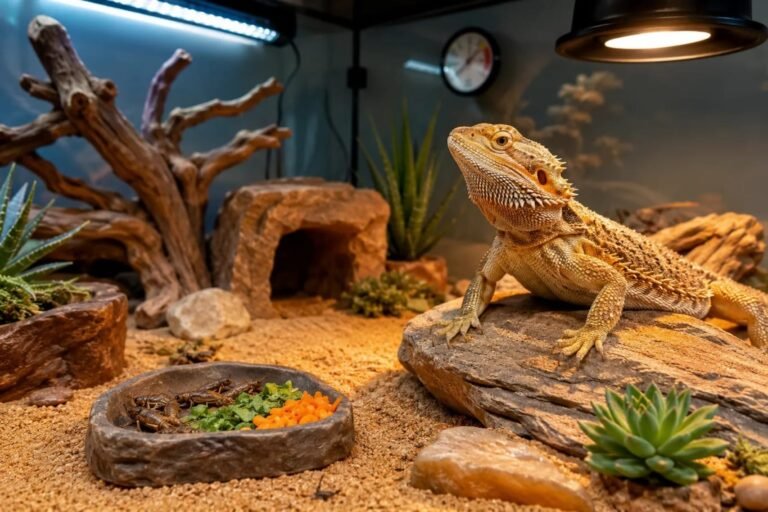
Temperature gradient. A bearded dragon needs a basking surface of about 100–110°F (38–43°C) for adults — up to around 110–115°F (43–46°C) is often used for babies — falling to a cool side of 75–85°F (24–29°C). A dragon kept too cool digests slowly, grows slowly, and sheds sluggishly and incompletely. Check your own gradient with the reptile temperature gradient calculator rather than trusting a single stick-on thermometer, which measures air, not the basking surface an infrared temperature gun reads.
Humidity. Bearded dragons are arid-zone animals from inland Australia, and an ambient humidity of roughly 30–40% suits them. Chronically high humidity invites respiratory problems, but chronically very low humidity — under 20%, common in winter with household heating — dries the separating skin layer and makes sheds stick. If your sheds have become ragged since the heating came on, check the number with the reptile humidity calculator before changing anything else.
UVB lighting. Ultraviolet B from a linear tube UVB lamp — typically a 10–12% tube mounted inside the enclosure, giving a UV Index of roughly 3–5 at the basking spot (Ferguson Zone 3) — drives vitamin D3 synthesis and calcium metabolism. Without adequate UVB, skin quality, appetite, and growth all suffer, and shedding becomes irregular. Tubes lose output long before they stop glowing and usually need replacing every 6–12 months depending on the brand. The reptile UVB lighting calculator helps match lamp strength and distance to your enclosure.
Hydration and nutrition. A dehydrated dragon sheds poorly. Offer water on leafy greens (collard greens, mustard greens, butternut squash), bathe occasionally if your dragon drinks in the bath, and keep calcium dusting consistent — chronic calcium and vitamin A imbalance is linked to poor skin quality and, in severe deficiency, to metabolic bone disease (MBD), whose soft jaw, tremors, and bent limbs are a veterinary problem, not a shedding problem.
Stuck shed (dysecdysis): what it is and how to help safely
Incomplete or retained shedding has a clinical name: dysecdysis. In bearded dragons it most often affects the toes, the tip of the tail, and skin around the eyes and vent. Retained layers matter because each new shed can stack on top of the old one; around a toe or tail tip, stacked dry skin tightens like a band, restricts blood flow, and can eventually cause the tip to die back. That progression — not a single pale patch — is the real risk.
Safe help at home is deliberately boring:
- Soak. Place the dragon in shallow, lukewarm water (about 85–90°F / 29–32°C), no deeper than its elbows, for 15–20 minutes. Supervise throughout.
- Soften, never pull. After soaking, you can very gently roll a softened edge with a damp cotton bud. If it does not release easily, stop. Pulling dry or resistant shed tears the new skin underneath and opens a route for infection.
- Add friction. Rough cork bark, slate, or a textured basking stone gives the dragon something to rub against, which is how it sheds in the wild.
- Fix the cause. Recheck basking temperature, ambient humidity, and UVB age. A soak rescues one shed; only corrected husbandry prevents the next one.
- Repeat once. A second soak the following day is reasonable. Shed still firmly stuck on toes, tail tip, or eyes after that belongs to a vet.
Never use shed-ease oils, tweezers, or peeling by hand, and never house dragons together to “help” each other — cohabitation stress and bite injuries around toes and tails are a common and avoidable cause of exactly the damage you are trying to prevent.

When shedding frequency is a warning sign
See a reptile vet promptly — an exotics vet, ideally one listed through the Association of Reptilian and Amphibian Veterinarians — if you notice any of the following alongside a shed problem:
- Shed retained on toes, tail, or eyes for more than about two weeks, or a toe or tail tip turning dark, thin, or shrivelled
- Shedding constantly with weight loss, or not shedding at all alongside loss of appetite and lethargy in a young, growing dragon
- Swollen limbs or jaw, tremors, or weakness — possible signs of metabolic bone disease
- Discoloured patches that are yellow, black, crusty, or spreading, which can indicate fungal or bacterial skin disease rather than normal shed
- A dragon under 12 months old sleeping for days and refusing food — juveniles should not brumate, so treat prolonged lethargy in a baby as illness until proven otherwise
The Merck Veterinary Manual’s overview of reptiles and amphibians is a useful owner-level reference for distinguishing normal reptile physiology from disease signs, and it reinforces the same point this guide makes: most shedding disorders in captive lizards are secondary to husbandry, and correcting the environment is part of the treatment, not an optional extra.
Vet note: This article is general husbandry information, not a diagnosis. If your dragon’s shed is stuck around the eyes or toes, its tail tip is darkening, or it has stopped eating, please see a reptile vet rather than waiting for the next shed to fix it.
Frequently asked questions
How long does a bearded dragon shed take from start to finish?
From the first dull, grey pre-shed colour to the last flake coming off, allow 3–7 days for a juvenile and 1–2 weeks for an adult shedding in patches. The active peeling itself is shorter — often 1–3 days in babies. If nothing has progressed at all after two weeks, treat it as stuck shed and work through the soak and husbandry checks above.
Why is my bearded dragon shedding so often?
Frequent shedding in a hatchling or juvenile is usually just fast growth and is normal every 1–2 weeks. In an adult, unusually frequent shedding can follow recovery from illness or weight gain, skin irritation, or a healing injury, because damaged skin is replaced more often. If frequent shedding comes with weight loss, raw patches, or discolouration, see a reptile vet.
Should I help my bearded dragon shed by peeling it?
No. Never peel shed that is still attached. You can support the process with a lukewarm soak, rough surfaces to rub on, and correct humidity, and you may gently roll fully softened, already-lifting edges with a damp cotton bud after a soak. Anything that resists should be left for the next day or for a vet.
Do bearded dragons stop eating when shedding?
Often, yes. Reduced appetite for a few days before and during a shed is one of the most consistent pre-shed signs, in babies and adults alike. Keep offering appropriately sized feeders and fresh greens, keep hydration up, and expect appetite to return within a day or two of the shed finishing. Refusal lasting well beyond the shed is a different problem and deserves investigation.
Is it normal for an adult bearded dragon to shed only part of its body?
Yes — patch shedding is the adult norm. Because adults are no longer growing as a whole, they replace skin region by region: the head one month, the tail or a single leg the next. A full-body shed in an adult is not required, and its absence is not a problem as long as each patch completes cleanly within about two weeks.