Why Does My Cockatiel Hang Upside Down? Explained
If you have just found your cockatiel dangling from the top of its cage like a small grey bat, you are probably wondering, why does my cockatiel hang upside down, and whether something is wrong. It looks wrong. Birds are supposed to sit upright on a perch, not hang upside down with their wings spread.
Take a breath. In most cases, a cockatiel hanging upside down is a happy bird, not a sick one. It is one of the silliest and most normal things a cockatiel does, and owners who know the behaviour find it charming rather than alarming.
This guide explains the five normal reasons cockatiels hang upside down, how their bodies make it possible, and the warning signs that mean something is actually wrong. By the end, you will know whether to laugh, or to call the vet.
Direct answer: A cockatiel hangs upside down because it is playing, feeling confident, guarding its cage, stretching, or sleeping.
In almost every case, it is normal behaviour and a sign of a healthy, comfortable bird. It only becomes a worry if the bird cannot get back upright, falls often, hangs for hours without stopping, or shows other signs of illness at the same time.
Why Does My Cockatiel Hang Upside Down? The Five Normal Reasons
Cockatiels do not hang upside down for one reason. They do it for five, and each one looks slightly different once you know what to watch for. Learning to tell them apart turns a scary sight into a useful window into your bird’s mood.
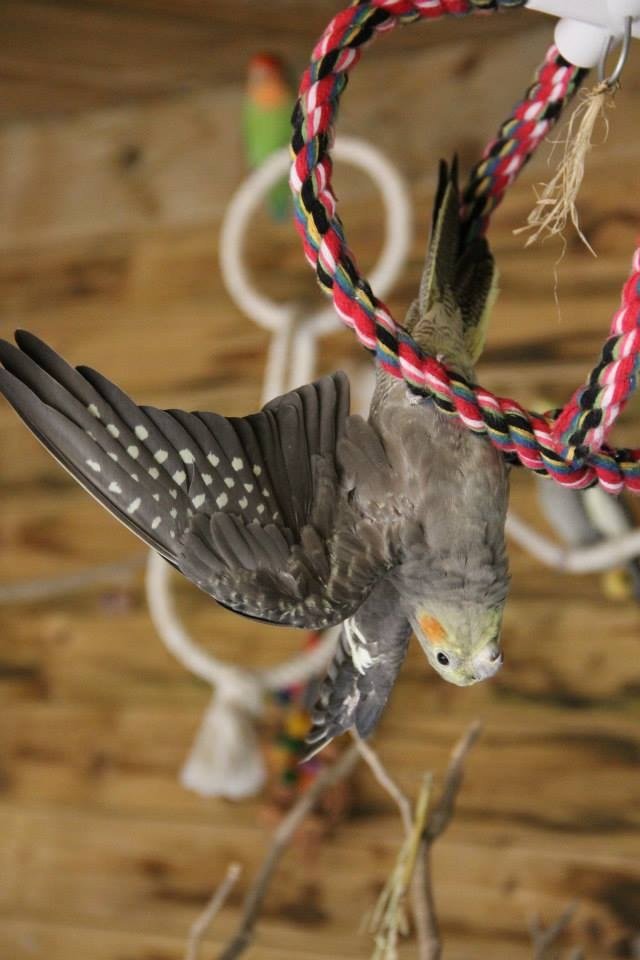
The first reason is play. A cockatiel that hangs upside down, swings from a toy, and flaps its wings is having fun. Young cockatiels do this most, and they often do it after a bath, after a meal, or when you come into the room. It is the bird version of a child hanging from a climbing frame.
The second reason is confidence. A bird that hangs upside down is showing you it feels safe. An upside-down bird cannot escape quickly, so it only takes that position when it trusts its surroundings. A new or frightened cockatiel almost never hangs upside down. When yours starts doing it, it is telling you it has settled in.
The third reason is territory. A cockatiel will sometimes hang upside down across the door of its cage, wings spread, to block the entrance. This is a guarding display, and it means the bird is protecting its space. It is normal, but it is also a message: the bird does not want to be disturbed right now.
The fourth reason is stretching and exercise. Cockatiels spend most of their day perched, and hanging upside down stretches their wings, their legs, and their back. It is a workout, and a bird in a cage needs that movement. A cockatiel that hangs and flaps for a minute or two, then rights itself and carries on, is just keeping fit.
The fifth reason is sleep. Some cockatiels nap, and even sleep overnight, hanging upside down from a perch or the cage top. This shocks new owners more than anything else, but it is well within the normal range. A bird that sleeps upside down, wakes readily when disturbed, and behaves normally during the day is simply a bird with an unusual sleeping habit.
Play: The Happy Acrobat
Play is the most common reason, and it is the easiest to recognise. A playing cockatiel is noisy, active, and obviously enjoying itself. It chirps, whistles, bobs its head, and swings from one bar to the next. It may hang by one foot, then two, then drop to a perch and climb straight back up.
Cockatiels are among the silliest of all pet birds. They are curious, social, and easily bored, and hanging upside down is one of the ways they entertain themselves. A bird with a rope toy, a swing, or a ladder will often hang from it for the fun of it, the way a child hangs from a swing.
Play hanging usually happens at the same times of day. Morning, after the cage cover comes off, is a favourite time. Late afternoon, when the family is home and the house is busy, is another.
A bird that hangs upside down while you are watching, chirping at you, is inviting you to notice. Talk back to it, whistle, or offer a treat, and you will usually get an even sillier display.
There is nothing to fix here. A playing bird is a healthy bird, and the best thing you can do is give it safe things to hang from.
Territory: Guarding the Cage Door
Not all upside-down hanging is play. Sometimes it is a warning, and learning to tell the difference keeps your fingers safe. A territorial cockatiel hangs across the entrance of its cage, wings spread wide, crest raised, and eyes pinned. It is blocking the door, and it means it.
This behaviour comes from the wild. In Australia, cockatiels nest in tree hollows, and a bird that guards the hollow keeps its mate and its chicks safe. A pet cockatiel treats its cage the same way. The cage is its nest, and the door is the entrance it must defend.
Territorial hanging is most common in spring, when the days get longer and breeding hormones rise. It is also common when the bird is moulting, tired, or has just been moved to a new cage. A bird that hangs upside down over its door and hisses or lunges when you reach in is not playing. It is telling you to back off.
Respect the message. Do not reach into the cage when the bird is guarding it. Wait until the bird moves away, or lure it to another perch with a treat. A cockatiel that feels its warnings are respected becomes less territorial over time. A bird that is grabbed out of its cage anyway learns that warnings do not work, and it starts biting instead.
Stretching and Exercise: A Bird’s Workout
A cockatiel that hangs upside down and flaps its wings slowly, several times in a row, is usually exercising. This is the bird equivalent of a morning stretch, and it matters more than owners realise.
Wild cockatiels fly for hours every day. A pet cockatiel in a cage flies far less, and its wing muscles weaken without regular use. Hanging and flapping keeps those muscles working, stretches the tendons, and keeps the bird’s balance sharp.
Watch how the bird moves. A stretching bird hangs, flaps, rights itself, and then goes about its day. The whole thing takes a minute or two. It is deliberate, controlled, and the bird looks relaxed throughout.
This kind of hanging is most common after the bird wakes up, after a bath, or after a long sit on a perch. It is also common in birds that do not get much time out of the cage. If your cockatiel hangs and stretches a lot, it may be telling you it needs more time outside the cage to fly.
Our guide to how long can a cockatiel be left alone explains how much time a cockatiel needs with its people each day, and a bird that gets regular out-of-cage time hangs less from boredom and more from pure enjoyment.
Sleeping Upside Down: The Scariest Normal Behaviour
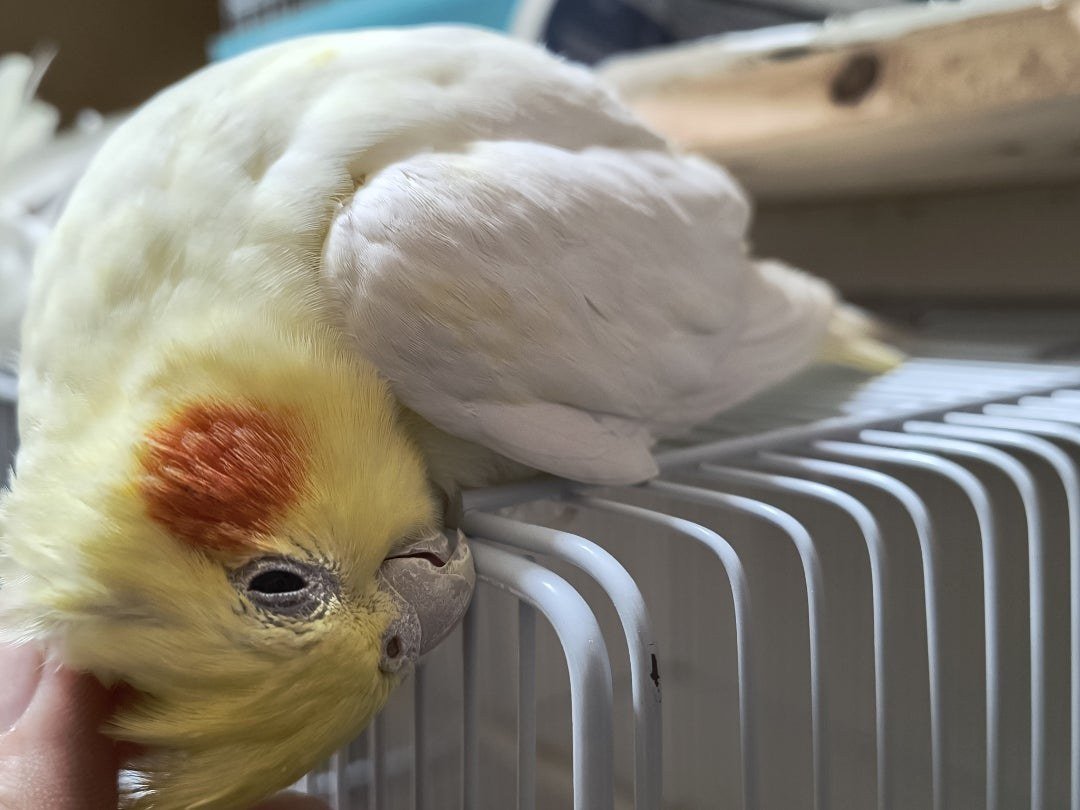
Nothing alarms a new cockatiel owner more than finding their bird asleep, upside down, with its eyes closed, hanging from the top of the cage. It looks dead. It is not. Some cockatiels genuinely prefer to sleep this way.
The reason is in the bird’s feet. A cockatiel’s toes lock onto a perch automatically when it bends its legs, and the grip holds without any effort. That locking mechanism works upside down just as well as it works the right way up. A bird can hang, fall asleep, and stay put all night without falling.
How do you know a sleeping upside-down bird is fine? Check three things. First, the bird should wake readily when you speak or move near the cage. Second, it should right itself easily and move normally when it wakes. Third, it should eat, drink, and behave normally during the day.
If all three are true, the bird is simply sleeping in an unusual position. Some cockatiels do this every night. Others do it only when they are very comfortable, or only on a favourite perch. It is an individual habit, not a symptom.
Sleep matters enormously for cockatiels. They need 10 to 12 hours of dark, quiet sleep, and a bird that does not get it becomes cranky, noisy, and prone to illness. Our guide to cockatiel night fright causes and prevention explains how to set up the night routine, and a bird that sleeps well — even upside down — is a bird that is coping well.
How Their Bodies Make It Possible
Cockatiels are built for hanging. Their feet are zygodactyl, which means two toes point forward and two point backward, forming a powerful pincer grip around a bar or a branch. That grip is far stronger than a human hand of the same size, and it works in any direction.
The grip is helped by a clever piece of anatomy. The tendons that close a bird’s toes run down the back of the leg, and when the bird bends its ankle, the tendons pull tight and lock the toes shut. The bird does not have to squeeze. It just has to bend its leg, and the grip holds itself.
Birds also tolerate being upside down far better than mammals do. A cockatiel can hang for minutes at a time with no discomfort at all.
The vestibular system, the balance organ in the inner ear, is also built for it. Wild cockatiels feed by hanging from seed heads and branches, and a bird that could not cope with being upside down would starve. The behaviour you see in your living room is the same behaviour wild cockatiels use every day to eat.
Which Birds Hang Most? A Species Comparison
Not all pet birds hang upside down equally. Some species are famous acrobats, and others rarely leave their perch. The table below shows where the cockatiel sits in the range, so you can judge whether your bird is typical for its species.
| Species | How often they hang | What it usually means |
|---|---|---|
| Caique | Constantly — the most acrobatic pet bird | Play, all day, every day |
| Conure | Very often, especially young birds | Play and exploration |
| Cockatoo | Often, with dramatic wing spreads | Play, attention seeking, and display |
| Budgie | Often, especially during play | Play and exercise |
| Cockatiel | Moderate — some birds a lot, some never | Play, territory, stretching, or sleep |
| African grey | Rarely | Usually a brief stretch, not a habit |
| Canary and finch | Almost never | Not part of how these birds behave |
The cockatiel sits in the middle of the range. It hangs less than a caique or a conure, but far more than an African grey or a canary. That means two things.
First, a cockatiel that hangs upside down is behaving normally for its species. Second, a cockatiel that never hangs upside down is also normal — individual birds vary a lot, and a bird that prefers its perch is not missing anything.
When Hanging Upside Down Means Trouble
Most upside-down hanging is harmless, but there are exceptions, and knowing them can save your bird’s life. The difference is in the details: how the bird hangs, how long it stays, and what else is happening at the same time.
A bird that hangs and cannot get back upright is in trouble. A healthy bird rights itself in a second. A bird that struggles, flaps wildly, or falls to the cage floor may have a leg injury, a wing injury, or a balance problem. Pick it up gently, check its legs and wings, and call an avian vet if it cannot perch properly.
A bird that falls often is also a worry. One fall from a perch is an accident. Repeated falls, especially from low perches, can mean weakness, a neurological problem, or a heavy metal poisoning from chewing on something zinc or lead. A bird that falls and then sits on the cage floor, fluffed up and quiet, needs a vet the same day.
Hanging that never stops is a third warning sign. A bird that spends hours upside down, ignoring food, water, and toys, is not playing. It may be stuck in a repetitive behaviour from boredom, or it may have a neurological problem affecting its balance.
The Furry Critter Network’s health guide on excessive hanging lists the same signs: hanging in contexts where the bird never hung before, and preferring to hang over everything else.
The clearest warning is a change in the bird’s other behaviour. A bird that hangs upside down and also stops eating, stops singing, breathes with its beak open, bobs its tail with every breath, or sits fluffed up on the cage floor is sick, and the hanging is not the problem.
It is a symptom. See an avian vet promptly, and do not wait to see if it gets better on its own.
Neurological problems are the most serious cause. Vestibular disease, a head injury, a brain infection, or heavy metal poisoning can all damage a bird’s sense of balance. A bird with one of these problems may hang upside down because it has lost its sense of up and down, not because it chose to. If your bird looks confused, tilts its head, circles, or cannot perch, treat it as an emergency.
Setting Up a Cage That Is Safe for Hanging
A cockatiel that likes to hang needs a cage that lets it do so safely. The good news is that a safe hanging cage is just a good cockatiel cage with a few extras.
Give the bird things to hang from. A clean cotton rope perch, a wooden swing, and a ladder give the bird safe places to climb and dangle. Check rope toys weekly for fraying, because a loose thread can wrap around a toe.
Keep the cage floor soft. A bird that falls from the top of the cage lands hard on a bare tray. A layer of paper over a soft mat, or a low perch near the floor, gives a falling bird a safer landing. Never put a mirror at the top of the cage where a hanging bird can hit it.
Remove hazards from the top of the cage. A bell with a wide slot can trap a beak. A chain with open links can trap a toe. A toy with a small gap can catch a foot. If a toy has a gap a toe could enter, it is not safe for a hanging bird.
Place food and water where a hanging bird can reach them easily. A bird that hangs a lot may prefer a food dish near the top of the cage, and it should always be able to reach water without climbing down.
The bird water intake calculator helps you check that your bird is drinking enough, and our guide to how often should a cockatiel bathe covers the bathing routine that keeps a playful bird’s feathers in good shape.
What to Do If Your Cockatiel Falls
A fall from a perch is frightening for you and for the bird. Stay calm, and follow the same steps every time. First, watch the bird for a minute before you touch it. A bird that gets up, shakes itself, and climbs back to a perch is usually fine.
If the bird stays on the floor, pick it up gently with both hands and check it over. Look at the wings, the legs, and the feet. Feel for swelling or a wing held at an odd angle. Check for blood, especially around the beak and the feet. A broken blood feather bleeds heavily and needs a vet.
Put the bird in a small, warm, quiet cage or carrier with food and water, and keep it there while you watch it. A bird that eats, drinks, and perches within an hour is probably fine. A bird that sits fluffed up, refuses food, or cannot perch needs a vet the same day.
After a fall, look for the cause. Was the perch slippery? Was the bird startled by a noise? Was it hanging from a toy that broke? Fix the cause before you put the bird back in its cage, or the same fall will happen again.
Food and age also play a part in falls. An older bird, or a bird on a poor diet, has weaker bones and weaker muscles, and it falls more often.
The cockatiel food calculator helps you get the diet right, and the cockatiel age calculator tells you where your bird is in its life. If your cockatiel has been sneezing or showing other signs of illness, our guide to why does my cockatiel sneeze so much explains when a sneeze needs a vet.
Frequently Asked Questions
Why does my cockatiel grind its beak?
Beak grinding is a happy sound. A cockatiel grinds its beak, usually before sleep, when it feels safe, warm, and content. It is the bird equivalent of a cat purring.
The sound comes from the bird rubbing its upper and lower beak together, and it often happens as the bird settles down for the night with its feathers fluffed and its eyes half closed. It is one of the best signs that your bird is comfortable. A bird that grinds its beak and then hangs upside down is having a very good day.
Why does my cockatiel flap its wings in the cage?
Wing flapping in the cage is usually exercise. A cockatiel holds onto a perch and flaps hard for a few seconds, sometimes several times in a row, to work its wing muscles and shake out its feathers.
It often happens first thing in the morning, after a bath, or when the bird is excited. It is normal as long as the bird settles down afterwards. Constant, frantic flapping, especially with screaming or panic, is different — that usually means the bird is frightened, and you should check for what scared it.
Do cockatiels like to be held upside down?
Most do not, and you should not try it. A cockatiel that hangs upside down on its own is choosing the position, and it can get out of it whenever it wants. A bird held upside down by a person has no choice, and most find it frightening.
Some very tame cockatiels will lie on their backs in a trusted owner’s hand, and a few enjoy it. But that is a trick learned over months of trust, not a game to try with a new bird. Never flip a cockatiel onto its back to see what happens — a frightened bird can bite hard, and a fall from your hand can injure it.
Why does my cockatiel sleep on one foot?
Sleeping on one foot is one of the most normal things a bird does. A cockatiel tucks one foot up into its belly feathers to keep it warm, and balances on the other. It is a sign of a healthy, comfortable bird.
Birds do this to save heat and to rest one leg at a time. A cockatiel that sleeps on one foot, with its head tucked under its wing, is sleeping deeply and well. The only time to worry is if the bird never uses one foot at all, or holds it up during the day while awake — that can mean an injury or a sore foot.
Is it normal for a cockatiel to sleep with its head tucked under its wing?
Yes, it is completely normal, and it is how most healthy cockatiels sleep. Tucking the head under a wing keeps the bird warm, blocks out light, and protects the sensitive skin around the eyes and beak.
A bird that sleeps with its head tucked, on one foot, and wakes up alert and hungry in the morning is sleeping exactly as it should. The position only becomes a worry if the bird also sits fluffed up and sleepy during the day, which can be a sign of illness rather than a sleep habit.
For more on cockatiel behaviour, Lafeber’s cockatiel species profile covers body language and daily care, and the VCA pet bird care guide explains when a behaviour change needs a vet visit.