Why Is My Fish Tank Filter So Loud? Name That Noise
If you are asking why is my fish tank filter so loud, you already know the sound. The hum that fills the room. The rattle that starts at midnight. The waterfall roar every time the water level drops half an inch. A fish tank is supposed to be calming. A noisy filter turns it into a machine you cannot ignore.
The good news is that most filter noise has a simple cause, and most of it can be fixed in minutes with no new equipment. A filter does not usually get loud because it is broken. It gets loud because something small has changed: the water level dropped, air got trapped inside, a part came loose, or grit found its way into the impeller.
The trick is to listen first and fix second. Every noise points to a different problem, and each problem has its own fix. A hum is not a gurgle. A rattle is not a waterfall. This guide teaches you to name the noise, find the cause in five minutes, and quiet the tank without harming your fish.
Direct answer: Your fish tank filter is so loud because of vibration, trapped air, low water, or a worn impeller. A low hum usually means vibration passing into the stand or glass. A rattle or chatter usually means grit or a worn impeller. A gurgle or slurp usually means trapped air. A waterfall roar usually means the water level has dropped below the filter outflow.
Start by topping the tank up so the water meets the filter spillway, then press your hand on the filter, stand and lid to feel for vibration, and unplug one device at a time to find the culprit. Most noise is fixed in minutes by topping up, reseating the filter, cleaning the impeller, or adding a soft pad under the equipment.
Why Is My Fish Tank Filter So Loud? Name That Noise
Before you touch anything, listen for thirty seconds and name the sound. The noise itself is the diagnosis. Each sound has a usual cause and a usual fix, and the table below sorts them out.
| What you hear | What it usually means | First fix to try |
|---|---|---|
| Low steady hum | Motor vibration passing into the stand, glass or wall | Put a soft pad under the filter or pump; move it off hard surfaces |
| Rattle or chatter | Grit in the impeller well, or a worn impeller shaft | Switch off, clean the impeller and housing, check for wear |
| Gurgle or slurp | Trapped air inside the filter or hoses | Prime the filter, tilt it gently, reseat hoses and seals |
| Waterfall roar | Water level too low; outflow falling too far | Top up the tank so the water meets the spillway |
| Buzz from the air pump | Pump vibrating on a hard shelf, or back pressure | Set the pump on a foam pad; add a gang valve, never clamp the line |
| Clicking or grinding | Damaged impeller, bent shaft, or a snail in the works | Switch off, open the impeller chamber, inspect and replace worn parts |
| Fizzing or bubbling | Air stone or sponge filter running too hard | Turn the air flow down with a gang valve |
Two of these sounds deserve a quick note. A low hum is the most common complaint, and it is almost never the filter itself. It is vibration travelling from the motor into something solid — the glass, the stand, a wall, a hollow floor. The filter is fine. The path the vibration takes is the problem, and a soft pad breaks that path.
A waterfall roar is the easiest fix of all, and it is the one keepers miss most often. When the water level drops, the filter outflow falls further and further, and the splash gets louder every day. Topping up so the water meets the bottom of the spillway turns the roar into a gentle ripple in seconds. If your water turns cloudy after a top-up or a change, our guide to why your fish tank is cloudy after a water change explains the three causes and the fix for each.
Safety First: Unplug Before You Touch the Water
Before you open a filter or put your hands in the tank, switch the equipment off. This is not a suggestion. Water and mains electricity are a dangerous mix, and a wet plug or a cracked heater can hurt you badly.
Unplug the filter and every submerged piece of equipment before you reach into the water. If a plug or a socket is wet or damaged, do not touch it. Switch the power off at the wall or the circuit breaker and get qualified help. Follow your own filter’s manual for taking it apart, and never open a sealed motor housing.
While the filter is off, remember that the clock is running. The bacteria in your filter need flowing, oxygen-rich water. A few minutes off for cleaning is fine. Hours off is not. Do your work, put the filter back together, prime it, and switch it back on. If you need to leave the filter off for longer, keep the media wet in a bucket of tank water.
One more safety habit is worth building. Always create a drip loop in every power cable: let the cable dip below the socket before it rises to the plug. If water ever runs down the cable, it drips off the loop instead of running into the socket. It takes ten seconds to set up, and it is the cheapest safety device in the hobby.
The 5-Minute Quiet Check
Run through this check in order before you buy anything or take anything apart. It solves most noise problems, and it tells you exactly which device is the culprit when it does not.
Minute 1: top up the water. Fill the tank so the water line sits right at the bottom of the filter spillway. This alone kills most waterfall noise. If your water level drops often, mark a top-off line on the glass with a small sticker and refill before the level falls below it.
Minute 2: feel for vibration. Place your hand on the filter, then on the stand, then on the lid. If you feel a buzz anywhere, you have found the path the vibration is taking. Move the buzzing item, cushion it with a thin foam pad, a mouse pad, a cork tile, or a folded towel, and check again. Thin pads work better than thick ones.
Minute 3: look for air. Check the filter and the hoses for bubbles. Trapped air causes gurgling and sloshing, especially after a water change. Prime the filter as its manual describes, tilt it gently to let the air escape, and reseat the hoses until they sit firmly. A loose intake seal lets air in with every cycle.
Minute 4: unplug one device at a time. If you run a filter, an air pump, and a powerhead, you may not know which one is loud. Unplug them one at a time, for a few seconds each, and listen. The room goes quiet when you unplug the culprit. This test takes a minute and saves you from fixing the wrong device.
Minute 5: check the lid and fittings. A loose lid rattles. A loose filter cover rattles. A tube touching the glass buzzes. Press each fitting until it sits snugly. Move airline tubing off wood and glass, and use soft silicone airline where it touches hard surfaces. Small rattles hide in small places.
If the noise survives all five minutes, the problem is inside the filter, and the next section covers that. But most keepers never get that far. The top-up and the foam pad fix the large majority of noisy tanks.
Fixes by Filter Type
Different filters make different noises, and the fix depends on the type you own. Use the guide below for your setup.
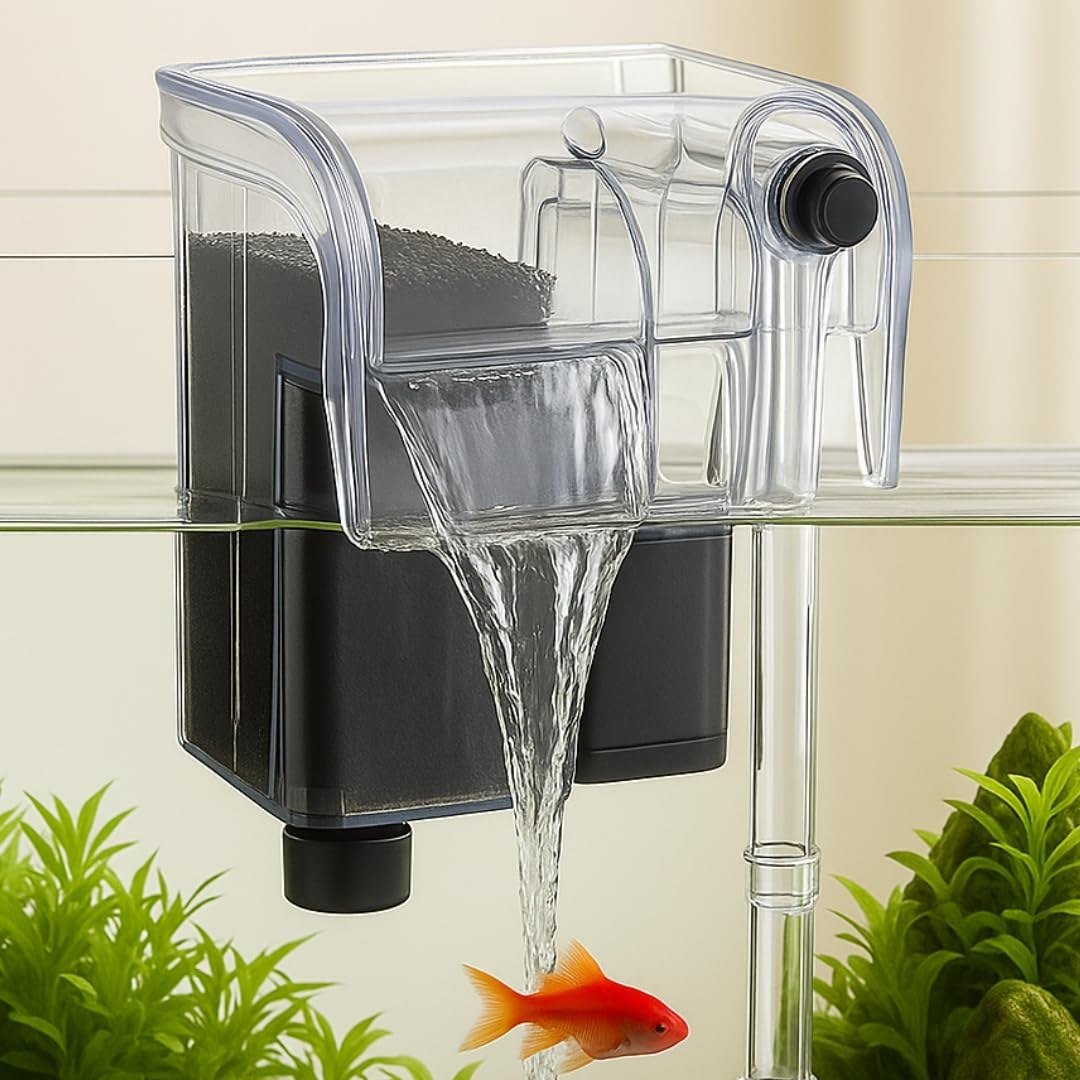
Hang-on-back (HOB) filters. These are the most common noisy filter, and the most common cause is low water. Keep the level high so the outflow barely breaks the surface. Make sure the filter sits firmly on the rim, and pad the contact points with thin rubber if it vibrates against the glass. If the impeller is worn or pitted, replace it. Impellers are cheap, and a new one often makes an old filter sound new. Add a pre-filter sponge to the intake to slow the flow and lift the water level inside the filter box, which reduces the drop height.
Canister filters. A canister that gurgles usually has trapped air. Tilt it gently, open the priming pump, and let the air work its way out. Check every hose connection and seal, because a tiny air leak at a seal will gurgle forever. A canister that hums is usually vibrating against the floor or the inside of the cabinet. Set it on a foam mat and make sure no hose touches the cabinet wall.
Internal filters. These sit inside the tank, so their noise usually comes through the glass and the water. Make sure the suction cups hold firmly. A filter that has slipped and hangs at an angle will rattle against the glass. Clean the impeller regularly, because internal filters sit low in the tank where waste and grit collect.
Sponge filters and air pumps. A sponge filter has no impeller, so its noise comes from the air pump that drives it. The pump is often the loudest thing in the whole setup, and it is usually the pump, not the filter, that keeps people awake. Set the pump on a soft pad, hang it from a hook so it does not touch the shelf, or move it into a cupboard with the lid ajar for airflow.
Never clamp the airline to reduce the flow. Instead, split the line with a T-piece and let the extra air vent, or fit a gang valve with a relief port. Back pressure makes pumps strain and buzz, and clamping the line creates back pressure.
If you are choosing a new filter and quiet matters to you, pick a larger filter and run it at a lower speed. Low revolutions usually mean less noise. DC controllable pumps are often quieter than fixed-speed AC pumps, and filters with ceramic shafts, rubber feet, and thick housings tend to hum less. The fish tank size calculator helps you match the filter to the tank so you do not end up with a small filter working too hard.
When the Noise Means the Filter Is Dying
Most noise is a small fix. Some noise is a warning that a part is wearing out. Knowing the difference saves you from a filter that fails while you are away for the weekend.
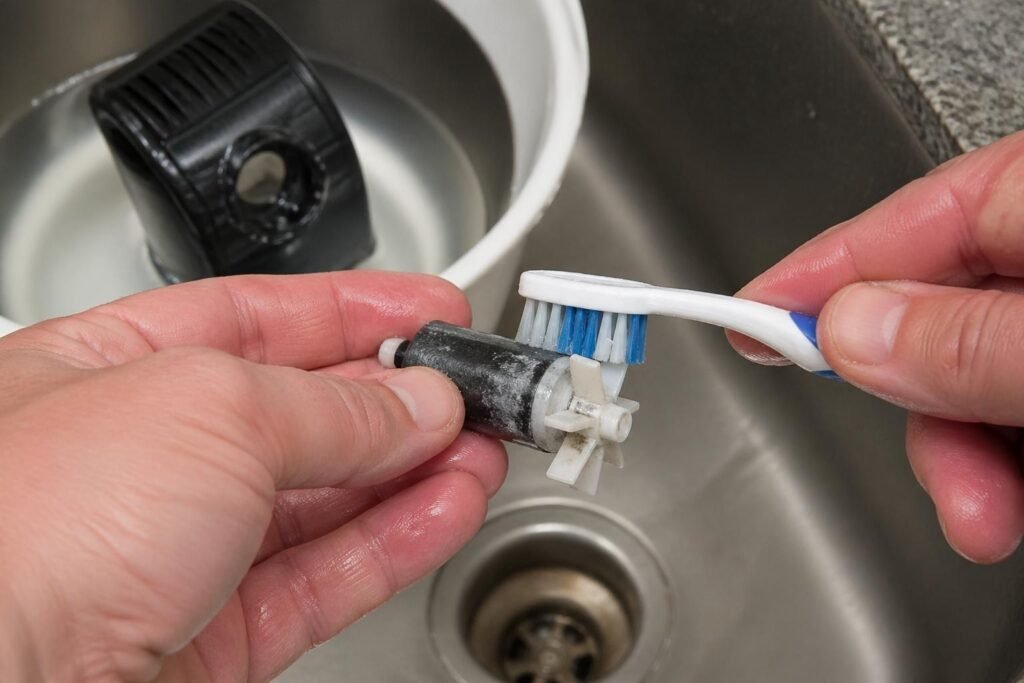
A sudden new noise usually means the filter needs cleaning or the impeller is worn, not that the whole unit is failing. Start by cleaning the impeller. Switch the filter off and unplug it, open the impeller chamber as your manual describes, and lift the impeller out. Look for grit, plant material, or a tiny snail caught in the well. Clean the well with a soft brush or an old toothbrush, rinse the impeller, and check the shaft.
The shaft is the thin rod the impeller spins on. If it is bent, pitted, or scored, the impeller wobbles as it spins, and that wobble is the rattle you hear. The rubber bushings at each end wear out too. Both parts are cheap and easy to replace on most models, and a new impeller and shaft can make a three-year-old filter run like new. Check your filter maker’s spare parts list before you assume the whole filter is finished.
There is a simple rule for repair versus replace. If the spare parts cost less than half the price of a new filter, repair it. If the parts cost more than half, or the motor housing is cracked, or the filter has failed twice in a few months, replace the unit. When you do replace a filter, seed the new one from the old media, exactly as you would with a cartridge change. The bacteria live in the media, not in the plastic box, and keeping them saves your cycle.
Watch for one more warning sign. If the filter stops and starts on its own, or the flow surges and fades, the motor may be failing. A filter that cannot hold a steady flow cannot hold a steady bacteria colony either. Do not wait for it to die completely. Replace it on your schedule, not on its schedule.
Does the Noise Bother the Fish?
Yes, and more than most keepers realise. Fish do not have ears like ours, but they sense pressure waves through a line of tiny sensors along their sides, called the lateral line, and through their inner ears. A tank sitting on a vibrating surface gives them no quiet corner. Constant vibration is a recognised stressor, alongside sudden knocks on the glass.
Stressed fish eat less, hide more, and get sick more easily. Their bodies release cortisol, the stress hormone, and high cortisol over time weakens the immune system. That is the same chain of events that turns a small water problem into a disease outbreak. A noisy filter is not just annoying for you. It is a low-level stress that never switches off for the fish.
Some fish are more sensitive than others. Bettas, gouramis, and other labyrinth fish live near the surface, close to the filter outflow, and feel every vibration. Small tetras and rasboras are skittish by nature and startle easily. Goldfish are tougher, but even they show the strain over time. If your fish are hiding more than usual, our guide to why your fish is hiding all the time covers the other causes to check.
The good news is that the fixes that help you also help the fish. A foam pad under the pump, a higher water level, a cleaned impeller, and a gentle ripple instead of a waterfall all cut the vibration the fish feel. You do not need a silent tank. You need a tank where the equipment hums softly instead of rattling the glass.
One thing you should never do to get quiet is switch the filter off. Our guide to whether you can turn off your fish tank filter at night explains why in detail, but the short version is simple. The filter media holds the bacteria that convert ammonia and nitrite. Without flow, those bacteria run out of oxygen and start to die within hours, and ammonia climbs the next day. In a warm or heavily stocked tank, stopping circulation overnight can also let oxygen fall to dangerous levels while you sleep. Fix the noise. Never switch the filter off to escape it.
Setting Up for Quiet From Day One
If you are setting up a new tank, you can build quiet in from the start. It is far easier than fixing noise later, and it costs almost nothing.
Start with a sturdy, level stand. A stand that flexes or tilts makes every filter vibrate unevenly. Use the foam or neoprene mat that comes with rimless tanks. It spreads the weight and soaks up vibration before it reaches the glass. Check the stand with a spirit level, front to back and side to side.
Choose your filter with noise in mind. Larger filters run at lower speeds, and lower speeds mean less noise. DC controllable pumps can be tuned to a quiet sweet spot. Filters with ceramic shafts, rubber feet, and thick housings hum less than thin, light ones. For air pumps, pick a model designed for silence, and mount it on a soft pad from the first day.
Plan the water level. A tank that runs with the water an inch below the rim will always be noisier than one that runs full. Fill the tank to the proper level, fit a lid, and mark a top-off line. Check the level twice a week. If you want to work out how much water your tank holds and how much a top-up should be, the aquarium water change calculator and the fish tank volume calculator both help with the maths.
Finally, keep a small spares box: a spare impeller for your filter model, a spare set of rubber bushings, a foam pad, and a gang valve. When the filter starts to rattle on a Sunday evening, the spares box is the difference between a five-minute fix and a noisy week. For trusted background on fish health and water quality, the Merck Veterinary Manual guide to disorders and diseases of fish and the RSPCA’s fish care advice are both worth bookmarking.
Frequently Asked Questions
Can I turn off my filter at night to stop the noise? No, never. The filter media holds the bacteria that convert ammonia and nitrite, and without water flow those bacteria run out of oxygen and start to die within hours. Ammonia climbs the next day, and in a warm or heavily stocked tank the oxygen can fall to dangerous levels overnight. Fix the noise with a top-up, a foam pad, or a cleaned impeller instead. Quiet is a maintenance job, not a switch.
Why is my filter loud after a water change? A water change almost always lets air into the filter. When you lower the water level, the intake can suck air, and when you refill, bubbles get trapped in the impeller chamber and the hoses. The fix is to prime the filter after every water change: switch it off, fill the filter box with tank water, tilt it gently to let the air escape, and switch it back on. The gurgling usually stops within a minute or two. If it does not, check that the intake tube is fully underwater and the seals are tight.
What is the quietest fish tank filter? For most home tanks, a large sponge filter driven by a good air pump on a foam pad is the quietest setup, because it has no impeller at all. Among powered filters, a quality canister filter is usually quieter than a hang-on-back filter, because the motor sits in a sealed unit under the tank instead of hanging on the glass. Whichever type you choose, an oversized filter run gently is always quieter than a small filter working at full speed.
Is it normal for a new filter to be noisy? A new filter can be a little noisy for the first day or two while trapped air works its way out and the impeller beds in. A light gurgle or hum that fades within 48 hours is normal. A loud rattle, grinding, or waterfall roar from a brand-new filter is not normal. Check the water level, prime it properly, and make sure it is seated level on the rim. If the noise does not settle, the impeller may be faulty, and you should ask the seller for a replacement.
Why does my filter get louder over time? Parts wear out. The impeller shaft and rubber bushings slowly pit and loosen, grit builds up in the impeller well, and the motor works harder as the media clogs. A filter that gets gradually louder over months is usually asking for a clean and a new impeller, not a whole new filter. Clean it every month, replace worn parts when you find them, and the noise will stay low for years.