Why Is My Goldfish Sitting at the Bottom of the Tank?
If you are asking why is my goldfish sitting at the bottom of the tank, you have spotted one of the most confusing behaviours in fishkeeping. A goldfish resting on the gravel at midnight is usually a goldfish asleep. The same goldfish, in the same spot at midday with its fins clamped tight, is often a goldfish in trouble. Carassius auratus — the common goldfish and its fancy relatives such as the fantail, oranda, and ranchu — cannot tell you which one it is. You have to read the posture, the breathing, the time of day, and above all the water test results. This guide gives you that reading order, so you stop guessing and start diagnosing.
Direct answer: A goldfish sitting at the bottom of the tank is normal if it happens at night or in short rests and the fish swims off normally when disturbed. It is a warning sign when it lasts for hours in the daytime with clamped fins, rapid breathing, or no interest in food. The most common cause is poor water quality: ammonia and nitrite must test at 0 ppm, nitrate should stay below 40 ppm, and any ammonia reading of 0.25 ppm or higher means a 30–50% water change today.
The next causes are cold water below 60°F (15.5°C), swim bladder trouble — especially in fancy goldfish — and illness. That is the short answer to why is my goldfish sitting at the bottom of the tank.
Start With the Clock: When Bottom-Sitting Is Just Sleep
Goldfish do not sleep like mammals, but they do rest. At night, or whenever the room and tank go dark and quiet, a healthy goldfish slows down, sinks toward the substrate, and hovers or rests lightly on the gravel for long stretches. Its fins stay relaxed and slightly spread, its breathing stays slow and even, and its colour stays normal. Disturb it gently — turn on a soft room light, move slowly in front of the glass — and it wakes, stretches its fins, and swims off in a normal, level posture.
Short daytime rests are normal too, especially after a big meal and in older fish. What is not normal is a change of pattern: a fish that used to cruise the mid-water all day now spending most of the day on the bottom, a fish that does not come up for food, or a fish whose rest looks like collapse — lying tilted on one side, curved, or propped against décor at an odd angle.
Timing plus posture is your first diagnostic filter, and it costs nothing. Only after that do you reach for the test kit — which, if the pattern has changed, you should always do next. If you are asking why is my goldfish sitting at the bottom of the tank, that change of pattern is the detail to note.
Why Is My Goldfish Sitting at the Bottom of the Tank? The Five Real Causes
Work through these five causes in order. The first explains most cases, and it is also the one you can confirm in five minutes with a liquid test kit. Keep the question in mind as you go: why is my goldfish sitting at the bottom of the tank?
1. Ammonia or nitrite poisoning. Goldfish produce a lot of waste for their size, and in a tank that is new, undersized, overfed, or behind on water changes, the nitrogen cycle falls behind. Nitrifying bacteria should convert ammonia to nitrite and then to nitrate, but when ammonia or nitrite builds up, it damages the gills and, in nitrite’s case, blocks the blood from carrying oxygen. A poisoned goldfish feels weak and suffocated, and it sinks to the bottom to save energy.
Look for rapid or laboured breathing, red or streaky gills, clamped fins, and a fish that ignores food. The Merck Veterinary Manual’s chapter on disorders and diseases of fish identifies poor water quality — high ammonia above all — as the most common environmental cause of disease in aquarium fish. The University of Florida IFAS Extension publication on ammonia in aquatic systems adds the detail that catches keepers out: ammonia is invisible, so a crystal-clear tank can still be poisoning its fish.
2. Water that is too cold. Goldfish are coldwater fish, but cold has limits. Their comfort range is roughly 65–75°F (18–24°C). Below about 60°F (15.5°C) the metabolism of a fancy goldfish slows sharply, digestion nearly stops, and the fish becomes sluggish and bottom-bound. An unheated tank in a cold room in winter, or a tank placed against a cold outside wall, can drift into this zone overnight. A thermometer — not the room thermostat — tells you the truth.
3. Swim bladder disorder. The swim bladder is the gas-filled organ that holds a goldfish level in the water. When it under-inflates or is squeezed by a full, constipated gut, the fish cannot rise and sinks to the bottom, sometimes struggling up for food and sinking straight back down. This cause has a posture signature — sinking rather than resting — and it is far more common in fancy goldfish, for reasons covered below.
4. Illness or parasites. Bacterial infection, gill flukes, and other parasites all produce lethargy and bottom-sitting as an early, general sign. Suspect this group when bottom-sitting comes with white spots, a grey film, frayed fins, flashing or rubbing against décor, or a fish that has stopped eating for more than two days with clean water tests.
5. Stress and exhaustion. A new tank in the first days, a recent large water change, bullying by a faster tankmate, or a tank with no cover at all can leave a goldfish hiding and resting at the bottom. Stress bottom-sitting usually improves day by day once conditions settle; illness and poisoning do not.
Use this table to match what you see to the most likely cause:
| What you see at the bottom | Most likely cause | First check |
|---|---|---|
| Rests at night only, swims off normally when disturbed | Normal sleep | None — observe |
| Daytime sitting, clamped fins, rapid breathing | Ammonia or nitrite | Liquid test — act at 0.25 ppm |
| Sluggish, ignores food, tank feels cold | Low temperature | Thermometer — below 60°F / 15.5°C is the danger zone |
| Sinks back down after trying to swim up, worse after meals | Swim bladder / constipation | Feeding history — fast, then feed a skinned pea |
| Sitting plus spots, film, frayed fins or rubbing | Illness or parasites | Inspect closely; test water to rule out cause 1 |
| Hiding at the bottom after a move or change | Stress | Give 48 hours of quiet; test if not improving |
Fancy Goldfish vs Single-Tails: Why Body Shape Changes the Odds
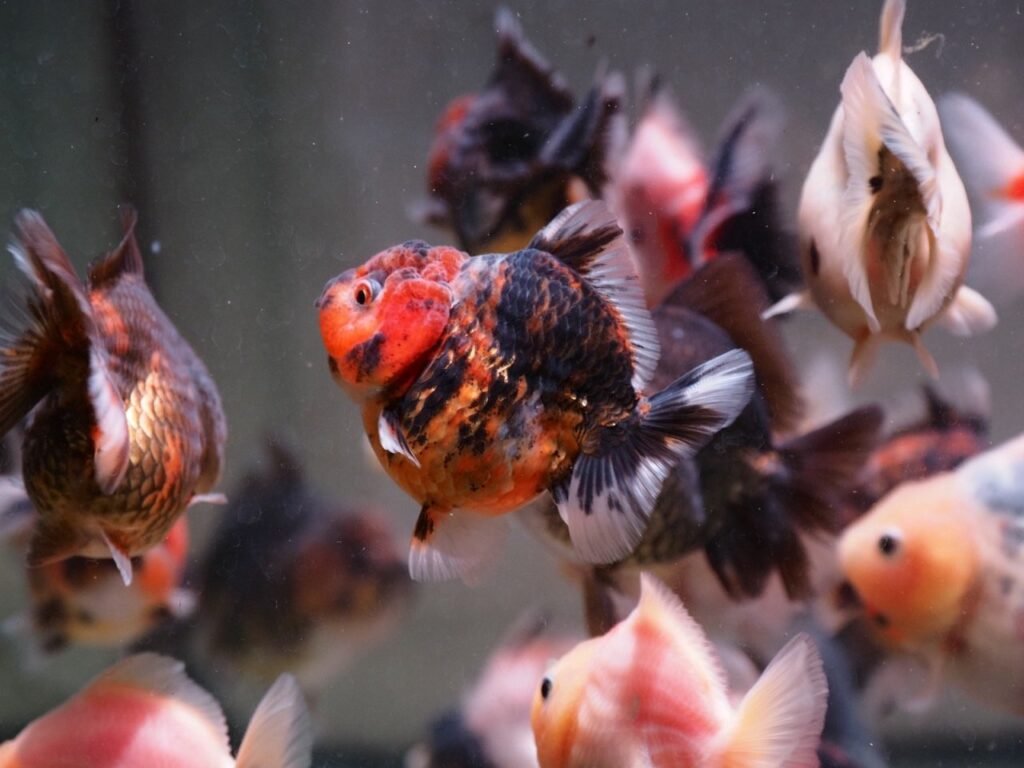
A comet, common, or shubunkin goldfish has the long, streamlined body of its wild carp ancestors, with a swim bladder shaped to match. A fancy goldfish — fantail, oranda, ryukin, ranchu, pearlscale — has been bred into a deep, egg-shaped body, and its internal organs, including the swim bladder and gut, are compressed into that round shape. The result is a fish that is mechanically prone to buoyancy problems. Dry food that swells in the stomach presses directly on the swim bladder, a constipated gut does the same, and the fish sinks or tips.
This changes your response in two ways. First, in a fancy goldfish that sinks after meals but is otherwise bright, think digestion before disease: fast the fish for 24 to 48 hours, then feed a single skinned, blanched pea, and switch the routine diet toward sinking pellets and pre-soaked food so less air and dry bulk is swallowed at the surface.
Second, tank size and depth matter differently. Fancies are weak swimmers and do better in long, moderately shallow tanks with gentle filtration, while single-tails are strong swimmers that need real length — a comet in a small tank is a water-quality problem waiting to happen. If you are checking whether your setup honestly fits your fish, our goldfish tank calculator works out suitable volumes for fancy and single-tail goldfish, and the fish tank volume calculator confirms your true water volume once gravel and décor have displaced their share.
What to Do in the First Hour
Test before you treat. Test ammonia, nitrite, nitrate, and pH with a liquid kit, and check the thermometer. Write the numbers down. Every decision below hangs on them, and “the water looked fine” has never once been a test result. The numbers answer why is my goldfish sitting at the bottom of the tank faster than any guess.
If ammonia or nitrite is above 0 ppm, change 30–50% of the water now with dechlorinated water matched within 1–2°F (about 1°C) of the tank. Retest the next day and repeat daily until both read zero. Our aquarium water change calculator converts those percentages into exact gallons and litres for your tank. Stop feeding for 24 hours — a hungry goldfish is in no danger, and every meal adds ammonia while the biofilter recovers. For context on fasting tolerance, see our guide to how long aquarium fish can go without food.
If tests are clean but the water is cold, raise the temperature slowly — no more than about 2°F (1°C) per hour — toward 68–72°F (20–22°C) with an aquarium heater, and move the tank away from drafts if you can. Never pour warm water straight in; a sudden swing is its own shock. A cold tank is a common answer to why is my goldfish sitting at the bottom of the tank in winter.
If tests are clean, temperature is fine, and the fish sinks rather than rests, run the swim bladder routine: fast 24–48 hours, feed a skinned pea, and review the diet for dry surface food. If the fish cannot right itself, lies on its side for days, or stops eating entirely, that is the point to seek an aquatic veterinarian rather than adding random medications. If the fish still sinks, the question of why is my goldfish sitting at the bottom of the tank is one for an aquatic vet.
If tests are clean and the fish simply rests more than it used to, watch for 48 hours with a short daily note — appetite, posture, breathing. Bottom-sitting that follows a water change often overlaps with the harmless haze explained in our guide to why a fish tank goes cloudy after a water change, and both usually settle together. What you are watching for is direction: improving day by day means stress; static or worsening means keep working through the causes above.
Frequently Asked Questions
Is it normal for a goldfish to sit on the bottom of the tank?
Yes, in short rests and especially at night, when goldfish sleep low over the substrate with relaxed fins and slow breathing. It is not normal when it lasts most of the day, the fins are clamped, breathing is fast, or the fish ignores food. A change from the fish’s usual pattern is the real warning sign, not the resting itself. In short, why is my goldfish sitting at the bottom of the tank has two answers: rest, or a problem the water tests will reveal.
How long can a goldfish stay at the bottom before I should worry?
A healthy goldfish may rest for hours overnight. Worry when daytime bottom-sitting passes roughly 24 hours, when the fish misses two feedings in a row, or immediately — at any hour — if you see rapid breathing, lying on one side, or red, inflamed gills. Test ammonia and nitrite first; at 0.25 ppm or above, do a 30–50% water change the same day. If you are still asking why is my goldfish sitting at the bottom of the tank after a full day of daytime resting, test the water first.
Can swim bladder disorder make a goldfish sink to the bottom?
Yes. If the swim bladder under-inflates or is pressed by a constipated gut, the goldfish cannot hold itself up and sinks, often struggling to the surface for food and sinking straight back. It is most common in egg-shaped fancy goldfish such as orandas and ranchus. Fasting for 24–48 hours followed by a skinned pea resolves the digestion-linked cases. That is why swim bladder trouble is a common answer to why is my goldfish sitting at the bottom of the tank in fancy goldfish.
What water temperature makes goldfish sluggish and bottom-bound?
Goldfish are comfortable at about 65–75°F (18–24°C). Below roughly 60°F (15.5°C) their metabolism and digestion slow sharply and fancy goldfish in particular become lethargic and sit on the bottom. Warm a cold tank gradually — about 2°F (1°C) per hour — never with a sudden pour of warm water. In winter, that is often the answer to why is my goldfish sitting at the bottom of the tank.
Should I move a bottom-sitting goldfish to a separate tank?
Not as a first step. Moving adds stress, and the most common causes — ammonia, nitrite, cold — live in the main tank’s water, so fix and test that water first. A hospital tank makes sense only when you see clear signs of contagious illness, such as white spots or a spreading film, or when tankmates are bullying the resting fish. Most keepers asking why is my goldfish sitting at the bottom of the tank find the cause in the main tank’s water, not in a hospital tank.