How Long to Wait to Walk a Dog After Eating? Timing Guide
Almost every owner has stood at the door, lead in hand, wondering how long to wait to walk a dog after eating — and whether the warning about bloat means the walk has to wait an hour, or whether that only applies to a run in the park. The confusion exists because “a walk” covers everything from a three-minute shuffle to the toilet and back, to forty minutes of fetch. Those two outings carry completely different risk, and they need completely different waiting times. This guide separates them properly.
Direct answer: A slow, on-lead toilet walk can happen straight after a meal — it is safe for almost every dog. Wait at least 30–60 minutes after eating before a brisk walk, and a full 1–2 hours before running, fetch, swimming or rough play. Large, deep-chested breeds such as Great Danes, German Shepherds and Standard Poodles should get the longer end of every range, in both directions: no vigorous exercise for about an hour before a big meal either.
Why Timing Around Meals Matters: Digestion and Bloat
Two separate things happen after a dog eats. The first is ordinary digestion. A meal triggers gastric acid secretion and a wave of gut movement; blood flow is directed toward the stomach and intestines. Vigorous exercise competes with that process and commonly produces the mild consequences owners recognise — grass-eating, lip-licking, vomiting up an undigested meal, or an urgent, loose stool mid-walk. Unpleasant, but not dangerous for most dogs.
The second is the serious one: gastric dilatation-volvulus, or GDV, commonly called bloat. In GDV the stomach fills with gas and food, dilates, and then twists on its axis (volvulus), trapping its contents and cutting off its own blood supply. Pressure builds, blood return to the heart falls, and the dog can progress from restless to critical within a couple of hours. GDV is a surgical emergency with a significant mortality rate even with treatment. The evidence linking exercise around meals to GDV is observational rather than experimental — no one has run a trial deliberately exercising dogs on full stomachs — but the mechanism is plausible (a full, heavy stomach suspended on its ligaments has more momentum to swing and rotate during running, jumping and rolling), and veterinary advice is consistent: keep a buffer of calm time on both sides of a large meal for at-risk dogs. For a full clinical description of GDV, its signs and its treatment, see the Merck Veterinary Manual on gastric dilatation-volvulus.
How Long to Wait to Walk a Dog After Eating, by Walk Intensity
The practical answer is a ladder, not a single number. Match the wait to what you are actually about to do.
Gentle toilet walk — no wait needed
A short, slow, on-lead outing purely so your dog can urinate and defecate is fine immediately after eating, and is in fact part of many dogs’ normal routine: eating stimulates the gastrocolic reflex, so a meal often makes a dog need to toilet within 10–30 minutes. Keep it to a few minutes, on the lead, at the dog’s pace, with no stairs sprinting, ball games or greeting-fuelled pulling. Puppies in particular should go out straight after meals — it is the cornerstone of house training.
Brisk walk — wait 30–60 minutes
A purposeful walk at a steady pace, hills included, is best left until at least half an hour after a normal meal, and closer to a full hour after a large one. This is the slot most daily walks fall into, and it is why “walk first, then feed” is the routine most trainers recommend: it removes the calculation entirely. Our dog walking calculator sets the daily walking target for your dog’s age, breed and weight — this article is about where in the day those minutes should sit relative to meals, not how many there should be.
Running, fetch, swimming and play — wait 1–2 hours
High-intensity activity — running, sprinting after a ball, wrestling with other dogs, agility, swimming — should wait at least an hour after any substantial meal, and up to two hours for large and deep-chested dogs or after an unusually big meal. The same buffer applies in reverse: let a dog cool down, stop panting heavily and settle for 30–60 minutes after hard exercise before feeding a main meal, rather than tipping dinner into a dog that is still hot and gulping air.
If you are planning the whole exercise day rather than a single walk, our dog exercise calculator breaks daily activity into sensible sessions you can place either side of feeding times.
Meal Size and Meal Pattern Change the Wait
A dog that eats two moderate meals a day has a smaller peak stomach volume than a dog fed one large meal, and one large daily meal is itself a recognised GDV risk factor in large breeds. Splitting the ration into two (or, for the highest-risk dogs, three) smaller meals shortens every waiting window in this article and reduces the amount of food and gas in the stomach at any one time. Our dog food calculator works out the daily amount to split.
Speed matters as much as size. Dogs that gulp — common in Labrador Retrievers, Beagles and multi-dog households where competition speeds eating — swallow air with their food (aerophagia), which adds gas to an already full stomach. Slow-feeder bowls, scattering kibble, or feeding dogs separately are simple, effective countermeasures. Feeding from a raised bowl, once recommended for large breeds, has been associated in studies with higher GDV risk and is now generally advised only where a vet recommends it for another condition, such as megaoesophagus.
Which Dogs Need the Strictest Timing?
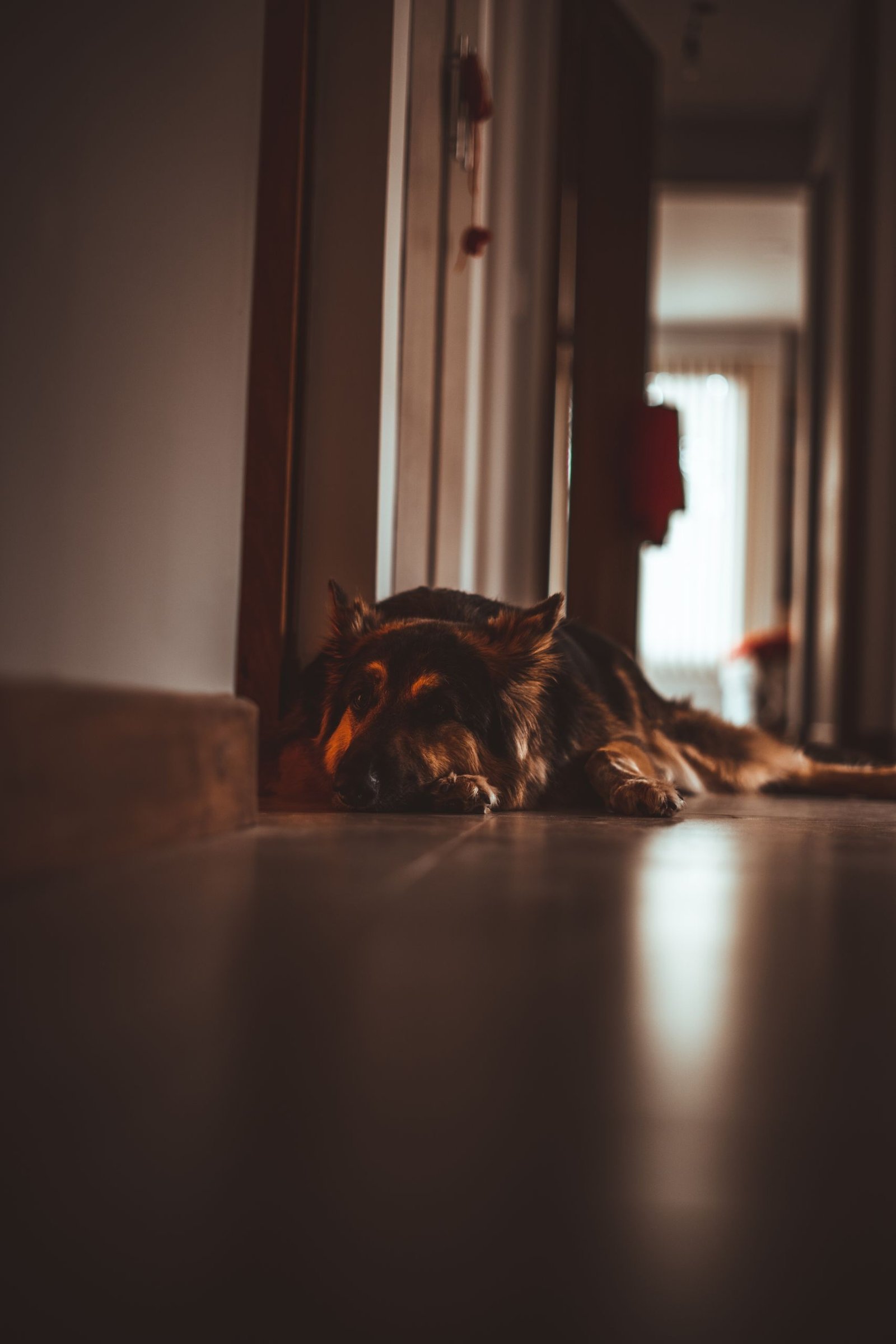
GDV risk is heavily concentrated by anatomy. The highest-risk breeds are large and giant dogs with deep, narrow chests: the Great Dane (the highest lifetime risk of any breed), German Shepherd Dog, Standard Poodle, Weimaraner, Gordon and Irish Setters, Boxer, Doberman Pinscher, Akita, Bloodhound and large mixed breeds of similar build. Risk also rises with age, with being lean or underweight for the breed, with having a first-degree relative (parent or sibling) that has had GDV, with a fearful or anxious temperament, and with eating one large meal quickly. Small and medium dogs — a Cavalier King Charles Spaniel, a French Bulldog, a Cocker Spaniel — can bloat, but it is uncommon, and for them the waiting times in this article are good digestion hygiene rather than a strict safety rule. Owners of high-risk breeds should also discuss prophylactic gastropexy (a preventive operation that tacks the stomach to the body wall, often done at neutering) with their vet; it is the single most effective preventive measure, far outweighing any exercise timing rule.
See your vet — urgently: Bloat signs are a same-hour emergency, not a wait-and-see: a swollen, tight, drum-like belly; retching or trying to vomit but bringing nothing up; drooling; restlessness, pacing and inability to settle; stretching in a “prayer” position; rapid panting or collapse. Go to the nearest emergency veterinary clinic immediately and phone ahead. GDV survival depends on how fast the stomach is decompressed and operated on.
A Daily Routine That Removes the Guesswork
For most households, the simplest safe pattern is: morning walk first, home, settle for 30 minutes, then breakfast; evening meal after the day’s main exercise, again with a short settle first; and a final gentle toilet stroll last thing at night, whenever it falls. That structure naturally places every vigorous session on a reasonably empty stomach and every meal in a calm window, without anyone watching a clock. On days when life does not cooperate — a late feed before a planned hike, visitors who throw balls — just downgrade the activity to match the meal: a full stomach gets a gentle walk, and the game of fetch moves to later.
Frequently Asked Questions
Can I walk my dog straight after eating at all?
Yes — a short, slow, on-lead toilet walk is fine straight after a meal for almost every dog, and puppies should be taken out after meals as part of house training. What needs a wait is brisk or vigorous exercise, not a gentle stroll.
How long to wait to walk a dog after eating before running or fetch?
At least 1 hour after a normal meal, and up to 2 hours for large, deep-chested breeds such as Great Danes, German Shepherds and Standard Poodles, or after a particularly large meal. Apply a similar 30–60 minute buffer between hard exercise and feeding.
Is it better to walk a dog before or after feeding?
Before, for the main walk. Walking first, letting the dog settle for around 30 minutes, then feeding removes any post-meal waiting problem and suits digestion. A gentle toilet walk after feeding is still fine whenever your dog needs one.
Does walking after eating actually cause bloat?
It has not been proven in controlled studies — the link between vigorous exercise around meals and GDV is observational — but a full, heavy stomach is mechanically more able to twist during running, jumping and rolling, and veterinary consensus is to keep a calm buffer around large meals for at-risk breeds. The buffer costs nothing and may matter a great deal.
My dog vomits if we walk too soon after food. Is that bloat?
Usually not. Vomiting up undigested food shortly after an over-soon walk is most often simple exercise-on-a-full-stomach nausea. Bloat looks different: retching without producing vomit, a visibly swollen tight abdomen, drooling and distress. That combination is an emergency — go to a vet immediately.
How long to wait to walk a dog after eating? For a family dog, the answer to how long to wait to walk a dog after eating is usually 30 to 60 minutes for a brisk walk and 1 to 2 hours for running or fetch. Ask your vet how long to wait to walk a dog after eating for your dog.
How long to wait to walk a dog after eating also depends on breed and meal size. A deep-chested dog should wait longer, so how long to wait to walk a dog after eating for a Great Dane is closer to two hours for vigorous exercise. If in doubt, ask your vet how long to wait to walk a dog after eating for your dog.