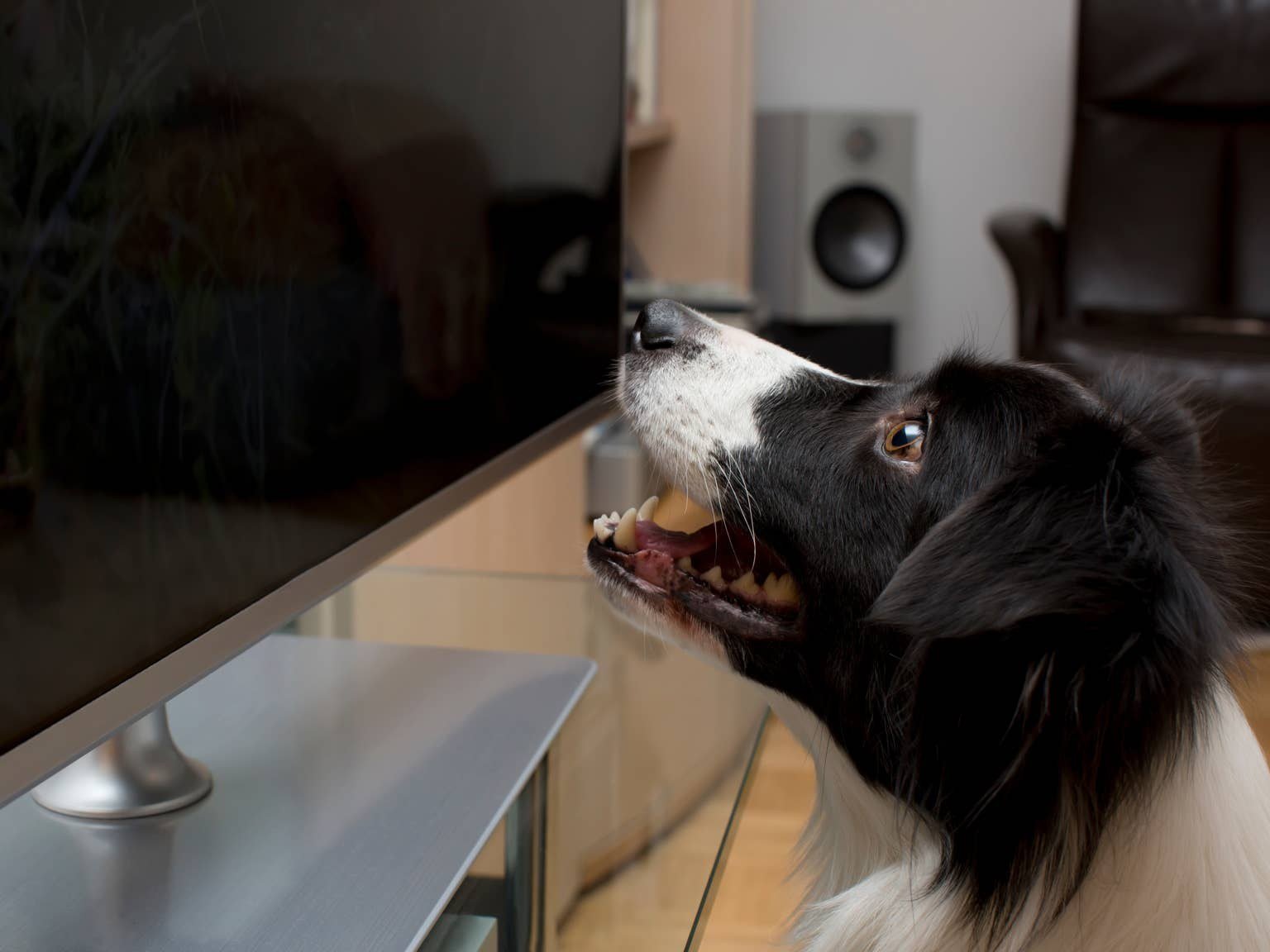
Why Does My Dog Bark at the TV? Explained
You are halfway through a nature documentary when a wolf appears on screen. Your dog leaps up, barks at the television, and stares at the wolf as if it might jump out of the wall. A minute later a doorbell rings on a drama, and your dog charges the TV again. If you have ever asked why does my dog bark at the tv, the short answer is simple. Your dog thinks the screen is real.
Dogs do not watch television the way we do. Their eyes work differently, their ears hear more, and they cannot smell what is on screen. A dog on TV looks and sounds like a real dog to them, and a doorbell on TV sounds exactly like someone at the door.
The good news is that TV barking is one of the easiest barking problems to fix. It is not stubbornness, and it is rarely a sign of a serious problem. Once you know which trigger sets your dog off, you can train calm behaviour with a simple plan. This guide explains how dogs see and hear television, the five triggers that cause most barking, and a step-by-step plan to get your evenings back.
Direct answer: Dogs bark at the TV because they see and hear real animals, doorbells, and sudden sounds on screen, and their brains treat those as real events in the room. Modern HD and 4K screens show smooth motion that dogs can follow, and dogs hear high-pitched sounds we barely notice. Barking is usually excitement, territorial alarm, or confusion, not aggression. It can be reduced with lower volume, a resting spot away from the screen, and short desensitisation training.
Some dogs never bark at the TV at all, and that is normal too. Breed, age, and personality all matter. Herding and sporting breeds react most, while scent-driven breeds often ignore the screen completely. If the barking is new, frantic, or comes with trembling and an inability to settle, talk to your vet or a qualified behaviour professional.
Why Does My Dog Bark at the TV? The Short Answer
Your dog barks at the TV because, as far as its brain is concerned, something real just happened in your living room. A dog appeared out of nowhere. A doorbell rang. An animal ran across the room. Your dog’s job, as it sees it, is to warn you about it.
The confusion is built into how dogs see the world. Dogs rely on sight, sound, and smell together to judge whether something is real. Television gives them the first two and none of the third. There is no smell coming from the screen, but the picture moves and the sound is convincing. For many dogs, that is enough. The screen is real enough to bark at, even if it is not real enough to bite.
Modern televisions have made the problem worse. Old tube TVs flickered at a rate dogs could see, so the picture looked choppy and unreal to them. Modern HD, 4K, and OLED screens refresh at 60, 120, or more cycles per second, which is fast enough for a dog’s eyes to read as smooth, real motion. The better your TV gets, the more real it looks to your dog. That is why so many owners notice the barking started after they upgraded their set.
Sound is the other half of the story. Dogs hear a wider and higher range of frequencies than people do. A doorbell, a dog bark, a squeaky toy, or a sudden loud noise in a soundtrack can sound urgent to a dog even when it sounds ordinary to you. The dog is not overreacting. It is hearing a different version of the same show.
What Your Dog Actually Sees on a Screen
Dogs see the world differently from us in three important ways. The first is colour. Humans have three types of colour-sensing cells in the retina. Dogs have two. They see blues and yellows well, but reds and greens look dull. A dog running across a blue sky will catch your dog’s eye. A red car on a green lawn probably will not.
The second is sharpness. A dog’s vision is roughly 20/75, compared to our 20/20. That means a dog needs to be much closer to the screen to see it as clearly as we do. It also explains why dogs often sit very close to the TV, or move towards it when something interesting appears. They are not being rude. They are trying to see.
The third is motion. Dogs are far more sensitive to movement than to still images. On a screen, a running animal or a fast car chase is far more interesting than a talking head. This is why nature documentaries and sports cause the most barking, and news programmes usually do not.
Research backs this up. A 2024 survey published in the journal Applied Animal Behaviour Science asked more than 1,200 dog owners about their dogs and screens. It found that 86 percent watched screen content, 78 percent approached the screen, and 76 percent vocalised, meaning they barked, whined, or howled. Animal content grabbed their attention most. A 2025 Auburn University survey found that dogs that watch TV do so for about 14 minutes on average, in short bursts.
Dogs also recognise what they see. In one study, nine pet dogs sorted photos of dog faces from faces of people and dozens of other species on a computer screen, whatever the breed. In another study, dogs reacted with surprise when a video of a dog was paired with the wrong sound, such as a frog croaking. They noticed the mismatch. Your dog is not staring at random light. It is reading the screen, and it knows a dog when it sees one.
What Your Dog Hears
Sound triggers more TV barking than pictures do. Many dogs bark at the TV without even looking at it. They are lying on the floor, a doorbell rings in a drama, and they are up and barking before the scene changes. The sound alone is enough.
The biggest sound triggers are doorbells, knocks, and dogs barking. A doorbell on TV sounds exactly like your doorbell, because it often is the same recording. Your dog has spent its whole life learning that a doorbell means someone is at the door. The same is true of a dog barking on screen. To your dog, that is a strange dog in its territory, and barking back is the natural reply.
High-pitched sounds are another trigger. Squeaky toys, babies crying, and birds calling all sit in a frequency range dogs hear very clearly. A sound that is background noise to you can be a sharp alarm to your dog. Sudden changes in volume matter too. Advert breaks are often louder than the programme, and a sudden blast of music can startle a dog into barking.
The 5 Triggers That Set Dogs Off
Not every dog barks at the TV for the same reason, and matching the fix to the cause is the whole game. Here are the five triggers that cause most TV barking.
1. Animals on screen
Dogs, cats, horses, birds, and wildlife moving across the screen are the most common trigger. Your dog sees a real animal and reacts the way it would to a real animal: barking, chasing, or trying to find it. This is the trigger most owners notice first, and it is the hardest to avoid, because animals appear in adverts, documentaries, and dramas alike.
2. Doorbells and knocks
Doorbell and knock sounds on TV are a special problem because they are designed to sound real. Your dog has been trained by real life to treat that sound as an alarm. When it hears the same sound from the TV, it responds the same way. Dogs that are already door-reactive in real life are the worst affected, because the TV version pulls the same emotional lever.
3. Sudden loud noises
Explosions, gunshots, shouting, sirens, and sudden music stings can startle a dog into barking. A dog that is relaxed and half asleep is more likely to bark at a sudden noise than a dog that is already alert. Action films and thrillers are the worst offenders.
4. Excitement and overstimulation
Fast motion, flashing light, and animal sounds together can overwhelm a sensitive dog. The barking is not a warning. It is overflow. The dog is too excited to stay quiet, and the bark is the excitement leaking out. It is the same overflow you see in the post-poop zoomies, and puppies and high-energy breeds are most prone to it.
5. Attention and learned habit
Sometimes barking at the TV works. Your dog barks, you look over, you talk to the dog, you get up, or you turn the TV down. All of that is attention, and attention is a reward. Dogs that learn that barking at the TV gets a reaction will bark at the TV more. Even an annoyed “quiet” counts. The habit can also be self-reinforcing: every time the dog barks and the scene changes, the bark seems to have worked, so the dog barks harder next time.
Why Some Dogs Bark and Others Ignore the TV
If you have two dogs and only one barks at the TV, you are not imagining it. Breed, age, and personality all shape the reaction, and the differences are large.
Breed is the biggest factor. Herding breeds such as Border Collies and Australian Shepherds are visually focused and bred to watch and chase moving things. Sporting breeds such as Labrador Retrievers and Spaniels are also likely to react. Terriers, bred to notice small fast movements, often bark at animals on screen. Scent hounds such as Beagles and Bloodhounds, which live by their noses, often ignore the TV completely, because a picture with no smell is not very interesting to them.
Personality and past experience fill in the rest. A confident, well-socialised dog may watch a dog on TV with mild interest and then look away. An anxious dog, or a dog that is already reactive to real dogs or doorbells, will often generalise that reaction to the screen. Dogs that have been rewarded for barking, even accidentally, will bark more.
None of this is a flaw in your dog. It is a normal range of dog behaviour, and it tells you something useful about your dog’s temperament. A dog that ignores the TV is not smarter than a dog that barks at it. It is simply less visually driven, or less anxious, or more used to screens.
The Trigger-Type Triage Table
Work out which type of TV barker your dog is, and the fix becomes obvious. Most dogs fit one row clearly. Some fit two, in which case start with the one that happens most often.
| Barker type | What it looks like | Main trigger | First fix |
|---|---|---|---|
| Sound barker | Barks without looking at the screen | Doorbells, knocks, barking, high sounds | Lower the volume, mute adverts |
| Movement watcher | Stares, stalks, jumps at the screen | Animals running, fast motion | Move the bed away from the TV, block the view |
| Advert barker | Quiet during shows, barks at adverts | Loud jingles, sudden volume jumps | Record shows, skip adverts, lower volume |
| Excitement barker | Barks, spins, cannot settle during action scenes | Fast motion plus loud sound together | Give a chew on a mat before the show |
| Fearful barker | Barks with tucked tail, trembling, hiding after | Thunder, shouting, scary scenes | Turn it off, comfort the dog, talk to your vet |
| Attention barker | Barks, then looks at you for a reaction | Anything that has worked before | Ignore the bark, reward quiet calmly |

A Calm Plan to Stop TV Barking
You do not need to stop watching television, and you do not need to punish your dog. The plan below works for most dogs in two to three weeks, and it is built on one idea: teach your dog that the TV is boring, and that being calm during TV time is rewarding.
Start with the easy wins. Lower the volume, especially during adverts. Move your dog’s bed to a spot where it cannot see the screen directly. Give your dog a long-lasting chew or a stuffed Kong on its mat before you sit down to watch. A dog with a full mouth cannot bark, and a dog that is busy chewing is learning to settle during TV time.
Next, teach a “place” or “settle” command. Put a mat or bed in the room, and reward your dog for lying on it calmly. Start with short sessions when the TV is off. Then turn the TV on at low volume and reward calm lying. The goal is a dog that hears the TV and chooses its mat.
Then work on the specific trigger. If your dog barks at doorbells on TV, find a recording of a doorbell sound and play it at very low volume while your dog is relaxed. Reward calm behaviour, and raise the volume a little at a time over several days. This is called desensitisation: the dog learns the sound predicts nothing bad. Keep sessions to five minutes, and stop while your dog is still calm.
Manage the moments you cannot train yet. When a trigger comes on screen and your dog starts to bark, do not shout. Shouting sounds like barking to a dog, and it joins in. Instead, calmly block the view, lead the dog to its mat, and wait for a moment of quiet before rewarding it.
Be consistent. Everyone in the house needs to follow the same plan. If one person laughs at the barking and another tries to train it away, the dog gets mixed messages and the habit survives. Give the plan at least two weeks before judging it.
TV Setup Changes That Help
Small changes to your setup can make a big difference, and they cost nothing. The first is volume. Most TV barking is sound-triggered, and a lower volume means a less urgent alarm. Turn the volume down a notch from your usual level, and use subtitles if you need to. Your dog will notice the difference even if you barely do.
The second is distance and angle. Dogs that sit close to the TV see more detail and react more. Move your dog’s bed further from the screen, or angle it so the dog cannot see the TV without turning around. A dog that has to work to watch the TV will usually choose to rest instead.
The third is light. A bright screen in a dark room is more dramatic and more startling. A small lamp on in the room softens the contrast and makes sudden flashes less alarming. It also helps you see your dog’s body language, which is the early warning sign that barking is about to start.
When Barking at the TV Means Something More
Most TV barking is a normal, fixable habit. A small number of cases point to something deeper, and it is worth knowing the difference. The key question is how your dog looks and feels while it is barking.
A dog that barks with a loose, wiggly body, a wagging tail, and bright eyes is excited. A dog that barks with a stiff body, tucked tail, and pinned ears is frightened. Fearful barking needs a different approach. The dog is scared, and it needs distance from the trigger, not training to tolerate it. Turn the TV off and talk to your vet or a qualified behaviour professional.
Barking that is getting worse is also a warning sign. If your dog used to ignore the TV and now barks at every show, or if the barking is spreading to the window or the door, the dog’s overall anxiety may be rising. This can happen after a house move, a new baby, or a change in routine.
Lunging, snapping, or aggression at the TV is a clear line. A dog that lunges at the screen, tries to bite it, or redirects its frustration onto a person or another pet in the room needs professional help. Do not try to train this away on your own. A veterinary behaviourist can work out whether the cause is fear, frustration, or a compulsive pattern, and can make a plan that is safe for everyone.
Night-time barking deserves a mention too. Some dogs bark at the TV in the evening and then carry on barking at sounds in the night. Our guide on why dogs bark at nothing at night covers that side of the problem, and our dog sleep calculator can help you check whether your dog is getting the rest it needs.
The American Kennel Club’s guide to understanding and stopping barking makes the same point this guide does: barking is communication, and the first step is always to work out what the dog is trying to say. National Geographic’s look at why dogs watch and react to TV explains the vision science behind it, including the 2013 Animal Cognition study that showed dogs can recognise other dogs on screen by sight alone.
Frequently Asked Questions
Should I leave the TV on for my dog when I go out?
It depends on your dog. For some dogs, a calm television or radio left on quietly is comforting, because it masks outside noises and makes the house feel less empty. The American Kennel Club suggests familiar household sounds can help some dogs settle when their owners are away.
For other dogs, especially TV barkers, leaving the TV on is a bad idea. It gives them hours of triggers with no one there to manage them, and the barking can become a habit that is much harder to break. If your dog barks at the TV when you are home, do not leave it on when you leave. A radio set to a calm talk station at low volume is a safer choice.
What TV shows do dogs like best?
Research and owner surveys agree: dogs like shows with animals, especially other dogs, and fast-moving nature scenes. Wildlife documentaries, dog shows, and sports are the most popular. Dogs also respond to programmes made for them, such as DogTV, a channel designed with dog colour vision and frame rates in mind. Most dogs watch in short bursts of a few minutes, not whole programmes. If your dog watches calmly, that is fine. If it barks, the show is too exciting for now.
Why does my dog look behind the TV?
Your dog is looking for the animal it just saw disappear. When a dog runs across the screen and vanishes at the edge, your dog’s brain expects it to appear somewhere nearby, usually behind the TV. This is normal and a sign that your dog recognises the animal as real. Puppies do it most, and most dogs stop as they learn that TV animals never come out the other side. If your dog keeps checking behind the TV, the show is too exciting.
Why does my dog only bark at certain shows?
Because only certain shows contain your dog’s triggers. A dog that barks at doorbells will only bark at shows with doorbells. Adverts are a special case: they are louder, faster, and full of animals and sudden changes, so many dogs that ignore dramas will bark at every advert break. Pay attention to what is on screen in the seconds before the bark. That is your dog’s trigger, and it tells you exactly what to train.
Can watching TV hurt my dog’s eyes?
There is no evidence that normal television watching damages a dog’s eyes. Dogs watch in short bursts and look away often. The one thing to watch is distance: a dog that presses its nose against the screen is over-focused and over-excited. Move the bed back and give the dog a chew instead. If your dog’s eyes look red or cloudy, or it is pawing at its face, that is a health issue, not a TV issue, and it needs a vet visit.
Barking at the TV is your dog doing its job as it understands it. The screen shows a dog, a doorbell rings, an animal runs, and your dog warns you about it. The barking is not defiance and it is not a flaw. Once you know your dog’s trigger type, the fix is straightforward: lower the volume, move the bed, give the dog something to chew, and train calm behaviour a few minutes at a time. Most dogs improve within a few weeks.