Why Does My Dog Run After Pooping? Zoomies Explained
Your dog finishes pooping, and suddenly he is a different animal. He tucks his back end down, flattens his ears, and tears around the garden in wide circles like he has just won a race. Thirty seconds later he stops, shakes himself, and looks at you as if nothing happened. If you have ever asked why does my dog run after pooping, you have watched one of the funniest and most normal behaviours in the dog world.
Dog owners call it the zoomies. Vets call it a frenetic random activity period, or FRAP for short. It happens after pooping more than at almost any other time, and there are good reasons for that. The run is part relief, part biology, and part message — and it is almost always a sign of a happy, healthy dog.
Direct answer: Dogs run after pooping because of the zoomies, known to vets as frenetic random activity periods (FRAPs). Passing a stool stimulates the vagus nerve, which drops the heart rate and creates a wave of physical relief that feels good. The run also releases pent-up energy, spreads scent around the area, and celebrates the freedom of an empty bowel.
It is normal and healthy, especially in puppies and young dogs. See a vet only if the running comes with pain, scooting, blood in the stool, or frantic behaviour that never settles.
Why Does My Dog Run After Pooping? The Short Answer
Your dog runs after pooping because pooping feels good, and running is how a dog celebrates a good feeling. The act of passing a stool relieves pressure in the bowel, stimulates a major nerve, and triggers a small rush of feel-good chemicals. The result is a burst of energy that has to go somewhere, and for a dog, that somewhere is a flat-out sprint around the garden.
The run also has a practical side. A dog that has just pooped has left a strong scent mark, and running in circles around the area spreads that scent further. Wild canids would move away from their waste quickly to avoid attracting predators, and the sprint may be a leftover of that old habit. Whatever the mix of causes, the pattern is the same: poop, pause, sprint, flop.
It helps to know that the zoomies are not random. They follow a pattern, they end on their own, and they happen most in dogs that are otherwise happy and full of energy. A dog that zooms after pooping is usually a dog that is enjoying life.
What Are the Zoomies (FRAPs)?
The zoomies have a proper scientific name: frenetic random activity periods, shortened to FRAPs. The name describes exactly what you see. Frenetic means wild and fast. Random means the running has no clear direction or purpose. Activity period means it is a short burst, not a lasting state.
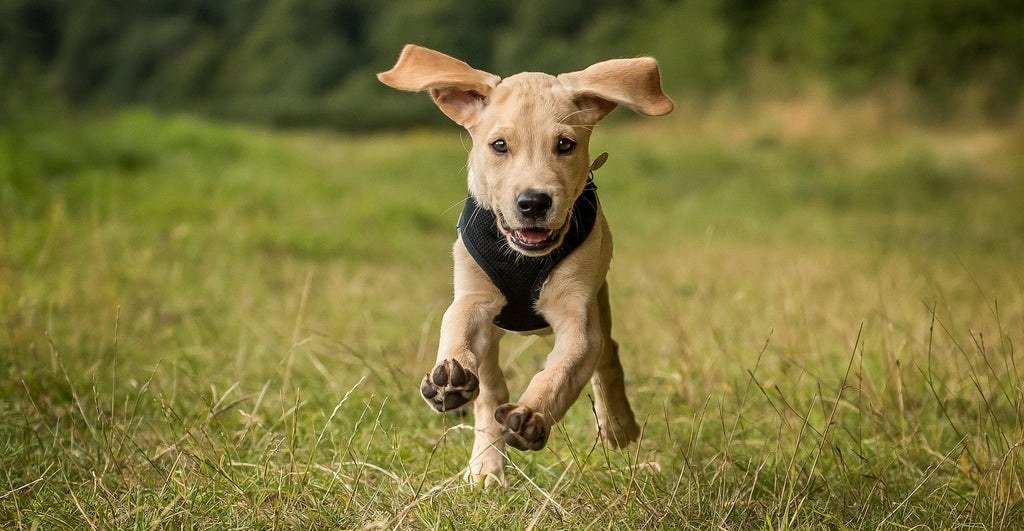
A typical zoomie episode looks like this. The dog suddenly drops into a play bow or tucks its rear end low, then takes off at full speed. The run is usually in circles or figure-eights, often around furniture, trees, or the edges of a room. The dog’s ears flatten back, the tail may tuck, and the eyes go wide and bright. The whole thing lasts from thirty seconds to a few minutes, and then it stops as suddenly as it started.
The dog may flop down panting, or simply carry on as if nothing happened.
Cornell University’s Riney Canine Health Center explains that there is no single known cause of FRAPs, but that they appear to be a way to release pent-up energy or to relieve stress. A dog that has been resting, confined, or under-stimulated for a while may feel the need to zoom to let the pressure out. Cornell also notes that FRAPs are most common in puppies and young dogs, but that dogs of all ages get them from time to time.
You can read their clear overview in Cornell’s guide to the zoomies.
Zoomies are not a sign of madness, and they are not a behaviour problem. They are a normal, healthy part of being a dog, and they are usually a sign that the dog feels safe enough to let loose. A frightened or unwell dog rarely zooms.
The Vagus Nerve and the Wave of Relief
The most interesting reason for the post-poop sprint sits inside your dog’s body. It involves a nerve called the vagus nerve, which runs from the brain all the way down to the abdomen. It is the longest nerve in the body, and it connects the brain to the gut, the heart, and the lungs.
When a dog passes a stool, the muscles of the bowel contract and the vagus nerve is stimulated. That stimulation slows the heart rate slightly and lowers blood pressure for a moment.
The effect is a wave of physical relief, a little like the feeling you get after a long sneeze or a deep stretch. Some people describe it as a small rush of calm and lightness. For a dog, that rush of relief feels so good that it spills over into movement.
There is also a chemical side to the story. Physical relief and excitement trigger the release of dopamine, a brain chemical linked to pleasure and reward. The zoomie sprint may be the dog’s way of riding that small dopamine wave. The dog is not thinking about it. The body feels good, the brain lights up, and the legs take over.
This also explains why the run happens after pooping and not before. Before pooping, the dog is focused and a little uncomfortable. The bowel is full, the dog is looking for the right spot, and the body is holding tension. After the stool passes, the tension is gone in a second. The contrast between holding it in and letting it go is what creates the burst.
Dogs that have been holding a poop for a long time — after a night indoors, or after a long car journey — tend to zoom hardest, because the relief is biggest.
Scent Marking: The Victory Lap Has a Message
Relief is not the whole story. The post-poop run also does a job, and that job is scent marking. A dog’s poop carries a strong scent, and that scent tells other dogs who was there. But a poop in one spot is a quiet message. A dog that runs in circles around the spot, kicking up grass and dirt as it goes, spreads the message over a much wider area.
The kicking matters here too. As the dog sprints, its back paws tear up the ground and scatter scent from the paws themselves. Dogs have scent glands between their toes, and the kicked-up earth carries those pheromones along with the smell of the stool. The result is a marked patch of ground that other dogs can read from a distance.
In a park where many dogs walk, that marked patch is a claim: this is my route, I was here, and I am healthy enough to run.
There is also an older, wilder reason. In the wild, a canid that has just defecated has left a strong smell that predators can follow. Moving away from the waste quickly, and spreading scent as it goes, makes the animal harder to track. Domestic dogs no longer need to worry about predators, but the instinct to move fast after toileting has survived.
That is why the run often takes the dog away from the poop, in a wide arc, rather than back towards the house.
Some dogs also run because they have learned that pooping earns a reward. Puppies in toilet training are praised and treated for pooping outside, and some carry the excitement of that reward into adulthood. The run becomes part of the celebration: I did the thing, now I get to run. That is not a problem. It is a dog that has learned that toileting outside is a good thing.
Why Puppies and Young Dogs Do It Most
If you have a puppy, you have probably seen the post-poop zoomies more than anyone else. Puppies zoom after pooping more often, more wildly, and for longer than adult dogs. There are three reasons for that.
The first is energy. Puppies have enormous amounts of energy and very little ability to hold it in. An adult dog can feel the post-poop relief and simply walk on. A puppy feels the same relief and has to run, because running is what puppies do with every feeling. Everything in a puppy’s life is bigger: the joy, the excitement, and the sprint.
The second is learning. A puppy is still learning how its body works. The first few times it feels the vagus nerve wave after pooping, the sensation is new and startling, and the response is dramatic. As the dog grows older, the feeling becomes familiar, and the response calms down. Most dogs zoom less as they age, and many stop doing it after pooping altogether by the time they are three or four years old.
The third is routine. Puppies poop more often than adult dogs — after every meal, after every nap, after every play session. More poops mean more chances to zoom. A puppy that poops five times a day has five chances to sprint. An adult that poops twice has two. The maths alone explains much of the difference.
Senior dogs rarely zoom after pooping. Stiff joints, sore hips, and lower energy make a flat-out sprint less appealing, and the relief wave is the same but the response is gentler. A senior dog that suddenly starts zooming frantically after pooping, when it never did before, is worth a vet check, because a sudden change in an old dog can signal pain or discomfort rather than joy.
When the Post-Poop Sprint Is a Warning Sign
The post-poop zoomies are normal in almost every case. There are a few exceptions, and they are worth knowing, because they are the difference between a funny habit and a vet visit. The key is to watch what comes with the running, not just the running itself.
A healthy zoomie ends on its own within a few minutes, and the dog settles calmly afterwards. The dog’s body is loose and bouncy, the ears are back but the face is relaxed, and the dog can be called or distracted easily. That is joy. A worrying sprint looks different: the dog is tense, the tail is tucked hard, the eyes are wide and staring, and the dog cannot settle even after the running stops.
Pain is the main thing to rule out. A dog that yelps during or after pooping, strains for a long time, or runs while scooting its bottom along the ground may have sore anal glands, constipation, or worms.
A dog that runs to the same spot and strains again and again may be constipated. Blood in the stool, mucus, or diarrhoea alongside the running always earns a vet visit. These are not zoomies. They are a dog trying to tell you that pooping hurts.
Panting that will not settle after the run is another sign to watch. Our guide on why dogs pant at night explains the resting breathing-rate check and the red flags.
| What you see | What it usually means | First step |
|---|---|---|
| A short sprint in circles right after pooping, then a calm flop | Normal post-poop zoomies | None — enjoy it |
| Zoomies after every poop in a puppy or young dog | Normal, high energy | None — it fades with age |
| Running plus scooting the bottom on the ground | Sore anal glands or worms | Vet check, do not squeeze glands at home |
| Running plus straining, yelping, or passing no stool | Constipation or pain | Vet visit promptly |
| Running plus blood or mucus in the stool | Gut infection or parasites | Vet visit, bring a stool sample |
| Frantic running that never settles, with a tense body | Pain, fear, or anxiety | Vet visit, note when it started |
| Sudden zoomies in a senior dog that never zoomed before | Pain or a sudden change | Vet visit, mention the change |
How to Handle the Dash Safely
The best response to a post-poop zoomie is usually to stand back and let it happen. The dog is happy, the burst is short, and trying to stop it mid-sprint can cause an accident. A dog that is grabbed or shouted at while running at full speed can twist, slip, or crash into furniture. Let the run finish, then carry on with the walk.
If the zoomies come with barking at night, that is a separate behaviour with its own triggers. Our guide on why dogs bark at nothing at night explains what dogs hear and smell after dark.
Safety is about the space, not the dog. Zoomies are safest on grass or carpet, where the dog has grip. They are dangerous on slippery floors, wet tiles, and polished wood, where a dog at full speed can slide and injure a leg. They are dangerous near stairs, roads, and sharp furniture corners. If your dog zooms indoors, clear a path: move shoes, close doors to staircases, and keep the dog away from the kitchen while the run lasts.
On walks, the same rules apply. Let the dog zoom in a fenced garden or an open field, not next to a road or in a crowded park. A zooming dog has no attention to spare for traffic, other dogs, or small children, and a collision can hurt everyone involved. Keep the lead loose enough for the dog to run in a safe area, and clip it back on before you reach the road.
You can reduce the intensity of the zoomies without stopping them. A dog that gets enough exercise every day zooms less frantically, because the energy is spent gradually rather than all at once. Check your dog’s daily needs with our dog exercise calculator and our dog walking calculator, and give the dog a longer sniffy walk or a game of fetch before the evening poop.
A tired dog still zooms, but the sprint is shorter and calmer. Diet plays a part too: a dog that is fed the right amount for its size and age has regular, comfortable stools, and comfortable stools mean calmer post-poop behaviour. Our dog food calculator gives a portion guide by weight, age, and activity level.
Never punish the zoomies. They are not disobedience, and punishment teaches the dog that the happiest moment of its day earns a scolding. If the zoomies happen at a bad time — during a walk, in a small flat, or around a toddler — manage the space instead. Move the poop spot to a safer area, walk at quieter times, and give the dog a garden or field where the sprint is welcome.
See your vet: Post-poop zoomies are normal on their own. Book a vet visit if the running comes with scooting, straining, yelping, blood or mucus in the stool, or diarrhoea, or if a calm dog suddenly starts running frantically after every poop. A dog that strains to poop and passes nothing, or that collapses or cannot settle after running, needs prompt veterinary care.
Frequently Asked Questions
Why does my dog run around before pooping?
Dogs often run in circles before pooping because they are looking for the right spot. The circling helps them check the ground, find a comfortable position, and align their body with the earth’s magnetic field — a behaviour researchers have actually measured in dogs. The pre-poop run is also about comfort and safety: the dog is finding a place where it feels safe to be briefly vulnerable. It is a different behaviour from the post-poop zoomies, and it has a different cause. One is preparation, the other is celebration.
Why does my dog run away while pooping?
A dog that runs away while it is still pooping is usually impatient, not frightened. It wants to get to the running part and cannot wait for the pooping part to finish. This is common in puppies and in dogs that are very excited by the walk. It can also happen if the dog is uncomfortable: long fur around the back end, a sore bottom, or a stool that is hard to pass can all make a dog want to move while it goes.
If the running-while-pooping comes with yelping, straining, or blood, it is a vet visit rather than a quirk. Otherwise, it is a puppy being a puppy, and it usually settles as the dog matures.
Do all dogs get the zoomies after pooping?
No, not all dogs do it. Some dogs poop, walk away calmly, and never run a step. Others zoom after every single poop. Both are normal. Whether a dog zooms depends on age, energy level, breed, and personality. High-energy breeds such as Border Collies, Jack Russell Terriers, and Labrador Retrievers zoom more than calm breeds such as Greyhounds and Basset Hounds. Puppies zoom more than adults, and adults zoom more than seniors. A dog that never zooms is not missing anything. A dog that zooms every time is not doing anything wrong.
Why does my dog get the zoomies after a bath too?
The post-bath zoomies have a similar cause to the post-poop zoomies: relief and release. A bath is stressful for many dogs, and the moment the towel comes off, the dog feels a wave of freedom. The dog also wants to dry off and get its own scent back, because shampoo strips the natural smell from the coat. Rolling on the carpet, rubbing against furniture, and sprinting around the house all help the dog feel like itself again.
Like the post-poop sprint, the post-bath zoomie is normal, short-lived, and best managed by giving the dog a safe space to run it out.