Why Does My Dog Kick After Peeing? Explained
You watch your dog finish peeing on the lawn. Then the back legs start flying. Grass, dirt, and the odd dandelion shoot into the air behind him, and he trots off looking pleased with himself. If you have ever asked why does my dog kick after peeing, you are not alone. It is one of the most common questions dog owners ask, and the answer is more interesting than it looks.
Most people guess their dog is trying to bury the pee, the way a cat covers waste in a litter box. That guess is wrong. Your dog is doing the opposite. He is spreading the scent further, not hiding it. The kick is a message, written in smell, for every dog that passes that spot later.
Direct answer: Dogs kick after peeing to spread and strengthen their scent mark. Glands between their toes release pheromones, and the kicking motion scatters urine scent over a wider patch of ground and lifts some of it into the air. The scuffed earth also leaves a visual mark other dogs can see.
It is normal, instinctive behaviour, seen in wolves and wild canids as well as pet dogs. It only needs a vet visit if the kicking is new and frantic, comes with limping or paw pain, or comes with straining, frequent peeing, or blood in the urine.
Why Does My Dog Kick After Peeing? The Short Answer
Your dog kicks after peeing because urine alone is a quiet message, and kicking makes it louder. The pee carries your dog’s scent, but it sits in one small wet patch. A few hard kicks spread that scent across a much bigger area. The motion also throws tiny drops of urine and scent onto grass blades, where the smell travels further on the breeze.
The kick adds a second message on top of the first. Dogs have scent glands in their paws, between the toes and in the pads. When the paws scrape the ground, they leave pheromones from those glands behind. So the finished mark carries two scents at once: the urine and the paw scent. Other dogs read both, and the combination tells them more than either one alone.
This is why the kicking looks so enthusiastic. It is not random excitement. It is a deliberate piece of dog communication, and it is over in seconds. A normal kick lasts a few seconds, happens right after the dog finishes peeing, and ends with the dog walking away calmly.
The Paw Glands Behind the Kick
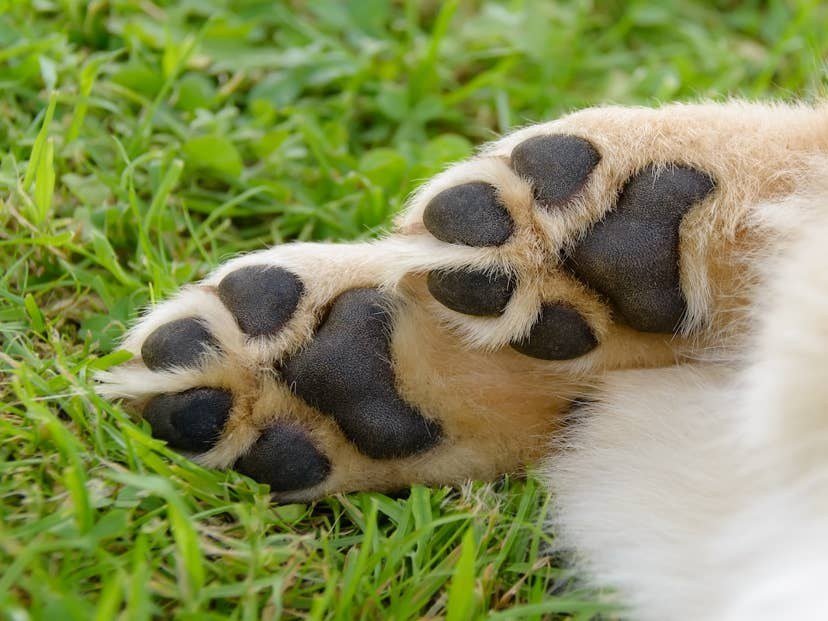
The key to the whole behaviour sits between your dog’s toes. Dogs have small scent glands in the skin between their toes and in their paw pads. These are called interdigital glands, and they make pheromones — chemical signals that other dogs can smell and read. Every dog’s paw scent is different, a little like a fingerprint.
When your dog kicks, the paws press hard into the ground and scrape backwards. That scraping does three things at once. It deposits paw pheromones onto the soil and grass. It tears up the surface, which releases the smell of the earth itself. And it spreads the urine over a wider area than the original wet patch.
Urine is already rich in information. It tells another dog the sex of the dog that left it, whether that dog is intact or neutered, roughly how long ago it passed by, and something about its identity. The paw scent adds a second layer of information that lasts longer in the ground than urine does. Urine dries and fades. A scuffed patch of earth, carrying paw scent pressed into the soil, can last for days.
That is why dogs kick hardest on soft ground. Grass, loose soil, leaf litter, and damp earth all take a scent well and show the scuff clearly. On concrete or pavement, there is nothing to tear up and little scent to leave behind, so most dogs kick less or skip it entirely. The surface decides how much kicking is worth doing.
What Your Dog Is Actually Saying
A kick after peeing is not one message. It is a small bundle of messages, and other dogs read them the way we read a notice board. The first message is identity. The combined scent of urine and paw pheromones says, in effect, “I was here.” Dogs that walk the same route every day build a map of these messages, and they update it constantly.
The second message is timing. Fresh scent tells a passing dog that another dog was here recently. Old scent says the dog passed by long ago. By kicking scent up onto grass blades, your dog makes the message easier to find and harder to miss. It is the difference between whispering and speaking up.
The third message is a reply. Dogs kick hardest when they find another dog’s fresh mark. This is called counter-marking or over-marking. Your dog smells a stranger’s pee, pees on or near the same spot, and then kicks hard to lay his own scent over the top. It is not aggression. It is conversation.
In a busy park, where dozens of dogs mark the same trees and lamp posts, the kicking gets more dramatic because the competition for the message board is higher.
The fourth message is confidence. A relaxed, confident dog kicks freely. An anxious dog in a new place may kick harder than usual, as if to say “I belong here too.” A frightened dog may not kick at all. The kick is a small window into how your dog feels about the ground he is standing on.
Why Some Dogs Kick Hard and Others Never Kick
Not every dog kicks, and among the dogs that do, the energy varies wildly. Some dogs give two polite scrapes and move on. Others turn into a small rototiller, sending turf flying for several seconds. Both are normal. The difference comes down to a handful of factors.
Hormones play a big part. Intact dogs — dogs that have not been spayed or neutered — tend to kick more often and more forcefully than neutered dogs. Their marking drive is stronger because their reproductive hormones are higher. Neutering usually reduces the intensity, though it rarely removes the behaviour entirely, because the instinct is older than the hormones.
Place matters just as much. A dog on his home turf, where his scent is already everywhere, may barely bother. The same dog in a new park, full of strange smells, may kick like he is digging for treasure. New ground needs new messages. The same logic explains why dogs kick more on walks than in their own garden. The garden is already signed. The street is not.
The ground itself is the third factor. Soft, damp grass invites a big kick. Dry concrete does not. Dogs learn this quickly, and they adjust without thinking. A dog that kicks hard on grass and not at all on pavement is not being inconsistent. He is being practical.
Age changes the picture too. Older dogs often kick less than they used to. Stiff joints, sore hips, and arthritis make the hard backward scrape uncomfortable, so the dog tones it down or stops. A senior dog that used to kick with enthusiasm and now does not may simply be sore, and that is worth mentioning at a vet visit.
Stomach trouble shows up in other ways too. Dogs with nausea often lick floors and smack their lips, as explained in our guide on why dogs lick the floor.
The Difference Between Kicking and Scratching an Itch
Dog owners sometimes confuse two different kicks. One is the kick after peeing, which is a scent-marking behaviour. The other is the leg kick you see when you scratch your dog’s belly in just the right spot. That second kick is a scratch reflex, and it works completely differently.
The scratch reflex is automatic, like a knee jerk at the doctor’s office. Nerves under the skin send a signal to the spinal cord, and the spinal cord sends a signal straight back to the leg muscles. The brain is barely involved. Your dog is not choosing to kick. His leg is responding to a tickle on its own.
The kick after peeing is a chosen behaviour, even if the choice is instinctive. The dog decides to do it, aims the legs, and controls the force. The two kicks look similar from a distance, but the context gives them away. The scratch reflex happens while you are touching the dog. The marking kick happens after peeing, on the ground, with no one touching the dog at all.
There is one more kick worth knowing about. Some dogs kick the ground after pooping as well as after peeing. The reason is the same: scent marking. The poop carries scent, the paws add pheromones, and the kicked-up earth spreads both. Dogs that kick after one usually kick after the other, and the same rules about normal and worrying apply to both.
The Kick Test: Normal Kicking vs. a Problem
Most kicking is harmless. A simple check tells you whether your dog’s kicking belongs in the normal pile or the vet-visit pile. Watch three things: when it happens, how the dog moves, and what else is going on at the same time.
Normal kicking happens immediately after peeing, lasts a few seconds, and stops on its own. The dog walks away normally, with no limp and no sign of pain. It happens on grass or soil, and it may be stronger in new places or where other dogs have marked. That is a healthy dog doing a healthy dog thing.
Worrying kicking looks different. It starts suddenly in a dog that never kicked before. It goes on much longer than usual, or the dog seems unable to stop. The dog limps afterwards, holds a back leg up, yelps, or licks at the hind paws. Or the kicking comes with changes in peeing itself. Those are the signs that turn a quirk into a symptom.
| What you see | What it usually means | First step |
|---|---|---|
| A few quick kicks on grass right after peeing, dog walks off fine | Normal scent marking | None — enjoy the show |
| Harder kicking in new places or where other dogs have marked | Counter-marking | None — normal behaviour |
| Kicking plus limping, yelping, or holding a leg up | Paw injury or joint pain | Check paws, call the vet |
| Kicking plus constant licking of the hind paws | Paw irritation, allergy, or a thorn | Check between toes, vet if it continues |
| Kicking plus straining to pee, frequent peeing, or blood | Urinary infection or bladder stones | Vet visit promptly |
| Sudden frantic kicking in a dog that never kicked before | Pain, anxiety, or a sudden change | Vet visit, note what changed |
| No kicking at all, on any surface | Normal for that dog | None — some dogs never kick |
When Kicking After Peeing Means a Vet Visit
A kick on its own is almost never a reason to worry. A kick with other symptoms is. The two groups of symptoms to watch are pain symptoms and peeing symptoms, and either group earns a vet visit.
Pain symptoms show up in the legs and paws. A dog that limps after kicking, holds a back leg off the ground, yelps during the kick, or starts licking its hind paws obsessively may have a sore paw, a torn nail, a thorn or grass seed stuck between the toes, or arthritis in the hip or knee. Grass seeds are a particular problem in summer: a sharp seed can work its way between the toes and cause swelling and pain within a day.
Check between the toes and under the pads, and look for redness, swelling, or a small wound.
Peeing symptoms show up in the toilet routine. A dog that strains to pee, pees in small dribbles, asks to go out far more often than usual, has accidents in the house after being house-trained for years, or passes cloudy or bloody urine may have a urinary tract infection, bladder stones, or crystals.
These problems are common, treatable, and painful, and they often change the kicking first: the dog kicks more, kicks frantically, or kicks at odd times because peeing itself has become uncomfortable. The Merck Veterinary Manual’s page on urinary tract infections in dogs explains the signs and the tests your vet will run.
A sudden change in a senior dog deserves attention on its own. A dog that kicked happily for years and suddenly stops may be stiff or sore. A dog that never kicked and suddenly starts kicking hard every time may be anxious, in pain, or dealing with a new urinary problem. Sudden change is the signal vets take most seriously, whatever the behaviour is.
Kicking, Lawns, and Muddy Paws
The biggest complaint about kicking is not medical. It is the lawn. A enthusiastic kicker can tear up turf, leave bare patches, and fling mud across a patio. Dog urine itself can also burn grass, leaving yellow spots with green rings, so a kicking dog can do double damage in one visit to the same patch.
The damage is usually worst in dry weather, when the grass is already stressed, and in small gardens where the dog uses the same corner every day. A big dog with strong back legs can peel up a strip of turf in a single kick. The fix is not to punish the kicking. It is to manage where it happens.
Give the dog a kicking zone. A patch of hardy grass, a gravel area, or a mulched corner takes the damage without looking ruined.
Encourage the dog to pee there by walking him to it first thing in the morning and after meals, and rewarding him when he uses it. Water the lawn after the dog pees to dilute the urine, and reseed bare patches in spring with a tough grass mix. A short walk after peeing also helps: the dog does his marking on the street, and your lawn gets a rest.
Muddy paws are the other half of the complaint. A dog that kicks wet soil tracks it straight into the house. Keep an old towel by the back door and wipe the paws after every wet-weather outing. A shallow tray of water by the door works for very muddy days. Check between the toes while you wipe: mud hides grass seeds, thorns, and small cuts, and a quick check catches them early.
What to Do on Walks
On a walk, the kick is the dog’s business, and the best response is usually to let it happen. The dog is marking, and marking is part of how dogs experience a walk. A walk without sniffing and marking is, for a dog, like a walk with your eyes closed. Let the dog finish, then move on with a cheerful word.
There are two places to step in. The first is flower beds and vegetable patches. A hard kick can destroy seedlings and scatter mulch, and other people’s gardens are not a message board. Keep the dog on the path through planted areas and let him kick on grass verges and open ground instead.
The second is other dogs. A dog that kicks hard right next to another dog can spray dirt into the other dog’s face, and that can start a scuffle. Give other dogs space when yours is in marking mode.
Do not yank the leash mid-kick. A sudden pull while the dog’s back legs are driving backwards can throw him off balance and strain a leg.
Wait two seconds for the kick to finish, then walk on. If your dog kicks on every single lamp post and the walk turns into a stop-start marking tour, shorten the stops gently: keep walking at a steady pace, praise the dog for moving with you, and give him two or three proper marking stops per walk rather than thirty.
A well-exercised dog also kicks less frantically. A dog that has had a good run or a long sniffy walk is calmer at every lamp post.
If your dog’s marking has become intense and constant, check whether he is getting enough exercise for his breed and age with our dog exercise calculator and our dog walking calculator. Fresh water matters too, especially on long walks: use our dog water intake calculator to check the daily amount, since a dog that drinks too little may pee in concentrated bursts and mark more intensely.
Walk timing matters too. If you head out right after a meal, read our guide on how long to wait to walk a dog after eating first, since a full stomach and a long marking tour do not mix well.
See your vet: Kicking after peeing is normal on its own. Book a vet visit if the kicking is new and frantic, comes with limping, yelping, or paw licking, or comes with straining to pee, frequent peeing, accidents in the house, or blood in the urine. A dog that strains to pee and cannot pass urine at all needs emergency care — a blocked bladder is life-threatening.
Frequently Asked Questions
Do female dogs kick after peeing too?
Yes. Female dogs kick after peeing just as males do, though males often kick harder and more often. The behaviour is not limited to one sex. Both males and females have interdigital scent glands in their paws, and both use urine and paw scent to leave messages. In females, the kick may be shorter or less dramatic, and some female dogs squat low and kick forward rather than backwards, but the purpose is the same.
If your female dog kicks, she is marking, not misbehaving.
Do puppies kick after peeing?
Yes, puppies can kick after peeing, though the behaviour usually appears gradually. Most puppies start showing ground-scratching between eight and sixteen weeks of age, once they are eliminating outside regularly. Early attempts look clumsy: one leg, a half-hearted scrape, or a kick in the wrong direction. As the puppy grows, especially through adolescence, the kicking becomes stronger and more deliberate.
Intact adolescent males often kick the hardest of all. If a puppy never kicks, that is normal too — not every dog develops the habit.
How do I get my dog to stop kicking after peeing?
You probably cannot stop it completely, and you do not need to, because it is normal instinctive behaviour. You can reduce it. Neutering often softens the marking drive in males, though it rarely removes kicking entirely.
Management works better than training against an instinct: guide your dog to a kicking zone in the garden, let him mark on grass rather than flower beds on walks, and keep moving at a steady pace so he gets a few marking stops instead of dozens. Never punish the kick. Shouting or jerking the leash at a dog that is marking adds stress and can damage trust without changing the instinct.
Are certain breeds more likely to kick after peeing?
Yes, some breeds kick more than others, though any dog of any breed can do it. Terriers, hounds, German Shepherds, and other breeds with a strong scenting or territorial drive tend to kick more often and more vigorously. Scent hounds such as Beagles and Bloodhounds live by their noses and take marking seriously. Small dogs kick too, though their kicks throw less dirt and attract less attention.
Breed is only one factor: hormones, age, confidence, and the number of other dogs in the area all matter as much as the breed on the pedigree.