Why Does My Dog Bury Treats in the Couch?
You hand over a good treat, your dog trots away with it like treasure, and ten minutes later you sit down and find it wedged behind a cushion. If you keep asking why does my dog bury treats in the couch instead of just eating them, the answer is rarely that your dog dislikes the treat. It is usually the opposite. Burying is what dogs do with food they value too much, have too much of, or do not feel entirely safe eating in the open — and which of those three it is tells you what, if anything, to change.
Direct answer: Dogs bury treats in the couch because of caching — an inherited food-storage instinct from wild canid ancestors who buried surplus food in cool soil to eat later and hide it from competitors. Indoors, cushions, blankets, and laundry piles substitute for soil. The most common modern triggers are treats that are too large or too frequent to eat now, a high-value chew the dog wants to keep, and competition or unease around other pets. A healthy dog that buries an occasional treat and later retrieves and eats it is behaving normally. Keep this in mind whenever you wonder why does my dog bury treats in the couch — it is caching, not rejection.
Caching: The Wild Instinct Behind the Sofa
Caching is the scientific name for storing food for later use, and it is widespread in the animal kingdom for a simple reason: food in the wild arrives unevenly. A wolf or wild dog that killed or scavenged more than it could eat in one sitting faced a choice — leave the surplus for ravens, foxes, and rival packs, or hide it. Soil solved the problem elegantly. Buried food stays cooler, which slows spoilage, its scent is masked by earth, and it is out of sight of competitors flying or walking past. That wild history is the root answer to why does my dog bury treats in the couch instead of eating them on the spot.
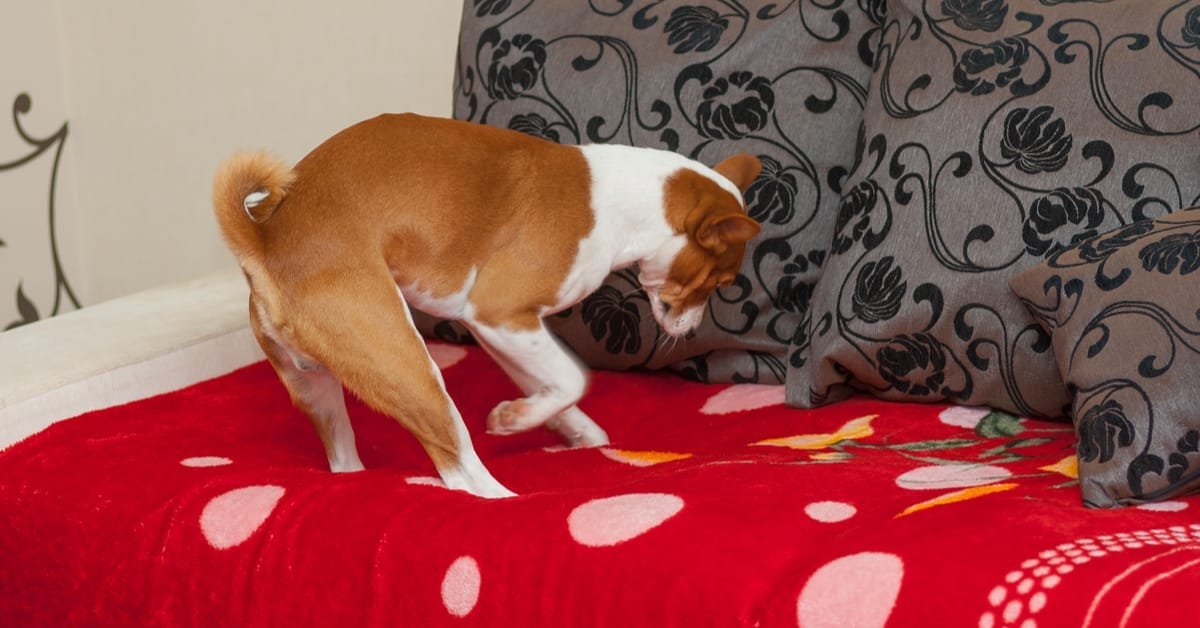
Domestic dogs have not needed that insurance policy for thousands of years, but the behavior pattern survived domestication almost intact, because nothing selected against it. The full sequence is still visible if you watch closely: the dog carries the item to a chosen spot, digs or pushes with its nose and paws, places the item, then pushes covering material over it — nose first, in repeated forward strokes.
On grass or soil, that sequence works. On a sofa, the “soil” is imaginary, so the dog mimes pushing cushions, blankets, or rug edges over the treat with its nose. Behaviorists call this vacuum or displacement-style burying: the motor pattern runs even though the material does not cooperate. So why does my dog bury treats in the couch when the pantry is always full? Because the motor pattern survived domestication intact.
That nose-pushing detail matters for welfare, not just curiosity. A dog that buries enthusiastically on hard floors, wooden boards, or rough upholstery can rub the top of its nose raw — a red, hairless, sometimes scabbed patch sometimes called burying abrasion. If your dog’s nose looks sore, the fix is not punishment; it is giving the behavior a softer, legal outlet, described below. A sore nose is also a sign to ask why does my dog bury treats in the couch on hard floors — and to offer a softer surface instead.
Why Does My Dog Bury Treats in the Couch Instead of Eating Them?
The instinct explains how dogs bury. It does not explain why this treat, today, got buried. In practice, one of five triggers is usually at work, and they are easy to tell apart if you look at the pattern rather than the single event. The trigger is usually one of five — and knowing which one answers why does my dog bury treats in the couch for your dog.
| What you see | Likely trigger | What it means | First fix |
|---|---|---|---|
| Buries treats only when given several in a short time | Surplus | Your dog is full and storing the overflow | Fewer, smaller treats; check the treat budget |
| Buries only big or long-lasting chews, eats small treats at once | High value / too large | The item is treasured — or simply too big for one sitting | Offer smaller portions of the same chew |
| Buries only when another dog or cat is nearby; guards the spot | Competition | Your dog does not feel the treat is safe in the open | Feed treats separately, behind a door or gate |
| Buries, then seems restless, repeats with toys and your socks | Anxiety or boredom | Digging and hiding are self-soothing, repetitive outlets | More exercise, sniffing games, predictable routine |
| A rescue dog buries food daily, even meals, months after adoption | Past scarcity | Learned survival behavior from a time food was uncertain | Patience, fixed meal routine, never remove stashes punitively |
The surplus trigger deserves emphasis, because it is the one owners create by accident. Treats are meant to be a small part of the diet — a common veterinary rule of thumb is that treats should supply no more than about 10% of a dog’s daily calories. A dog that is quietly stockpiling treats around your home is often a dog whose treat supply exceeds its appetite.
Run your dog’s numbers through our dog treat calculator and our dog calorie calculator, and you may find the couch problem solves itself when the daily treat budget shrinks to match the dog. If meals are also being left or hidden, check total portions with our dog food calculator before assuming it is purely behavioral. If your dog is stockpiling, ask why does my dog bury treats in the couch — and check the daily treat budget first.
Breed plays a supporting role. Terriers — Jack Russell Terriers, Dachshunds (bred to go to ground after badgers), Beagles and other small hounds were selected for digging and pursuing quarry underground, and they tend to bury and dig with extra enthusiasm. Retrievers and Labradors, by contrast, more often carry and parade a valued item. Any breed can cache, however; the instinct predates every breed split. If you have ever asked why does my dog bury treats in the couch, you are watching the same ancient instinct.
Is It Ever a Problem? The Honest Checklist
Most couch burying is harmless, apart from the surprise of sitting on a damp chew. Work through this checklist — if every answer is “no,” you are watching normal instinct and can simply manage it. Any “yes” deserves more attention. If every answer is ‘no,’ you are watching normal instinct — and that is the most common answer to why does my dog bury treats in the couch.
Problem checklist — check your dog this week:
- ☐ Has burying started suddenly in an older dog that never did it before?
- ☐ Is your dog burying regular meals, or eating noticeably less at the bowl?
- ☐ Is the top of the nose red, hairless, or scabbed from pushing on hard surfaces?
- ☐ Does your dog growl, snap, or freeze over a hidden stash when people or pets approach?
- ☐ Are hidden fresh foods (meat, soft chews) rotting in warm places, attracting flies or ants, or being eaten days later?
- ☐ Is burying part of a wider pattern — pacing, panting, hiding, loss of appetite — rather than a brief after-treat ritual?
Sudden food hiding with appetite loss can accompany nausea, dental pain (a dog that wants food but cannot comfortably chew may carry and stash it), or illness, and it belongs in a veterinary conversation.
Guarding a stash with growling or snapping is resource guarding, which is also normal canine communication at a low level but can escalate in multi-dog homes; separating dogs for chews is a safety measure, not a failure. And a dog that buries a perishable treat and retrieves it days later can give itself a gastrointestinal upset — quietly audit the usual hiding spots once a week and discard anything fresh you find. That is when why does my dog bury treats in the couch stops being a curiosity and becomes a veterinary conversation.
Mealtime behavior connects here too. A dog that is mildly nauseous or has eaten too much may walk away from food it would normally take, which is one reason the timing habits in our guide on how long to wait to walk a dog after eating matter: a settled stomach and a predictable routine make eating — rather than storing — the default choice. A settled stomach and a predictable routine make eating — rather than storing — the default choice, which is one more answer to why does my dog bury treats in the couch.
How to Manage Couch Burying Without Fighting Instinct
You will not train caching out of a dog, and you do not need to. You manage the inputs and give the instinct a better address.
Shrink the treat, not the joy. Break large biscuits and chews into pieces small enough to be eaten in a few seconds. A treat that takes 2 minutes to eat is a snack; a treat that takes 20 minutes is, in your dog’s mind, a carcass worth storing. Offer the pieces one at a time during training or play instead of handing over the whole item. A treat eaten in seconds is never buried, which is the simplest fix for why does my dog bury treats in the couch.
Give burying a legal outlet. A dig box — a low box or corner of the garden filled with loose soil or sand, with a few treats buried shallowly by you — lets terriers and dedicated diggers perform the whole sequence safely. Indoors, a dedicated snuffle mat or a folded old blanket that your dog is allowed to “bury” safe items in protects both the sofa and the dog’s nose. If your dog is a dedicated digger, a dig box is the kindest answer when you ask why does my dog bury treats in the couch.
Separate competitors. In multi-pet homes, give long-lasting chews in separate rooms or crates. Many dogs that bury only under social pressure eat happily and openly once nobody can steal the prize, because the behavior was never about storage — it was about security. In multi-pet homes, giving chews in separate rooms often ends the burying entirely — and that tells you competition was the answer to why does my dog bury treats in the couch.
Keep a stash audit. Once a week, check behind cushions, under beds, and in laundry piles. Remove perishable items, wash cushion covers that smell of old chew, and note whether the volume of stashing is rising or falling as you adjust treat size and frequency. That trend is your feedback loop. That trend is your feedback loop: if stashing falls as you adjust treat size and frequency, you have found your answer to why does my dog bury treats in the couch.
For background reading on normal canine behavior and body-language signals around valued resources, the AVMA’s pet owner resources and the Merck Veterinary Manual’s behavior of dogs section are reliable, non-commercial starting points.
See your vet or a qualified behaviorist: Book help if food hiding arrives with appetite loss, weight loss, vomiting, or drooling (possible nausea or dental pain), if guarding over stashes involves snapping or biting, or if burying has become repetitive and hard to interrupt. Those patterns point beyond ordinary instinct.
Frequently Asked Questions
Why does my dog bury treats in the couch but eat other treats right away?
Because the buried treats are different in your dog’s accounting: bigger, richer, longer-lasting, or simply one treat too many. Dogs bury surplus and high-value items and eat ordinary, right-sized treats on the spot. Try offering the same treat broken into small pieces — if the burying stops, size or surplus was the trigger. Either way, it is not dislike — dogs bury food they value, which is the heart of why does my dog bury treats in the couch.
Why does my dog push his nose along the couch like he is covering the treat?
That nose-pushing is the covering stage of the burying sequence: wild ancestors pushed soil over cached food with their noses, and your dog runs the same motor pattern over cushions and blankets even though nothing actually covers the treat. Watch the top of the nose for redness if your dog does this on rough or hard surfaces.
Should I stop my dog from burying treats indoors?
You do not need to stop the instinct, and punishing it tends to make dogs sneakier and more anxious about valued items. Manage it instead: smaller treats, fewer at a time, separate feeding in multi-pet homes, a permitted dig box or snuffle blanket, and a weekly check of hiding places for anything perishable. For most households, that routine is the practical answer to why does my dog bury treats in the couch.
Why does my rescue dog hide food all over the house?
Dogs that have lived with real food scarcity — strays, hoarding-case rescues, and some former street dogs — often keep caching long after food becomes reliable, because the behavior once kept them alive. It usually fades over months as meal times become boringly predictable. Keep a fixed routine, let the dog eat undisturbed, and never scold or confiscate stashes in front of them.
Is burying treats a sign my dog does not like them?
Almost never. Dogs ignore food they dislike; they bury food they value. Hiding is a compliment to the treat and a comment on quantity or context — your dog is full, the piece is too big for now, or the spot does not feel safe enough to eat it in the open. Hiding is a compliment to the treat and a comment on quantity or context — and that is the short answer to why does my dog bury treats in the couch.