Why Does My Dog Yawn When I Pet Him? Explained
You are giving your dog a gentle stroke behind the ears, and it lets out a huge yawn. Is it bored? Is it tired? Is it telling you to stop? If you have ever asked why does my dog yawn when i pet him, you have noticed something most owners miss. A yawn during petting can mean two opposite things, and the difference matters.
A yawn can mean your dog is deeply relaxed and happy. It can also mean your dog is stressed, uncomfortable, or quietly asking you to stop. The yawn itself looks the same either way. What tells you the truth is the rest of the body: the eyes, the ears, the mouth, and the posture. Learn to read those, and you will know whether to keep petting or to give your dog some space.
This guide explains the science of dog yawning, the nine reasons a dog yawns while being petted, and a simple decoder table that tells you in seconds whether the yawn is happy or stressed. It also covers when yawning is a health warning, and how to pet your dog in the way dogs actually enjoy.
Direct answer: Dogs yawn when petted because yawning is a calming signal and a state-change signal. A loose, floppy dog that yawns once while settling into a cuddle is usually relaxed or sleepy. A stiff dog that yawns repeatedly, with lip licking, pinned ears, or a turned-away head, is usually stressed or uncomfortable and asking for space. Read the body, not just the yawn.
Yawning is also contagious in dogs, just as it is in people. Dogs are more likely to yawn when someone they are bonded to yawns. Occasional yawning is normal. Yawning that is constant, new, or paired with lethargy, loss of appetite, drooling, or pawing at the mouth needs a vet visit.
Why Does My Dog Yawn When I Pet Him? The Short Answer
Yawning in dogs is not just about being tired. It is a piece of body language, and it does several jobs at once. It can release tension, signal a change of state, calm a situation down, or simply mean the dog is sleepy. When you pet your dog, you are changing its state, and a yawn is often the dog’s way of processing that change.
Think of it like a human sigh. A sigh can mean contentment, boredom, relief, or frustration, and you can only tell which one it is from the context. A dog’s yawn works the same way. A yawn from a dog that has just flopped down next to you, gone soft all over, and half-closed its eyes is a happy sigh. A yawn from a dog that has gone stiff, turned its head away, and is licking its lips is a polite request to stop.
The science behind this is well established. Norwegian dog trainer Turid Rugaas first described yawning as one of the “calming signals” dogs use to defuse tension and show peaceful intent. Veterinary behaviourists now list yawning alongside lip licking, looking away, and shaking off as signals a dog uses when it feels uneasy or overstimulated. The VCA’s guide to canine communication describes yawning and nose-licking as ambivalent behaviours, meaning the dog is cautious, concerned, or stressed, and may respond with aggression if the situation escalates.
There is also a social side. A 2013 study from the University of Tokyo found that dogs yawn more when a person they are emotionally bonded to yawns. The researchers called it contagious yawning, and they linked it to empathy. Your dog may yawn when you pet it partly because it is tuned in to you, and partly because petting itself triggers the same calming response.
The 9 Reasons Dogs Yawn When Petted
Here are the nine reasons, from the most common to the least. Most yawns during petting come from the first three. The last three are the ones that need attention.
1. Relaxation and contentment
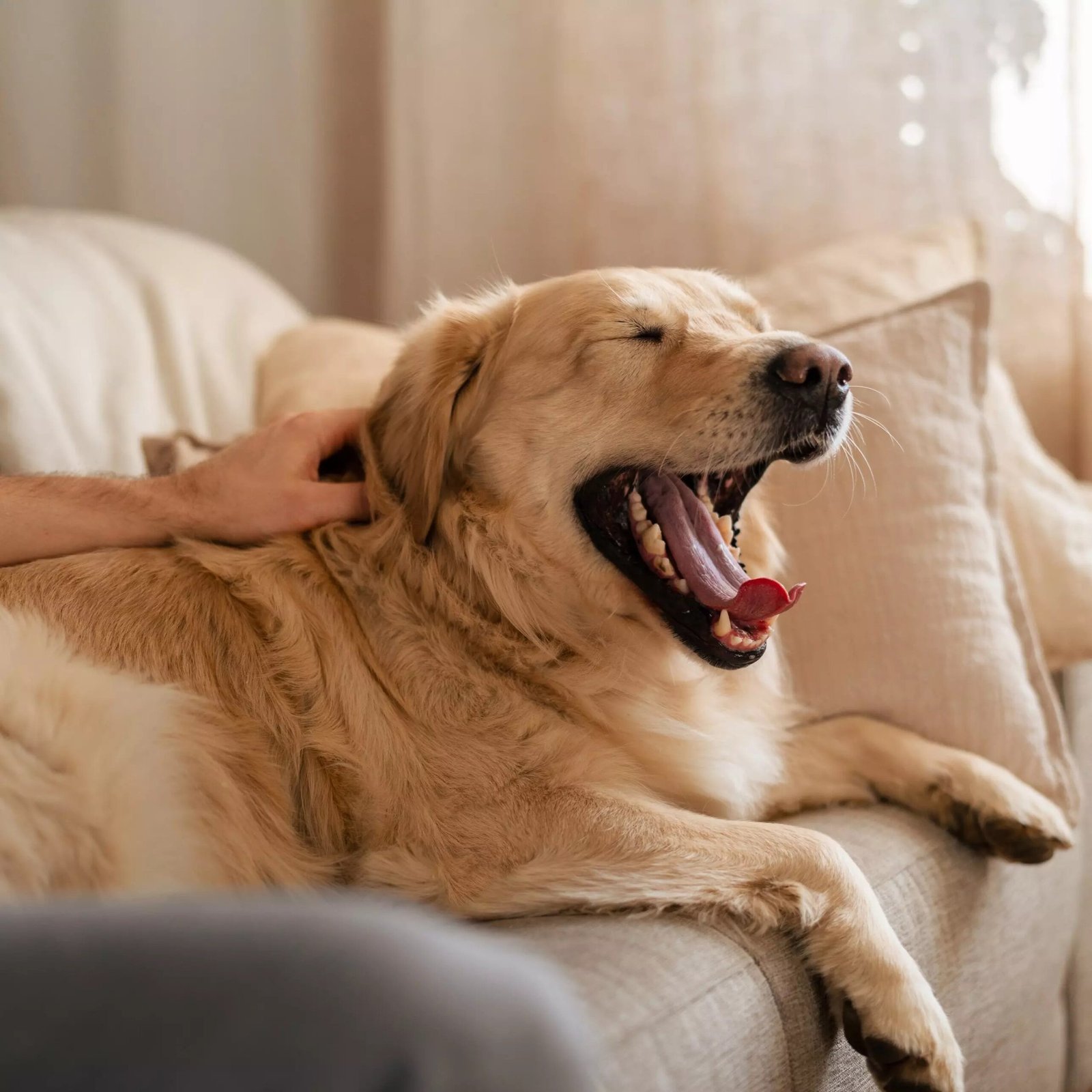
This is the most common reason, and the easiest to recognise. Your dog flops down, goes soft, closes its eyes halfway, and lets out a long yawn as it settles in. This is the dog version of sinking into a warm bath. The petting feels good, the dog is safe, and the yawn is a release of tension as the body relaxes.
You will usually see this yawn at the start of a cuddle session, or when your dog is settling down for a nap after petting. The body is loose, the breathing is slow, and the dog may sigh or groan softly with the yawn. If this is what you see, keep petting. Your dog is enjoying it.
2. Sleepiness
Sometimes a yawn is just a yawn. Dogs yawn when they are tired, just as people do. If you pet your dog in the evening, or after a long walk, the yawn may simply mean the dog is ready for sleep. The petting is not causing the yawn. The time of day is.
You can tell a sleepy yawn by the context. It happens at rest times, it comes with slow blinking and a general droopiness, and the dog may curl up or drift off within minutes. There is nothing to fix. Let the dog sleep.
3. Excitement
It seems backwards, but dogs also yawn when they are excited. The yawn is a release valve for big feelings. A dog that is thrilled to see you, or thrilled that the petting has started, may yawn as the excitement spills over. This is common in young dogs and high-energy breeds.
Excitement yawns usually come with a wiggly body, a wagging tail, and bright eyes. The dog is not trying to calm down because it is unhappy. It is trying to manage a happy overload. If the rest of the body is loose and joyful, the yawn is a good sign.
4. Stress and discomfort
This is the reason that matters most, and the one owners most often miss. A dog that yawns while being petted may be saying that the petting is too much, too fast, or in the wrong place. The yawn is a calming signal, a polite way of saying “I am not comfortable with this.”
The body language gives it away. A stressed dog yawns with a stiff body, ears pinned back, eyes wide or showing the whites, and lips licked. It may turn its head away, duck under your hand, or freeze for a moment. If you see this pattern, stop petting and give the dog space. The dog is not being rude. It is communicating clearly, and it deserves to be heard.
5. Conflict and confusion
Dogs yawn when they feel torn between two feelings. Your dog may love you and want to be close, but also feel unsure about being touched in a particular way. That conflict produces a yawn. It is the dog’s way of buying time while it works out how it feels.
You will often see conflict yawns during training, when a dog is unsure what you want, or when a new person pets the dog. The dog wants to be polite, but it is not sure the situation is safe. Slow down, let the dog come to you, and keep the petting short and predictable.
6. Overstimulation
Petting feels good, but too much of a good thing can overwhelm a dog. Vigorous rubbing, fast strokes, or petting that goes on for a long time can overstimulate some dogs, especially puppies and sensitive breeds. The yawn is the dog’s way of saying “that is enough for now.”
Overstimulation yawns often come in clusters, one after another, and the dog may start to mouth your hand, shift away, or suddenly get the zoomies. If your dog yawns repeatedly during a long petting session, take a break. Let the dog choose whether to come back for more.
7. Contagious yawning
Yes, really. Dogs catch yawns from people they love. The University of Tokyo study showed that dogs yawned more often after watching their owner yawn than after watching a stranger yawn. The researchers linked this to empathy and the strength of the bond. If you yawn while petting your dog, and your dog yawns back, it may simply be mirroring you.
This is a good sign, not a problem. It means your dog is tuned in to you and bonded to you. It is also a reminder that your own body language matters. If you are tense, your dog may pick that up too.
8. A coping habit
Some dogs learn to yawn as a habit whenever they feel mildly unsure. It becomes their default response to new people and new situations, including being petted by someone they do not know well. The yawn is a tool the dog uses to stay calm, not a sign of a problem.
You will see this most in rescue dogs and dogs that were not well socialised as puppies. The yawn is their way of managing the world. Be patient with these dogs. Let them approach you, keep petting brief, and reward calm behaviour with a treat rather than more touching.
9. Pain or a medical problem
Yawning can also be a sign that something hurts. Dogs with dental pain, jaw pain, ear infections, nausea, or stomach discomfort may yawn frequently. The yawn is the dog’s response to discomfort it cannot explain any other way. If your dog is yawning a lot and also drooling, pawing at its mouth, refusing food, or acting lethargic, the yawn may be a symptom, not a signal.
This is the reason to take seriously. A new pattern of frequent yawning, especially if it comes with other changes, deserves a vet visit. The vet can check the teeth, ears, and stomach, and rule out the medical causes before you assume the yawning is behavioural.
The Yawn Decoder: Relaxed Yawn vs. Stress Yawn
This table is the heart of the guide. Read your dog’s whole body, not just the yawn, and match it to a row. If most of the signs point to one side, that is your answer.
| What to look at | Relaxed, happy yawn | Stress or discomfort yawn |
|---|---|---|
| Body | Loose, floppy, soft muscles | Stiff, tense, frozen, or braced |
| Eyes | Soft, half-closed, slow blinks | Wide, staring, or showing the whites |
| Ears | Neutral or relaxed, in their normal spot | Pinned flat back against the head |
| Mouth | Open and relaxed, tongue soft | Lips licked, mouth tight, teeth showing |
| Head | Leaning into your hand | Turned away or ducking under your hand |
| Tail | Loose wag or resting calmly | Tucked low or held stiff and still |
| How often | Once or twice, then the dog settles | Repeated, in clusters, again and again |
| What happens next | Dog relaxes, sighs, or falls asleep | Dog moves away, mouths your hand, or freezes |
| Your move | Keep petting gently | Stop, give space, let the dog come back |

Where Dogs Like to Be Petted — and Where They Do Not
Where you pet your dog matters as much as how long you pet it. Most dogs love slow strokes on the chest, the shoulders, and the base of the ears. These are the safe zones. A dog that yawns happily while you rub its chest is enjoying itself, and you can keep going.
The top of the head is a different story. Many owners reach for the top of the head first, but most dogs find a hand coming down over their head mildly threatening. It blocks their vision and feels like a dominance gesture. A dog that yawns when you pat the top of its head may be asking you to pet somewhere else. Try the chest or the side of the neck instead, and watch the yawning stop.
The belly is another tricky area. A dog that rolls over and shows its belly is often asking for space, not a belly rub. It is a submissive gesture, a way of saying “I am not a threat.” Rubbing the belly of a dog that is offering it as an apology can make the dog more nervous. If your dog rolls over and yawns, let it get up on its own terms.
Paws, tail, and the back of the neck are sensitive spots for many dogs. Some dogs love having their paws handled, usually because they were trained to accept it as puppies. Others hate it. If your dog yawns, pulls away, or mouths your hand when you touch its paws, that is a clear no. Respect it.
The best rule is simple: let the dog choose. Offer your hand, let the dog lean into it, and pet the spot the dog offers you. If the dog moves away, let it go. A dog that controls the interaction will yawn far less, and enjoy the petting far more. Dogs that get plenty of exercise and mental stimulation are also calmer during petting, and our dog exercise calculator can help you check whether your dog is getting enough.
How to Pet Your Dog So It Does Not Yawn From Stress
Good petting is slow, predictable, and respectful. Start by letting your dog come to you rather than reaching for it. Hold your hand out at the dog’s nose level, let it sniff, and wait for it to lean in. A dog that chooses to be petted is a dog that is ready for it.
Use slow, gentle strokes in the direction of the fur, not against it. Short strokes on the chest and shoulders are better than long, fast rubs all over the body. Keep your hand where the dog can see it. Sudden movements from above or behind can startle a dog into a stress yawn, even if you mean well.
Watch for the five-second rule. Pet your dog for five seconds, then stop and take your hand away. If the dog leans in, nudges your hand, or stays close, it wants more. If the dog stays still, looks away, or moves off, it has had enough. This simple test tells you more about your dog’s feelings than any guide can. It also teaches your dog that it controls the interaction, which builds trust over time.
Keep sessions short, especially with puppies, rescue dogs, and dogs you do not know well. A minute of calm petting is better than ten minutes that ends in stress yawning and a dog walking away. End on a good note, while the dog is still relaxed, and the next session will go better.
Pay attention to timing. A dog that has just come in from a walk or woken from a nap is more likely to enjoy petting than a dog that is already wound up. A dog that is pacing or panting is not ready for a cuddle. Wait until it settles. If your dog’s energy seems out of balance, our dog sleep calculator can help you check whether its rest patterns are normal.
When Yawning Means a Vet Visit
Occasional yawning is normal. Frequent yawning is not, and the difference is worth knowing. There is no fixed number that counts as “too much,” because every dog is different. What matters is change. If your dog yawns far more than it used to, or yawns in situations where it never yawned before, something has shifted.
The warning signs to watch for are clear. Yawning that happens constantly, even when the dog is not tired. Yawning paired with drooling, pawing at the mouth, or difficulty eating. Yawning with lethargy, loss of appetite, or hiding. Yawning with trembling, disorientation, or collapse. Any of these needs a vet visit, and the last group needs one urgently.
Medical causes of excessive yawning include dental disease, jaw pain, ear infections, nausea, and stomach problems. Dogs with nausea often yawn, lick the air, and smack their lips. Nausea also drives other licking habits, as explained in our guide on why dogs lick the floor.
Stress-related yawning also deserves attention when it does not stop. A dog that yawns constantly at home, even when nothing stressful is happening, may be dealing with chronic anxiety. This is common in dogs with separation anxiety, noise phobias, or a history of punishment-based training. A veterinary behaviourist can help, and the earlier you ask, the easier it is to fix.
Before your vet visit, take a short video of the yawning. Note when it happens, how often, and what else is going on at the same time. A video is worth more than a description, because the vet can see the body language for itself. It will help the vet work out whether the yawning is behavioural, medical, or a mix of both. Our guide on why dogs pant at night covers a similar kind of body-language detective work, and the same approach applies here: look at the whole dog, not just the one behaviour.
Frequently Asked Questions
Do dogs yawn when they are happy?
Yes, dogs can yawn when they are happy, but the yawn on its own does not prove happiness. A happy yawn comes with a loose body, soft eyes, and a wagging tail, and the dog settles down afterwards. The same yawn with a stiff body and pinned ears means something else entirely. Happiness is in the whole picture, not in the yawn. If your dog yawns and then leans into you for more petting, it is happy. If it yawns and moves away, it is not.
Is yawning contagious in dogs?
Yes. A 2013 study from the University of Tokyo found that dogs yawned more after seeing their owner yawn than after seeing a stranger yawn. The researchers linked this to empathy and the strength of the emotional bond between dog and owner. Dogs also catch yawns from other dogs, especially dogs they live with. It works the same way as in people: seeing a yawn triggers a yawn. If your dog yawns right after you do, it is a small sign of how closely your dog is tuned in to you.
Why does my dog yawn so much?
Dogs yawn a lot for a few common reasons: they are tired, bored, or stressed, or they are using yawning as a calming signal in situations that make them uneasy. Puppies yawn more than adult dogs because everything is new to them. If the yawning is new, constant, or paired with lethargy, loss of appetite, or drooling, it can signal pain or nausea, and a vet visit is the right next step.
Can yawning mean my dog is in pain?
Yes, it can. Dogs in pain often yawn, lick their lips, and show other stress signals. Dental pain, jaw pain, ear infections, and stomach discomfort are the most common causes. The clue is the company the yawning keeps: yawning with pawing at the mouth, drooling, refusing food, or flinching when touched points to pain rather than relaxation. A dog that yawns when you touch a particular spot may be telling you that spot hurts. If you suspect pain, do not wait. Book a vet visit and mention the yawning pattern, because it helps the vet know where to look.
Why does my dog yawn when I hug him?
Many dogs do not enjoy hugging, even though people love it. A hug traps a dog, presses on its body, and puts a face close to its face, which most dogs find threatening. The yawn during a hug is usually a calming signal, the dog’s polite way of saying it is uncomfortable. The body language will confirm it: stiff body, turned-away head, lip licking, and pinned ears.
Some dogs do enjoy hugs, usually dogs that were raised with gentle hugging from puppyhood, but they are the exception. If your dog yawns when you hug it, try a side cuddle instead, where the dog can move away freely. Most dogs prefer that, and they will show it by leaning in rather than yawning.
A yawn during petting is a small message with a big meaning. It can mean “this feels wonderful, keep going” or “please stop, this is too much.” The yawn looks the same either way, so the answer is never in the yawn alone. It is in the eyes, the ears, the body, and what happens next. Learn to read the whole dog, pet the spots your dog offers, and stop when your dog asks. Do that, and the yawns you see will mostly be the happy kind, the ones that come with a soft sigh and a dog settling in close, exactly where it wants to be.