Why Does My Cat Sit on My Laptop? 6 Reasons
You open your laptop, settle in to work, and within two minutes a warm, furry body has parked itself squarely on the keyboard. Your screen is covered, your cursor is wandering, and a tail is swishing across the trackpad. You move her off, and she comes straight back.
If you have ever wondered why does my cat sit on my laptop, the answer is not spite, and it is not random. Your laptop is warm, it smells like you, it sits exactly where your attention goes, and it is the best seat in the house from a cat’s point of view. She is choosing the most rewarding spot in the room.
Cats do this to millions of owners, and the habit is so common that behaviour experts have studied it properly. The reasons are a mix of warmth, scent, attention, routine, and comfort, and each cat has her own blend. Once you know which reasons drive your cat, you can give her a better spot nearby and get your keyboard back.
Direct answer: Your cat sits on your laptop because it is warm, it smells strongly of you, it sits where your attention is, and it is a comfortable, slightly raised resting spot. Cats seek surfaces between 30 and 38°C, and a running laptop gives off exactly that kind of gentle heat. The behaviour is normal and usually harmless, but hours of daily contact with a hot laptop base can irritate a cat’s skin, so a warm bed beside the laptop is a better long-term spot.
Why Does My Cat Sit on My Laptop? The 6 Real Reasons
Most cats sit on laptops for more than one reason at a time. Warmth brings her in, your scent keeps her there, and your reaction teaches her to come back. The six reasons below cover almost every laptop cat, and the order matters: the first two explain most cases on their own.
1. Your laptop is warm, and cats love warm
Cats run hotter than people. A healthy cat’s body temperature sits between 100.5 and 102.5°F (38 to 39.2°C), a couple of degrees above ours, and cats lose heat quickly through thin fur and bare paw pads. To stay comfortable without burning extra energy, they seek surfaces in their thermoneutral zone — roughly 86 to 97°F (30 to 36°C) — which is warmer than most homes.
A running laptop sits right in that zone. The processor and battery give off steady, low heat through the base and keyboard, and the warmth is strongest exactly where your hands rest. To a cat, that feels like a sunbeam that never moves and never sets. It is no surprise that laptop sitting gets worse in winter, when the rest of the house is cooler and the laptop is one of the few warm surfaces available.
This is also why cats sit on radiators, cable boxes, game consoles, and the warm spot you just left on the sofa. The laptop is simply the warmest object that also happens to be near you.
2. Your laptop is where your attention goes
Cats watch their owners closely, and they learn fast what holds your focus. When you open the laptop, your eyes lock onto the screen, your hands start moving, and you stop looking at her. To a socially bonded cat, that is a clear signal: the laptop is the most important thing in the room right now, and sitting on it puts her back at the centre of your world.
The behaviour is self-reinforcing, because it works every time. She sits on the keyboard, and you look at her, talk to her, laugh, or pick her up. Even a scolding is attention, and cats count any reaction as a win. Certified cat behaviour consultant Marilyn Krieger has explained that cats quickly learn that sitting on the keyboard produces exactly what they want: interaction with their favourite person.
This is the same instinct that makes cats sit on the book you are reading, the newspaper you just opened, and the remote control in your hand. The object itself matters less than the fact that you are using it. If you want to know whether attention is your cat’s main reason, try this test: sit at your desk with the laptop closed and read a paper book instead. Many laptop cats will move straight onto the book.
3. Your laptop smells like you — and like her
Cats live in a world of scent far more than sight. Your laptop carries your smell more strongly than almost any other object in the house: your hands touch it for hours every day, your skin oils soak into the keys, and it sits in your chair, on your desk, in your space. To your cat, lying on it is like lying on a piece of you.
She also adds her own scent to it. Cats have scent glands in their cheeks, chin, paw pads, and along the flanks, and simply resting somewhere transfers some of that scent onto the surface. When she rubs her face on the laptop lid or kneads the keyboard, she is marking it as part of her territory — a safe, familiar object that belongs to her group.
Science writer BBC Science Focus recently reported the view of animal psychologist Dr David Sands, who argues that scent may matter even more than heat: the cat is not just seeking warmth, she is depositing her own scent and replacing yours, effectively claiming the object. Whether warmth or scent comes first, the two work together, and they explain why a cat often returns to the same laptop even when a warm bed is sitting empty nearby.
4. It is a routine — and cats love routines
Cats are creatures of habit, and they build their days around your schedule. If you open the laptop at the same time every morning, your cat learns the pattern within days: laptop opens, human sits down, human stays still for hours. The laptop becomes a reliable meeting point, and she arrives on schedule.
This is the same timekeeping that makes cats stare at you ten minutes before dinner, as we covered in our guide to why does my cat stare at me. Your cat is not guessing when you will sit down. She has learned the sequence, and she is already in position when the screen lights up.
Routine also explains why the behaviour is hard to break. A habit built over months of daily repetition does not vanish because you bought a cat bed. You need to replace the routine, not just the spot — which is why the 7-day plan below works on timing and reward, not on pushing her away.
5. It is high, flat, and in the middle of the action
A laptop on a desk is slightly raised, flat, and located where the household action happens. Cats like elevated spots because they can watch the room from safety, and they like defined, flat surfaces because they feel secure. A keyboard is a neat rectangle with edges, and cats are famously drawn to sitting inside outlines and defined shapes — the same instinct behind the “if I fits, I sits” love of boxes.
The desk position matters too. Your cat is not just sitting on a warm object; she is sitting where you are, at your height, with a view of the room. A cat that sleeps on your laptop is choosing the busiest, most social spot in the house rather than a quiet corner. That is a compliment, even when it costs you a paragraph of unsaved work.
6. She is bored, and the laptop is the most interesting thing around
An indoor cat with little to do will invent her own entertainment, and a laptop is a moving, clicking, glowing object that responds when she touches it. Keys depress, the cursor moves, windows open and close. To a cat, that is a toy that never runs out of surprises.
Boredom is the most likely reason if the behaviour peaks at dawn and dusk, when cats are naturally most active, or if it comes with other attention-seeking habits like knocking things off shelves or sprinting around the house. Our guide to why does my cat run around at 3am covers the same crepuscular energy — the laptop version is just the daytime edition.
Kittens and young adults are the worst offenders, because their play drive is at its peak between six months and three years old. Many cats grow out of the worst of it as they mature, but a bored adult cat of any age will still park on a keyboard if nothing better is on offer. Two short play sessions a day, ten minutes each, will drain a surprising amount of that energy.
Is It Bad for My Cat to Sit on My Laptop?
For most cats, sitting on a laptop is harmless, and the main victim is your work. But there are three real risks worth knowing, and one of them is genuinely newsworthy: prolonged heat on a cat’s skin can cause slow damage that owners rarely notice until it is advanced.
The skin risk has a name: erythema ab igne, Latin for “redness from fire.” It is a mottled, lace-like pattern of redness and brown discolouration caused by repeated exposure to moderate heat — not hot enough to burn, but warm enough to damage small blood vessels and pigment cells over weeks and months. The condition was once linked to coal fires and old kitchen stoves, and it is now showing up in veterinary clinics from laptop and heater exposure. A study in the journal Veterinary Dermatology confirmed it occurs in cats, with lesions on the belly, chest, flanks, and neck — exactly the surfaces pressed against a laptop base during a long nap.
Cats are especially vulnerable because their skin is thin on the belly, and their fur traps heat instead of letting it escape. Worse, cats do not feel gradual heat damage the way humans do: their pain threshold for heat is much higher, so a cat can lie on a warm laptop for hours without ever feeling uncomfortable, while the damage quietly builds. The warning signs are subtle — patchy fur loss, scaly or crusted skin, and mottled brown marks on the belly or chest. If you see those, stop the laptop naps and ask your vet to look.
The second risk is to the laptop. Fur clogs cooling vents, paws press keys and can delete work or send half-typed messages, claws scratch screens, and a kneading cat can crack a key or spill a drink. A cat that blocks the vents can also make the laptop run hotter, which makes the skin risk worse.
The third risk is hygiene, and it is small but real. If your cat goes outdoors, her paws can carry dirt, bacteria, and parasites onto the keyboard, which then ends up on your hands. Wipe the keyboard regularly, and wash your hands before eating. None of this means you must ban the laptop entirely — short visits are fine — but hours of daily contact with a hot base is not a good habit for either of you.
What the Pattern Tells You: A Quick Diagnostic Table
Not every laptop cat wants the same thing, and the fix depends on the pattern. Use the table below to work out what is driving your cat, then match the fix to the cause instead of guessing.
| When she sits on the laptop | Likely main reason | First fix to try |
|---|---|---|
| Only when it is on and warm, leaves when it cools | Warmth | Heated bed or warm blanket beside the desk |
| Only when you are typing or on a call | Attention | Play session before work; reward her for using her own bed |
| At the same time every day, like clockwork | Routine | Move the bed to the desk a week before changing anything else |
| At dawn and dusk, with zoomies and knocking things over | Boredom and play drive | Two 10-minute play sessions daily, ending with a small meal |
| On every object you touch — book, phone, remote | Scent and bonding | A worn T-shirt in her bed, so it smells like you |
| New behaviour in an older cat, with clinginess | Stress or illness | Vet check — see the warning section below |
Watch your cat for a few days before you act, and note the time, the temperature, and what you were doing. Most owners can name the main reason within a week, and the fix becomes obvious once you know it. A warmth cat needs a warmer bed, not a lecture. An attention cat needs a play session before work, not a closed door.
How to Move Your Cat Off Your Laptop: The 7-Day Plan
Pushing a cat off a laptop does not work, because the push is attention, and attention is the reward. The fix is to make a better spot available and to reward her for choosing it. This plan takes about a week, and it works best if you start on a weekend, when you have time to catch her making the right choice.
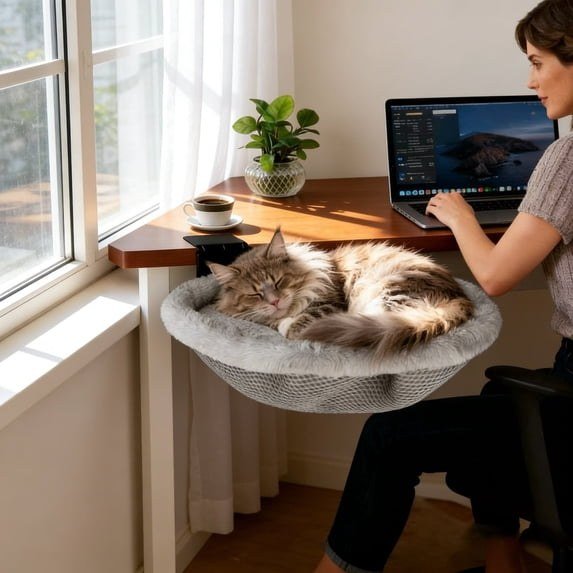
Day 1 and 2: put a warm, comfortable bed on the desk, right beside the laptop — not across the room, and not on the floor. Cats choose the warmest spot near you, so the bed has to compete on warmth and location at the same time. A heated cat bed is ideal, but a thick blanket warmed in the dryer, or a bed with a worn T-shirt of yours inside it, works well too. Do not move the laptop or change anything else yet.
Day 3 and 4: start rewarding the bed. Every time she settles in it, give her a small treat, a quiet word, and a gentle stroke. If she climbs onto the laptop instead, lift her calmly onto the bed without a fuss and reward her the moment she stays there. Keep your reaction to the laptop boring: no talking, no laughing, no eye contact. The bed should be the place where good things happen.
Day 5 and 6: add a short play session before your work block. Ten minutes with a wand toy, ending with a small meal or treat, burns off the hunting energy that drives a lot of laptop sitting. A tired cat with a full stomach is far more likely to curl up in her bed than to bat at your cursor. Our cat treat calculator can help you work out how many treats fit into her daily food allowance, so the rewards do not turn into extra weight.
Day 7: close the laptop when you step away. A closed laptop cools down and stops being the warmest seat in the room, which removes the temptation while you are gone. If she still chooses the laptop during work hours, check the diagnostic table again — you may be dealing with attention rather than warmth, and the fix is a play session, not a warmer bed.
A few rules make the plan work. Never spray water, shout, or punish her for sitting on the laptop, because punishment teaches her that you are unpredictable and makes her more anxious, not less. Never use double-sided tape or foil on the keyboard as a long-term fix, because it only teaches her to avoid the laptop when you are watching. And do not move her bed away from the desk once the habit sticks — she chose the desk because it is near you, and the bed has to stay near you to keep working.
When Laptop Sitting Needs a Vet
Laptop sitting on its own is not a health concern. But a sudden change in the behaviour can be, especially in a cat that never did it before. If your cat suddenly becomes much clingier than usual — following you from room to room, sitting on the laptop every time you open it, crying when you leave — and the change comes with other shifts, book a vet visit.
The warning signs to watch for are appetite changes, weight loss or gain, drinking much more or less water than usual, hiding more, missing the litter box, grooming less, or sleeping far more than before. In senior cats, sudden clinginess can be an early sign of hyperthyroidism, high blood pressure, cognitive dysfunction, kidney disease, or pain from arthritis. Cats hide illness well, so a behaviour change is often the first clue an owner sees.
Our cat calorie calculator can help you check whether her daily food intake still matches her weight and activity level, which is useful information to take to the vet. But no calculator replaces an exam: if the clinginess is new, sudden, and paired with any of the signs above, call your vet rather than trying to train the behaviour away.
The ASPCA’s guide to common cat behavior issues is a useful first read if you are trying to work out whether a behaviour is normal or a sign of stress, and the Merck Veterinary Manual’s page on normal social behavior in cats explains how scent marking, grooming, and resting together fit into a cat’s social life. Both agree on the core point: most laptop sitting is a normal, affectionate habit, and the cases that need a vet are the ones where the behaviour changes suddenly.
Frequently Asked Questions
Why does my cat sit on my phone?
For the same reasons she sits on your laptop: your phone is warm, it smells like you, and it is exactly where your attention is. A phone is even more concentrated than a laptop, because it is small, it vibrates, it lights up, and you pick it up constantly. To a cat, that makes it the most interesting object in the room.
The fix is the same too. Give her a warm spot beside you, reward her for using it, and put the phone down for a short play session instead of just looking up and going back to the screen. She wants your attention, not the phone itself, and a few minutes of real interaction usually satisfies her.
Why does my cat sleep on my laptop when it is switched off?
Because warmth is only part of the story. A switched-off laptop is cool, but it still smells strongly of you, it still sits where you work, and it still has the flat, defined shape cats like to settle inside. Some cats also choose it out of habit — it is the spot they always use, and the routine matters more than the temperature.
If she sleeps on a cold laptop, scent and routine are her main reasons, and a bed with a worn T-shirt of yours inside it is the best replacement. Put the bed in the same spot, on the same desk, and she will usually switch within a few days.
Can a cat break a laptop screen or keyboard?
Yes, and it happens more often than people expect. A cat’s claws can scratch a screen, a heavy cat landing on a closed lid can crack it, and paws pressing keys can delete unsaved work, send half-written messages, or trigger keyboard shortcuts that close programs. Fur getting into the cooling vents can also make the laptop overheat over time.
The practical fixes are simple: save your work often, use a keyboard cover, keep drinks away from the desk, and close the lid whenever you step away. A screen protector helps with scratches, but the best protection is a warm bed beside the laptop that your cat prefers.
Why does my cat sit on my papers and books?
Because paper is warm, flat, and covered in your scent — and because sitting on it guarantees your attention. A stack of papers also insulates your cat from a cold desk or floor, trapping a thin cushion of warm air underneath her. Freshly printed pages are warmer still, which is why cats love the printer tray.
Paper has another attraction: it is a defined, flat surface with edges, and cats are drawn to settling inside outlines. Researchers at Hunter College showed in 2021 that cats will sit inside an illusory square — four corner shapes that only suggest a box — at similar rates to a real square. A sheet of paper is a flat, low-effort version of a box, and your cat treats it the same way.