Why Does My Cat Bite My Hair? Grooming or Pica?
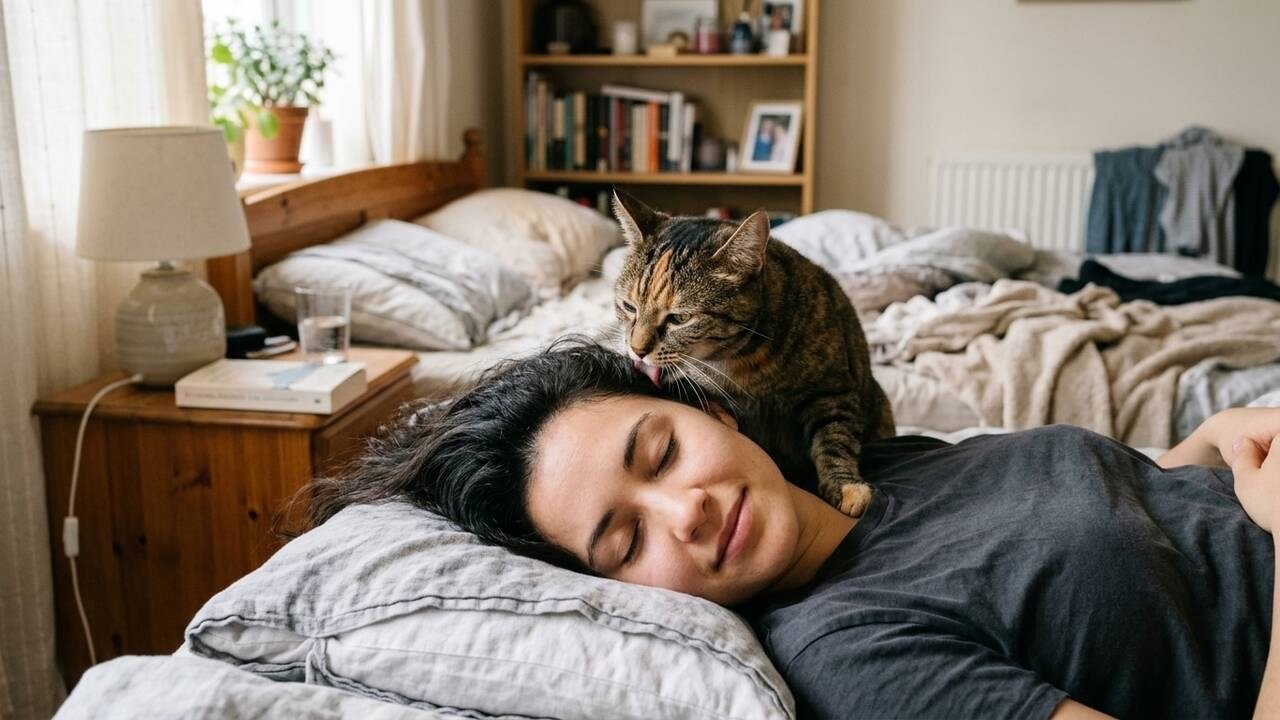
You are lying in bed, half asleep, when you feel it: a rough tongue on your scalp, then a gentle tug on a strand of hair. Your cat is grooming your head like you are a messy kitten, and she is very serious about the job. Or she grabs your ponytail, gives it a sharp bite, and dashes off.
If you have ever wondered why does my cat bite my hair, the answer depends entirely on what she does with the hair afterwards. Most of the time it is affection: social grooming, the same behaviour cats use on each other to strengthen bonds. Sometimes it is play, and sometimes it is a self-soothing habit. But there is a version that needs a vet, and a version that involves a hair product that can kill a cat.
The difference between the harmless version and the worrying version is simple to check, and it takes about ten seconds: look at what happens to the hair. Wet and chewed means grooming. Gone — swallowed — means something else entirely, and that is the version this article will help you spot.
Direct answer: Your cat bites your hair mostly because she is grooming you. Cats groom cats they trust, and your head is the warmest, strongest-smelling part of you, so she treats your hair the way she would treat a littermate’s fur — licking and nibbling to clean it and share scent. Play biting on a moving ponytail, rhythmic chewing to soothe herself, and attention-seeking bites are the other common causes. It becomes a vet problem if she actually swallows the hair, if the behaviour is new or obsessive, or if you use minoxidil or other medicated hair products, which are toxic to cats.
Why Does My Cat Bite My Hair? Grooming, Play, or Pica?
Hair biting looks like one behaviour, but it is actually three or four different behaviours that happen to involve the same target. The version your cat has determines whether you should enjoy it, redirect it, or book a vet visit. The sections below describe each version, so you can match what you see to the right response.
1. Allogrooming: she is grooming you because she loves you
The most common version is also the sweetest. Cats groom each other in bonded groups, a behaviour called allogrooming, and they concentrate on the head and neck — the areas a cat cannot easily reach on herself. When your cat licks and nibbles your hair, she is treating you as a member of her social group and doing the same job she would do for a trusted littermate.
A grooming bite looks gentle and methodical. She works through a section of hair, alternating licks with small, precise nibbles, sometimes holding your head still with a paw. The hair ends up wet and slightly chewed, but not swallowed. She is calm, her body is loose, she may purr, and she often kneads at the same time. Research on feline social behaviour finds that allogrooming happens mostly between cats with established relationships, so a cat that grooms your hair has placed you firmly inside her group.
Your head is also a practical target. It is the warmest part of your body, it carries your strongest scent from the oils your scalp produces, and it is right there when she curls up beside you. Cats groom the parts of each other they can reach, and your hair is the closest thing you have to fur.
2. Predatory play: your ponytail is prey
The second version is play, and it looks completely different. A cat in play mode targets hair that moves: a swinging ponytail, loose bangs, hair falling across your face when you bend over. The hair is thin, it moves unpredictably, and it slithers like a snake or an insect. To a cat’s hunting brain, that is an irresistible target.
Play biting is faster and rougher than grooming. She stalks the hair, her pupils widen, her body goes low, and then she pounces, bats at it, and bites — often while you are walking, brushing your teeth, or sitting at a desk. Kittens and young cats between six months and three years old are the worst offenders, because their play drive is at its peak and they are still practising the stalk, chase, pounce, and kill-bite sequence on anything that moves.
This version is harmless in itself, but it teaches a bad lesson if you react dramatically. Yelping, jumping, or laughing all count as attention, and attention is the reward. The fix is to redirect the hunting energy to a proper toy before she gets to your hair, which is covered in the stopping section below. Our cat treat calculator can help you work out a small food reward to use at the end of a play session, so the hunt ends with a catch and a meal, the way a real hunt would.
3. Self-soothing: rhythmic chewing as a comfort habit
The third version is quieter and easier to miss. A cat sits calmly, zones out, and gently chews or sucks on the ends of your hair, often while kneading with her paws and sometimes drooling slightly. She is not grooming you and she is not hunting. She is soothing herself, the way a child sucks a thumb.
This habit often traces back to early weaning. Kittens taken from their mother too young are more likely to develop oral comfort behaviours as adults, and hair chewing is one of the commonest. It can also appear during stress: a move, a new pet, a new baby, or a change in routine can push a cat toward a familiar comfort habit, and your hair is always available.
Self-soothing chewing is usually harmless if the hair is not swallowed, but it is worth watching. If the chewing becomes obsessive, if she does it for long stretches every day, or if it spreads to fabric, plastic, or string, it is no longer just a quirk — it is a compulsive behaviour, and it deserves a vet conversation. The same comfort-seeking drive appears in our guide to why does my cat knead and bite a blanket, where the target is fabric rather than hair, and the line between soothing and pica is the same: swallowed material changes everything.
4. Attention-seeking: biting works, so she keeps doing it
Cats are quick learners, and hair biting gets a reaction every single time. You squirm, yelp, move, push her away, or laugh — and all of that is interaction. A cat that has learned that biting your hair at 5 a.m. gets you out of bed and into the kitchen will keep doing it at 5 a.m., because the rule she learned is simple: bite hair, get breakfast.
Attention biting often happens at predictable times: when you sit down to work, when you pick up your phone, or when you settle into bed. Those are the moments your attention goes somewhere else, and the bite brings it back. The test is easy: if the biting stops when you give her a short play session or a meal, and starts again when you go quiet, attention is a big part of the cause.
The fix is the opposite of what feels natural. Stay boring when she bites: no talking, no laughing, no yelping, no sudden movement. Then give her the attention she wants a few minutes later, on your terms, for doing something else — sitting in her bed, playing with a toy, or settling beside you calmly. She will learn that calm behaviour earns attention faster than hair biting does.
5. Overstimulation: grooming that tips into a bite
Sometimes grooming starts sweetly and ends with a hard bite, and that is overstimulation. Close-range, repetitive contact builds arousal in a cat until she reaches her limit, and the bite is her way of saying stop. The scalp is sensitive skin, and sustained licking plus hair pulling can flip the switch from pleasure to irritation in seconds.
The warning signs arrive just before the bite: her tail starts lashing or thumping, the skin along her back ripples, her ears rotate backwards, her pupils widen, or her purring stops or changes pitch. If you see any of those, stop the session gently and let her walk away. Do not punish the bite — she was not being aggressive, she was over her limit, and punishment will only make her more anxious about close contact next time.
This is the same warning ladder that appears in our guide to why does my cat bite me when I pet her belly, and the rule is the same: the bite is a stop signal, not a betrayal. Short, calm grooming sessions that end before she gets overstimulated will keep the habit friendly.
6. Pica: when swallowing hair means something is wrong
The version that needs a vet is pica — the persistent eating of non-food items. A cat with pica does not just chew hair; she grinds it with her back teeth and swallows it, again and again. The Merck Veterinary Manual lists plastic, wool, cotton, fabric, and hair among the substances cats with pica will suck, chew, or ingest, and it advises that disease should be ruled out first in any cat showing these behaviours.
Medical causes include inflammatory bowel disease, exocrine pancreatic insufficiency, liver problems, hyperthyroidism, diabetes, dental pain, and nutritional deficiencies. Stress, anxiety, boredom, and early weaning can also drive it, and some breeds — Siamese, Burmese, and related Oriental breeds — develop pica more often than others, in a pattern vets compare to obsessive-compulsive disorders in people.
Swallowed hair is dangerous because it does not digest. It can form larger hairballs than normal fur grooming produces, and those hairballs can cause vomiting, gastric irritation, or a full intestinal blockage that needs surgery. If your cat is swallowing hair rather than just chewing it, book a vet visit. If she is also eating litter, fabric, plastic, or string, mention all of it, because the causes often overlap — and our why does my cat drool when purring guide covers another oral comfort behaviour that can look similar but usually means something different.
The Wet-vs-Gone Test: Which Version Does Your Cat Have?
You do not need a vet visit to work out which version you are dealing with. You need ten seconds and a look at the hair afterwards. The table below is the fastest way to tell grooming from play from pica, and it is the test behaviourists use when an owner describes the habit.
| What you see | Which version | What it means | What to do |
|---|---|---|---|
| Hair is wet and slightly chewed, not swallowed | Grooming (allogrooming) | Affection and bonding; normal | Enjoy it, or redirect gently if it bothers you |
| Bites target a moving ponytail or loose hair | Predatory play | Hunting practice; normal in young cats | Play session first; tie hair back during play |
| Slow, rhythmic chewing, kneading, zoning out | Self-soothing | Comfort habit, often from early weaning | Watch the frequency; vet if it becomes obsessive |
| Hard bite after licking, with tail lashing | Overstimulation | She hit her limit and wants it to stop | End the session calmly; keep sessions shorter |
| Hair is gone — swallowed, not just chewed | Pica | Possible medical or compulsive cause | Vet visit — rule out disease first |
| Chewing spreads to fabric, plastic, string | Pica or compulsion | The behaviour is escalating | Vet visit soon; remove the materials meanwhile |
The rule to remember is short: wet is fine, gone is a vet visit. A cat that grooms your hair and leaves it damp is telling you she loves you. A cat that eats your hair is telling you something is wrong, and the sooner a vet looks, the simpler the fix usually is.
The Minoxidil Warning: Hair Products That Can Kill Cats
Your hair is rarely just hair. It is usually coated in shampoo, conditioner, styling products, or hair-loss treatments, and some of those products are dangerous — one of them can be fatal. If you use minoxidil, read this section carefully, because it is the most important part of this article.
Minoxidil is the active ingredient in hair-growth products sold as Rogaine in the US and Canada and Regaine in the UK and Ireland. It is applied to the scalp as a foam, liquid, or spray, and it is extremely toxic to cats. Even a small amount — a few licks of treated hair, a lick of a pillow with residue on it, or grooming minoxidil off her own paws after walking through a spill — can cause low blood pressure, abnormal heart rhythm, and fluid in the lungs. Cats are especially sensitive because they groom constantly and their small body size means a tiny dose goes a long way.
The danger is not limited to the moment you apply it. Residue stays on hair, bedding, towels, pillowcases, and hands for hours, and a cat that grooms your hair at night can pick it up long after you have forgotten you applied it. Veterinary toxicology reports have linked minoxidil exposure in cats to serious heart and lung problems, and the advice from poison control services is blunt: if exposure is possible, call a vet or a poison control service immediately rather than waiting for symptoms.
Other hair products are less dangerous but still worth checking. Essential oils such as tea tree, lavender, peppermint, and eucalyptus are toxic to cats, and they turn up in shampoos, conditioners, and styling products. Hair dyes, bleaches, and strong chemical treatments can irritate a cat’s mouth and stomach if she licks them. The safest rule is simple: if you use any medicated or strongly scented product on your hair, do not let your cat chew or lick it, and keep treated hair covered at night.
If you think your cat may have licked minoxidil, do not wait to see whether she seems unwell. Cats hide illness well, and by the time symptoms appear — vomiting, weakness, difficulty breathing, or collapse — the poisoning is already serious. Call your vet, an emergency clinic, or an animal poison control service straight away, and take the product packaging with you so they can see the concentration.
How to Stop Your Cat Biting Your Hair
Most hair biting does not need stopping — grooming is a compliment, and many owners enjoy it. But if it wakes you at night, pulls painfully, or involves products you cannot remove, here is a gentle plan that keeps the bond intact while moving the behaviour somewhere better.
Start by removing the reward. When she bites your hair, stay calm and boring: no talking, no laughing, no yelping, no sudden movement. Gently move her to a spot beside you, or stand up and walk away for a minute. The goal is to teach her that hair biting produces nothing interesting, while calm behaviour produces attention, treats, and play.
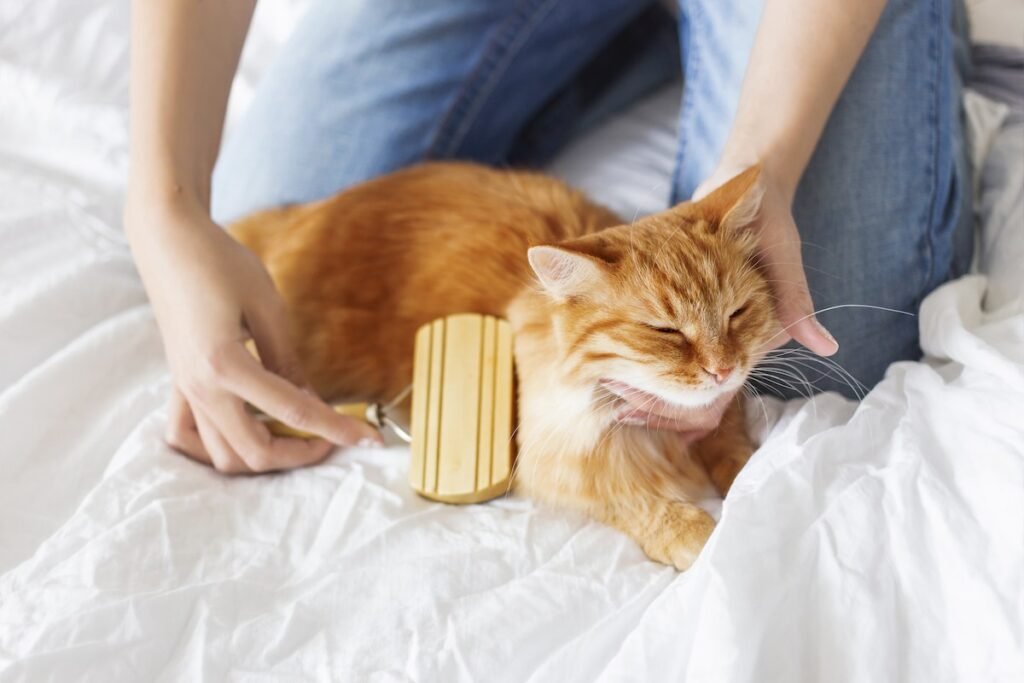
Next, give her a better outlet for the same need. If she is a groomer, offer a soft brush or a grooming session on her own terms — many cats that groom your hair will happily accept being brushed instead, which satisfies the same social urge. If she is a hunter, tie your hair back and schedule a play session before bed, ending with a small meal so the hunt finishes the way a real hunt would. If she is a soother, offer a soft blanket or a favourite toy to knead instead, and keep the bedtime routine calm and predictable.
Cover your hair at night if the biting wakes you. A silk scarf, a sleep cap, or simply tying long hair up and tucking it under a pillow removes the target while you sort out the routine, and most cats lose interest within a few nights once the hair is out of reach. Move the last meal closer to bedtime too, because a cat with a full stomach usually settles down instead of looking for something to chew.
Check her diet as part of the plan, because nutritional gaps can drive pica. Our cat food calculator can check whether her daily portions match her weight and activity level, and a vet can check for the deficiencies that sometimes sit behind hair eating. If she is teething — kittens between three and six months old chew everything — our cat dental calculator can help you work out where she is in her dental development, though teething alone rarely explains hair chewing in an adult cat.
When Hair Biting Needs a Vet
Book a vet visit if the hair is being swallowed rather than just chewed, if the behaviour is new or escalating, if it has spread to fabric, plastic, string, or litter, or if it comes with vomiting, weight loss, appetite changes, or a dull coat. Those are the signs that separate a quirk from a medical problem, and they are worth acting on quickly.
Also call your vet urgently if your cat may have licked minoxidil or any medicated hair product, even if she seems fine. Do not wait for symptoms. Bring the product packaging, and tell the vet exactly when the exposure may have happened.
For background reading, the Merck Veterinary Manual’s page on normal social behavior in cats explains allogrooming and scent sharing in detail, and the ASPCA’s guide to common cat behavior issues covers compulsive behaviours and pica with practical next steps. Both agree on the rule that runs through this article: licking is normal, swallowing is a warning, and the products on your hair matter as much as the behaviour itself.
Frequently Asked Questions
Why does my cat lick my hair at night while I sleep?
Because you are still, quiet, and going nowhere — which makes bedtime the easiest window for grooming. Cats feel most comfortable grooming something that stays still, and movement interrupts the process. A sleeping owner is calm, warm, and available for as long as the cat wants, so night-time grooming is very common.
If it is cutting into your sleep, move the last feeding closer to bedtime, add a short play session before lights-out, and cover your hair for a few nights while the routine settles. A cat with a full stomach and tired hunting muscles usually curls up and sleeps instead of grooming your head.
Why does my cat bite my beard?
For the same reasons she bites your hair, with one extra attraction: beards trap food smells. A beard is coarse, textured, and close to your mouth, so it carries the scent of everything you ate during the day. To a cat, that makes it even more interesting than the hair on your head.
Beard biting is usually grooming or play, and the same wet-vs-gone test applies. Keep beard products simple and unscented if your cat grooms there, and never let her near a beard treated with minoxidil or essential oils. If the biting is rough and playful, trim the beard shorter for a few weeks and redirect the hunting energy to a toy.
Why does my cat chew my hair ties and elastic bands?
Because they are small, stretchy, and smell like you — and because they are extremely dangerous. Hair ties, elastic bands, ribbon, and string are the most hazardous objects a cat can swallow, because they can cause a linear foreign body: the string anchors somewhere in the gut while the rest of it pulls the intestines into folds, which can cut off blood supply and needs emergency surgery.
Keep all hair ties, elastics, ribbons, and thread in closed drawers or containers, never on a bedside table or bathroom counter. If your cat has swallowed one, or if she is retching, vomiting, or refusing food after playing with one, go to an emergency vet immediately — do not try to pull it out yourself.
Why does my cat only bite my hair and not my partner’s?
Because she has chosen you as her grooming partner, and cats are specific about who they groom. Allogrooming happens between cats with established bonds, and your cat has decided that you are her person — the one she trusts, the one whose scent she knows best, and the one who sits still long enough to be groomed.
Hair length and products play a part too. Longer hair gives her more to work with, and a shampoo she likes — or one with a scent she wants to remove — can make your hair more attractive than your partner’s. It is a compliment, not a rejection of your partner, and it usually means she sees you as her closest family member.