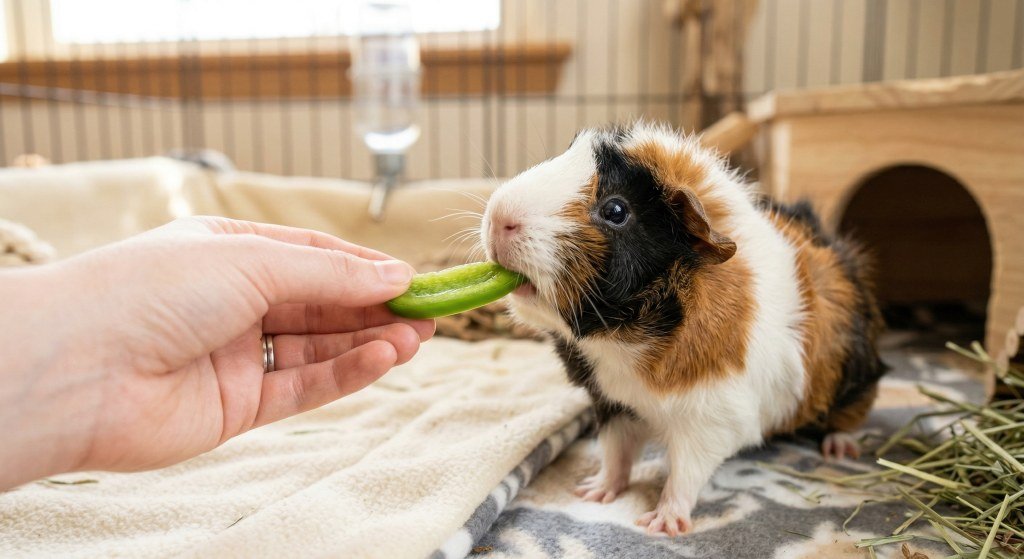
Can Guinea Pigs Eat Cucumber Leaves? Safe or Not
You have just sliced a cucumber for your guinea pig, and there is a pile of green leaves left on the chopping board. They look fresh, they smell like salad, and your piggy is already wheeking for more. So you ask the obvious question: can guinea pigs eat cucumber leaves, or should the leaves go in the bin?
Direct answer: Yes, guinea pigs can eat cucumber leaves, but only in small amounts and only occasionally. Offer one or two small, young, well-washed leaves a few times a week at most — never a whole pile, and never every day. Leaves from a shop-bought cucumber are fine; leaves from a garden plant that has been sprayed are not. If your guinea pig has bladder sludge or kidney stones, skip the leaves and ask your vet first.
That short answer hides a real argument. Search the question online and you will find websites that flatly disagree with each other. Some say the leaves are perfectly safe. Others say they should never be fed at all. This guide sorts out the contradiction, explains what is actually in a cucumber leaf, and gives you one clear serving rule you can use every time.
Can guinea pigs eat cucumber leaves? The short answer, in full
Yes, with limits. A cucumber leaf is not poisonous to guinea pigs. It is a green leaf from a plant in the squash family, and guinea pigs are built to eat green leaves. The problem is not poison. The problem is amount, and the problem is what else is on the leaf.
Cucumber leaves contain cucurbitacins. These are the bitter compounds that make some cucumbers taste sharp. In small amounts, a healthy guinea pig handles them without any trouble. In large amounts, they irritate the gut and cause soft droppings, gas, or a guinea pig that goes off its food.
Guinea pigs cannot vomit. That matters here. A human who eats too many bitter leaves feels sick and throws up. A guinea pig cannot do that. It just feels nauseous, stops eating, and waits for the feeling to pass. That is why “a little is fine” and “a lot is risky” are both true at the same time.
The second problem is the leaf itself. Cucumber leaves are rough, hairy, and tougher than lettuce or romaine. Young leaves are soft and easy to chew. Old leaves from the base of the plant are coarse, bitter, and much higher in cucurbitacins. Always pick the young, tender leaves from the growing tip, never the tough old ones.
The third problem is spray. Cucumber plants in gardens are often treated with insect sprays or fungicides. Those chemicals sit on the leaf surface and do not wash off fully. Only feed leaves from a plant you know has not been sprayed, or from a shop-bought cucumber with its leaves still attached.
What the websites say — and why they disagree
The reason this question is so confusing is that the ranking pages genuinely contradict each other. Here is what the main ones actually say, side by side:
| Website | What it says about cucumber leaves | How old / how reliable |
|---|---|---|
| Shuncy | Leaves are not safe and should be avoided entirely; cucurbitacins irritate the gut | Fresh page, but gives no amounts and no source for the claim |
| Precisely Pets | Do not feed leaves; little is known about them, and they can cause vomiting in humans | Over 3 years old; cautious but gives no evidence for guinea pigs |
| Guinea Pig Tube | Leaves are fine in moderation, small amounts, not every day; only young, fresh, raw leaves | Recent update; the most balanced answer of the group |
| My Pet Guinea Pig | Pigs enjoy the leaves, but remove the stems first because they can cut the mouth | Updated February 2026; practical, but thin on amounts |
| Healthy Guinea Pigs | Yes, absolutely — but only small quantities, as leaves are not part of the usual diet | Over 5 years old; short and confident, with no detail |
| Animal Hype | Yes in moderation; leaves have emetic (sickness-causing) properties in large amounts | 2021 page; the only one that explains the nausea mechanism |
| Animky | Yes, leaves are a good source of nutrients and fibre; introduce slowly | Over 4 years old; overstates the nutrition — leaves are mostly water and fibre |
Look at the pattern. Nobody cites a veterinary source. Nobody gives a portion in grams or leaves. The “never feed them” pages are guessing from the human vomiting fact. The “yes, feed them” pages are guessing from the fact that guinea pigs eat leaves in general.
The truth sits in the middle, and it matches how guinea pig diets actually work. A leaf that is mildly bitter, low in nutrients, and high in water is a fine occasional extra — and a poor daily food. That is the same logic behind our guide to can guinea pigs eat cucumber every day, where the flesh of the cucumber gets the same verdict: small amounts, a few times a week, never as a replacement for real greens.
None of the ranking pages gives you a serving rule, a way to pick the right leaves, or a warning for pigs with urinary problems. That is the gap this guide fills.
What is actually in a cucumber leaf
A cucumber leaf is mostly water, like the fruit. Fresh leaves are roughly 90% water, with a small amount of fibre, a little vitamin C, and small amounts of vitamin A and vitamin K. They are not a rich food. They will not fix a vitamin C shortage, and they should never replace bell pepper, which is the best everyday vitamin C source for guinea pigs.
The fibre in the leaf is useful. Guinea pigs need long-strand fibre to keep their guts moving and their teeth worn down. A leaf adds a little variety to the fibre mix, which is good. But hay is the fibre that matters — unlimited timothy hay, every day, all day. Leaves are a garnish, not a foundation.
The calcium in cucumber leaves is the part to watch. Cucumbers and their leaves are moderately high in calcium for a watery food. One leaf will not cause a problem. A daily pile of leaves, on top of a calcium-rich diet of kale and parsley, can push a sensitive pig toward bladder sludge — gritty calcium deposits in the urine that can turn into stones.
That is why the serving rule is small and occasional. It is not because one leaf is dangerous. It is because the foods that are safe in small amounts become a problem when they are fed every single day without a break.
Compare the leaf with the foods your pig eats every day. Romaine lettuce, green leaf lettuce, bell pepper, and coriander are the daily greens. They are low in calcium, rich in vitamin C, and gentle on the gut. Cucumber leaves sit a rung below them: safe, but not daily food. Our celery leaves guide makes the same distinction for another leaf that owners often assume is a daily green.
How much is safe — and how often
Here is the serving rule in one table. It works for a healthy adult guinea pig. Young, pregnant, old, or ill pigs need smaller amounts, and pigs with urinary problems should skip leaves until a vet says otherwise.
| Guinea pig | Serving of cucumber leaves | How often |
|---|---|---|
| Healthy adult (900 g – 1.2 kg) | 1–2 small young leaves, about the size of your thumb | 2–3 times a week at most |
| Smaller adult (700 – 900 g) | 1 small young leaf | 2 times a week at most |
| Young pig under 6 months | Do not offer leaves yet | Wait until 6 months old |
| Pregnant or nursing sow | 1 small leaf | Once a week at most |
| Pig with bladder sludge or stones | None | Ask your vet first |
Start smaller than the table says. On the first day, offer half a leaf. Watch the droppings for the next 24 hours. Normal droppings are firm, round, and dry on the outside. Soft, misshapen, or watery droppings mean the leaves did not agree with your pig, and you should wait a week before trying again with a smaller piece.
Always serve leaves as part of a mixed plate, never on their own. A good plate is a handful of romaine, a strip of bell pepper, a sprig of coriander, and one small cucumber leaf on top. That way the leaf is a small part of a balanced meal, and your pig gets vitamin C and fibre from foods that actually provide them.
Never feed leaves every day. The “a few times a week” limit is the whole point. A food that is fine twice a week can still cause soft droppings and calcium overload when it becomes a daily habit. If you want a daily green, use romaine or green leaf lettuce instead.
How to serve cucumber leaves safely
Picking the right leaves matters more than the amount. Follow these five steps every time, and the risk drops to almost nothing.
- Pick young leaves only. Take the soft, bright-green leaves near the growing tip of the plant. Skip the big, dark, rough leaves at the base. Young leaves are lower in cucurbitacins, softer to chew, and easier to digest.
- Check for spray. If the plant was treated with any insect spray, fungicide, or weedkiller, do not feed the leaves at all. If you are not sure, do not feed them. Shop-bought cucumbers sometimes come with leaves attached; wash those very well, and peel the skin of the fruit itself before serving.
- Wash well. Rinse each leaf under cold running water for 20 seconds. Rub both sides gently with your fingers. Shake off the water and pat the leaf dry. Dirt, dust, and spray residue all sit on the surface.
- Remove the stem. The leaf stem is stiff, woody, and sometimes sharp enough to scratch the inside of a guinea pig’s mouth. Tear the leaf off the stem and throw the stem away. This is the one practical warning that several ranking pages get right.
- Serve raw and fresh. Never cook cucumber leaves, never serve wilted or yellowing leaves, and never leave uneaten leaves in the cage. Pick up anything left after a few hours. Old leaves ferment quickly and can upset a guinea pig’s gut.
If you grow cucumbers yourself, you have the best source of all: an unsprayed plant in your own garden. Just be sure you know the plant. Cucumber leaves look like the leaves of other squash plants, and some ornamental gourds are not safe. Only feed leaves from a plant you planted and identified yourself.

What happens if your guinea pig eats too many leaves
Most of the time, nothing serious. A guinea pig that eats a few extra leaves will usually just pass soft droppings for a day and then go back to normal. But it is worth knowing the signs, because the same signs can mean something more serious.
Soft or watery droppings are the first sign. A small amount of soft stool after a new food is common and usually settles within 24 hours. Keep the hay full, offer plain water, and skip fresh vegetables for a day. If the droppings are back to normal by the next morning, the leaves were the cause and the amount was the problem.
A guinea pig that stops eating is a different matter. Guinea pigs should never go more than a few hours without eating hay. If your pig refuses hay, sits hunched and puffed up, or produces no droppings at all for 12 hours, that is an emergency. Call an exotic vet the same day. Gut slowdown can become life-threatening fast in guinea pigs.
Bloating is another warning sign. A belly that feels tight and round, with a pig that seems uncomfortable when you touch it, needs a vet. Do not try home remedies. Do not syringe-feed water unless your vet tells you to. Keep the pig warm, keep hay available, and get help.
Grinding teeth loudly, drooling, or dropping food from the mouth are signs of dental pain, not a leaf problem. Guinea pig teeth grow all through life, and overgrown teeth can make eating painful. If you see these signs, the leaves are not the cause — but the vet visit is still needed. Our guinea pig food calculator can help you check whether your pig’s daily diet has the right balance of hay, pellets, and fresh food.
Cucumber leaves in the weekly rotation
The easiest way to use cucumber leaves safely is to treat them as a rotation food. That means they appear on the menu some days and not others, alongside foods that do the heavy lifting.
A simple weekly pattern looks like this. Monday and Thursday: romaine, bell pepper, coriander, plus one small cucumber leaf. Tuesday, Wednesday, Friday, Saturday, Sunday: romaine, bell pepper, and a different green each day — green leaf lettuce, a little parsley, a dandelion leaf, or a small piece of broccoli leaf. That gives variety without letting any single food dominate.
Variety protects your pig in two ways. First, it spreads the calcium load. No single high-calcium food is eaten every day, so the kidneys get a break. Second, it spreads the vitamin C sources. Bell pepper is the reliable one, but different greens add small amounts of different nutrients.
Watch the total fresh food amount too. An adult guinea pig needs about one cup of fresh vegetables a day, split into two servings. A leaf is a tiny part of that cup. If the leaves are crowding out the bell pepper and lettuce, the balance is wrong, even if the amount of leaves looks small.
Use the guinea pig calorie calculator if you want to check the whole diet at a glance. It is a quick way to see whether treats and extras are pushing the daily intake too high. And if your pig’s weight is drifting up or down, the guinea pig weight calculator gives you a healthy range for its age and sex.
When to skip cucumber leaves
There are a few situations where the answer changes from “yes, in small amounts” to “no, not now.” All of them are about the individual pig, not the leaf.
Skip the leaves if your pig has ever had bladder sludge, bladder stones, or gritty white urine. The calcium in the leaves is not worth the risk when the urinary system is already struggling. Stick to low-calcium greens like romaine, green leaf lettuce, and bell pepper, and follow your vet’s diet plan.
Skip them if your pig is under six months old. Young guinea pigs have sensitive guts that are still settling. They need hay, pellets, and a few gentle greens. Bitter leaves are an unnecessary challenge for a young digestive system.
Skip them if your pig is recovering from illness, has had soft droppings in the last week, or is on antibiotics. A gut that is already upset does not need a new food. Wait until the droppings have been normal for a full week, then introduce half a leaf and watch again.
Skip them if you cannot verify the source. Leaves from a neighbour’s garden, a roadside plant, or a market stall where you do not know the grower are not worth the risk. Pesticides, weedkiller drift from nearby lawns, and car exhaust residue are all real. When in doubt, leave it out.
The Merck Veterinary Manual notes that guinea pigs need a constant supply of vitamin C from fresh food, because they cannot make it themselves. That is the real priority. Leaves are a fun extra. Vitamin C, hay, and clean water are the essentials. Read the Merck guide to guinea pig care for the full picture, and the RSPCA’s guinea pig diet guide for a clear daily feeding plan.
Frequently asked questions
Can baby guinea pigs eat cucumber leaves?
No, not until they are about six months old. Young guinea pigs have delicate digestive systems, and bitter leaves are too much of a challenge. Baby pigs need unlimited hay, a small amount of pellets, and a few gentle greens like romaine and bell pepper. Once your pig is six months old, start with half a small leaf and watch the droppings for a day before offering more.
Can guinea pigs eat pickled cucumbers?
No, never. Pickled cucumbers are soaked in vinegar, salt, and spices. The vinegar is acidic enough to upset a guinea pig’s gut, and the salt is dangerous in any amount. Pickles also contain garlic, dill, and other flavourings that are not part of a guinea pig’s diet. Only ever offer fresh, raw cucumber and its leaves. Anything pickled, cooked, or seasoned belongs in the bin.
Can guinea pigs eat cucumber flowers?
Yes, in tiny amounts. The yellow flowers of the cucumber plant are edible and most guinea pigs enjoy them. Offer one small flower at a time, a couple of times a week, and only from an unsprayed plant. Wash the flower first, and remove it from the cage if it is not eaten within a few hours. Flowers are a treat, not a food — they add almost no nutrition, so they should never replace the daily greens.
My guinea pig ate cucumber leaves from the garden — what should I do?
First, do not panic. One or two leaves from an unsprayed garden plant are unlikely to cause harm. Watch your pig closely for 24 hours. Check that it is eating hay, drinking water, and passing normal droppings.
If the droppings turn soft, skip fresh vegetables for a day and keep the hay full. Call your vet the same day if your pig stops eating, produces no droppings for 12 hours, seems bloated, or looks lethargic. If the plant was sprayed with any chemical, tell the vet exactly what was used.
Are cucumber leaves better than cucumber flesh for guinea pigs?
No — they are different, not better. The flesh is mostly water and vitamin C, with almost no fibre. The leaf has a little more fibre and a little more calcium, but still very little nutrition overall. Neither one is a daily staple.
The flesh is the safer and more popular choice, because it is gentler on the gut and easier to portion. The leaf is an occasional extra for variety. Think of the flesh as the treat and the leaf as the garnish on the treat.