Why Does My Dog Lick My Feet? Explained
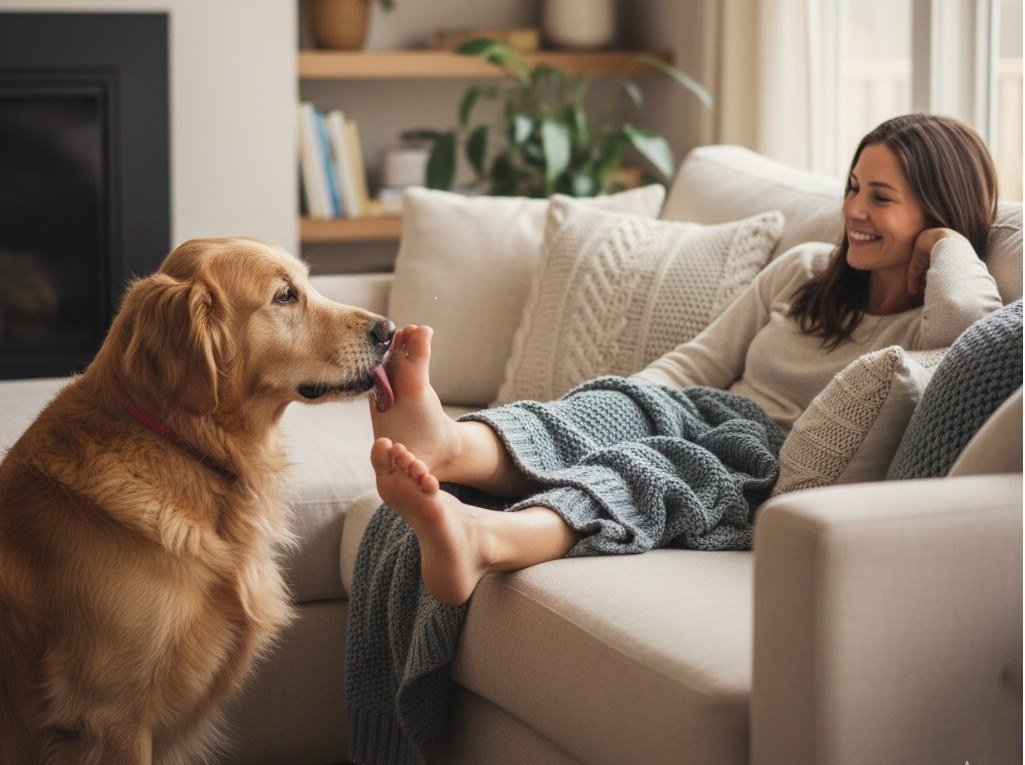
You sit down after a long day, kick off your shoes, and within seconds there is a warm tongue on your toes. It is wet, it is ticklish, and it is a little bit gross. If you have ever wondered why does my dog lick my feet, you are far from alone. It is one of the most common questions dog owners ask, and the answer is a mix of biology, habit, and love.
Most of the time, foot licking is completely normal. Your feet are salty, they are full of scent, and they are right at nose level for a dog. Licking them is your dog’s way of saying hello, gathering news about your day, and asking for a little attention. It feels strange to us, but to a dog it makes perfect sense.
That said, foot licking is not always innocent. When it starts suddenly, goes on for minutes at a time, or cannot be interrupted, it can be a signal that something is wrong. It can point to nausea, dental pain, anxiety, or even a stomach problem. This guide explains all eight real reasons dogs lick feet, when the habit is safe, when it is not, and how to stop it kindly if you have had enough.
Direct answer: Most dogs lick feet because feet are salty, smell interesting, and taste like you. Licking is also a greeting, a bonding habit, and a reliable way to get your attention. The American Kennel Club calls foot licking a normal behaviour. It only becomes a concern when it is obsessive, hard to interrupt, starts suddenly, or comes with signs of anxiety, nausea, or pain.
There are two real safety rules. Keep your dog away from broken skin, open wounds, and diabetic feet. And never let your dog lick skin that has medicated cream on it, because some creams are poisonous to dogs. On healthy, clean skin, an occasional lick is low risk.
Why Does My Dog Lick My Feet? The Short Answer
Your dog licks your feet for the same reason a person checks their phone in the morning. It is the fastest way to catch up on the news. Your feet carry salt from sweat, traces of everywhere you have walked, and your own personal scent. A dog’s nose is built to read all of that, and the tongue is the tool that delivers the sample.
Feet are also simply the easiest part of you to reach. A dog does not need to jump up or ask permission. Your feet are right there on the floor, at nose height, all day long. For a small dog, your feet may be the only part of you it can reach without climbing. Convenience matters as much as chemistry.
Then there is the social side. Puppies are licked by their mothers from the moment they are born, and puppies lick their mothers back. Licking is one of the first social behaviours a dog ever learns, and it stays wired to comfort, greeting, and bonding for life. When your dog licks your feet, it is often saying the same thing a hug says for us.
Finally, licking works. Every time your dog licks your feet, you react. You laugh, you talk, you push the dog away, or you get up. All of that is attention, and attention is a reward. Dogs repeat whatever gets a reaction, so a habit that started as curiosity can quickly become a routine. If you want to understand the behaviour, you have to look at all four parts: taste, scent, bonding, and reward.
The 8 Real Reasons Dogs Lick Feet
There is no single reason dogs lick feet. Most dogs do it for two or three reasons at once, and the mix changes with the moment. Here are the eight real reasons, from the most common to the least.
1. Salt and taste
Feet have one of the highest concentrations of sweat glands anywhere on the human body. Sweat is salty, and dogs like salt. After exercise, on a warm day, or after a long walk in shoes, your feet are at their saltiest, and that is when most dogs go straight for them.
2. Scent detective work
A dog’s sense of smell is extraordinary. Dogs have around 300 million scent receptors in their noses, while humans have about 6 million. They also have a second smell organ, the vomeronasal organ, in the roof of the mouth. It detects pheromones and chemical signals that ordinary smell misses.
3. Greeting and bonding
Wild dog puppies lick the muzzles of adults returning to the den. The licking prompts the adults to bring up food for the puppies. That greeting ritual survives in pet dogs as a habit: licking the faces and feet of the people they are pleased to see.
When your dog greets you at the door and goes straight for your feet, it is often excitement and affection. The licking releases endorphins in the dog’s brain, which feel good and calm the dog down. It is a self-rewarding habit, which is why it is so hard to break once it starts.
4. Attention
Dogs learn fast. If licking your feet reliably makes you look over, talk, laugh, or get up, your dog has learned a trick that works every time. Even an annoyed “stop it” counts as attention. To a dog, any reaction beats no reaction.
5. Comfort and self-soothing
Licking calms dogs down. The rhythmic motion releases endorphins, the same feel-good chemicals involved in comfort eating and thumb sucking in people. Dogs that feel nervous, bored, or unsettled often turn to licking as a way to soothe themselves.
6. Appeasement
In dog-to-dog communication, licking is a peace signal. A lower-ranking dog licks the muzzle of a more confident dog to say “I am not a threat.” Directed at you, the same signal can mean “please don’t be cross with me” or “I know I did something wrong.”
You will often see this after a telling-off, or when a dog approaches a person it finds a little intimidating. The body language gives it away: low posture, ears back, tail low, and quick, nervous licks. This kind of licking is not affection. It is a dog trying to defuse tension.
7. Boredom
A bored dog invents its own entertainment, and your feet are always available. Dogs that spend long hours alone, get too little exercise, or have no puzzle toys often develop licking habits simply because there is nothing better to do. Licking fills the gap.
This is the easiest reason to test. If your dog licks your feet mainly in the evening after a quiet day indoors, and far less on days with long walks and play, boredom is probably part of the mix. Bored dogs invent all kinds of habits, including burying treats in the couch, and foot licking is simply the easiest one to reach. If exercise seems to be the missing piece, our dog exercise calculator can help you work out how much daily activity your dog needs.
8. Something on your skin
Sometimes the answer is on your feet, not in your dog. Moisturiser, sunscreen, antifungal cream, and even the soap from your shower all leave tastes a dog wants to investigate. Some dogs are drawn to the smell of a particular lotion the way people are drawn to fresh bread.
Why Feet? What Makes Them So Interesting
It is worth asking why feet, of all body parts, get so much attention. The answer is a mix of anatomy and access. Human feet have about 250,000 sweat glands, more per square inch than almost anywhere else on the body. That makes them the saltiest, smelliest patch of skin you own, and dogs are built to notice exactly that.
Feet also collect the day. They pick up traces of the garden, the pavement, other animals, and other people. Every step adds a new scent layer. When your dog licks your feet after you come home, it is reading a diary of your whole day in one taste. No other part of your body carries that much information.
Then there is the simple fact of height. A dog’s nose is at foot level. Your hands are up in the air, your face is far away, but your feet are right there. Dogs investigate what is in front of them, and your feet are always in front of them. Puppies, small breeds, and older dogs that cannot jump up will almost always choose feet over faces for this reason alone.
When Foot Licking Is a Health Signal
Most foot licking is harmless, but some of it is a symptom. The difference is in the pattern. Normal licking is short, relaxed, and easy to interrupt. Problem licking is long, intense, hard to stop, or new. If your dog’s licking has changed, pay attention to what else has changed.
The most striking evidence comes from a 2012 veterinary study. Researchers looked at dogs that licked surfaces excessively and ran full health checks, including blood tests, ultrasound, and endoscopy. They found gut disease in 14 of the 19 dogs, including inflammatory bowel disease, delayed stomach emptying, chronic pancreatitis, and giardiasis. When the gut problems were treated, the licking improved in 10 of 17 dogs and stopped completely in 9 of them.
That study was about surface licking, not feet specifically, but the lesson carries over. Dogs that feel nauseous lick. They lick floors, they lick the air, they lick their lips, and they lick people. If your dog has suddenly started licking your feet a lot, and it comes with lip smacking, drooling, eating grass, or refusing food, nausea is the first thing to consider. Our guide on why dogs lick the floor explains the same stomach connection in more detail.
Dental pain is another common cause. A sore tooth, inflamed gums, or something stuck between the teeth can make a dog lick compulsively. If the licking started suddenly and your dog is also pawing at its face or dropping food, ask your vet to check the teeth.
Anxiety and compulsive behaviour are the third group. Dogs with separation anxiety, noise phobias, or chronic stress often develop repetitive licking that they cannot stop. The licking starts as self-soothing and becomes a habit loop. You can recognise it by the context: the dog licks when you leave, during storms, or when the house is tense, and it cannot be distracted with a toy or a treat.
Senior dogs deserve special attention. A dog that starts licking people or surfaces in old age, when it never did before, may be showing early signs of canine cognitive dysfunction, the dog version of dementia, or pain from arthritis. Any sudden behaviour change in a senior dog is worth a vet visit. Our dog sleep calculator can help you track whether your older dog is resting normally.
Is It Safe for You? The Honest Answer
For a healthy adult with clean, unbroken skin, an occasional foot lick is low risk. Dog saliva is not the danger people sometimes imagine. But “low risk” is not “no risk,” and there are specific situations where you should stop the licking straight away.
The main concern is broken skin. Dog mouths carry bacteria, including Pasteurella and Capnocytophaga canimorsus. On unbroken skin these are harmless. In a cut or a healing wound, they can cause a real infection. The risk is highest for people with weakened immune systems, people who have had their spleen removed, and people with diabetes. The CDC’s page on Capnocytophaga explains that most healthy dogs carry these bacteria and most people never get sick.
Diabetic feet deserve a firm rule. Diabetes can damage nerves and blood flow in the feet, which means small wounds heal slowly and infections spread fast. If you have diabetes, do not let your dog lick your feet at all.
Babies and small children are another clear exception. A baby’s skin is thin, and a baby’s immune system is still learning. There is a documented case of a 33-day-old baby developing meningitis after frequent licks from the family’s dogs. It is rare, but it is a real risk, and it is easy to prevent. Keep dogs from licking babies’ feet and faces.
The Merck Veterinary Manual’s page on diseases spread between animals and people covers the full list of infections that can pass between pets and humans.
The Risks for Your Dog
Foot licking is often riskier for your dog than it is for you, and most owners never realise it. The danger is not your feet. It is what is on them.
Medicated skin creams are the biggest risk. Some common creams are poisonous to dogs in small amounts, and a dog licking your feet is taking the dose. The worst is 5-fluorouracil, or 5-FU, a chemotherapy cream used for skin conditions. The US Food and Drug Administration has recorded dog deaths after 5-FU exposure. If you use 5-FU, your dog must never lick the treated skin, and the tube must be kept where the dog cannot reach it.
Other creams to keep away from your dog include flurbiprofen, a pain-relief gel, and hormone gels such as testosterone and oestrogen creams. These are absorbed through the dog’s skin and mouth and can cause serious hormonal effects. Antifungal creams, steroid creams, and some prescription patches are also unsafe for dogs to lick. Zinc oxide, found in many sunscreens and nappy creams, is toxic to dogs if swallowed in quantity.
The Foot-Licking Triage Table
Use this table to decide what to do. Find the pattern that matches your dog, and follow the first step. Most foot licking needs nothing more than a calm redirect. A few patterns need a vet visit, and it is worth knowing which is which.
| What you see | What it usually means | First step |
|---|---|---|
| Short licks at greetings, dog stops when asked | Normal greeting and bonding | None, or redirect to a toy |
| Licking after exercise or on hot days | Salt and taste | None, wash feet if it bothers you |
| Licking when you sit down to relax | Attention or comfort seeking | Ignore calmly, reward settling instead |
| Licking right after you apply cream or lotion | Attracted to the product | Stop it at once, keep creams away |
| Licking that lasts minutes and cannot be interrupted | Anxiety or compulsive behaviour | Vet visit, ask about a behaviour referral |
| Sudden licking plus lip smacking, drooling, or grass eating | Nausea or gut problem | Vet visit, mention the 2012 licking study |
| Sudden licking in a senior dog that never did it before | Pain or cognitive decline | Vet visit promptly |
| Licking your feet when you have open wounds or diabetes | Infection risk for you | Stop it every time, cover the skin |
| Licking paired with paw licking, red skin, or sores on the dog | Allergy, pain, or compulsion | Vet visit, check paws and skin |

How to Stop Foot Licking Kindly
You do not need to scold your dog to stop the licking. Scolding usually makes it worse, because the dog gets attention and stress at the same time. The method that works is simple: remove the reward, and give the dog something better to do.
Start by making your feet boring. When your dog starts licking, stand up calmly and walk away. Do not talk, do not laugh, do not push the dog away. Just leave the room for thirty seconds. The message is clear: licking makes the fun person disappear. Come back, sit down, and if the dog settles quietly, give a calm stroke or a small treat. You are rewarding the quiet, not the licking.
Give the dog a replacement. A lick mat smeared with a little peanut butter, a chew toy, or a stuffed Kong gives the dog the same tongue action in a better place. Offer it at the times your dog usually goes for your feet, such as when you sit down in the evening.
Fix the underlying cause if there is one. A bored dog needs more walks, play, and puzzle feeding. An anxious dog needs a calmer routine, a safe resting spot, and sometimes help from a veterinary behaviourist. A dog with a sore stomach needs a vet, not a training plan. No amount of redirecting will fix licking that is caused by pain.
Give it two weeks of consistency. Most dogs improve noticeably within two to four weeks if every person in the house follows the same rule. The key word is every person. If one family member laughs and lets the dog lick, the habit will survive.
What Not to Do
Do not punish the licking with shouting, smacking, or spraying the dog. Punishment teaches a dog to be afraid of you, not to stop licking. It also adds stress, and stress is one of the things that causes licking in the first place. You end up feeding the very behaviour you want to stop.
Do not ignore a sudden change. A dog that has never licked feet and suddenly starts is telling you something. It may be nothing, but it may be nausea, pain, or anxiety. A quick vet check is cheap compared to a missed gut problem or a sore tooth.
Frequently Asked Questions
Why does my dog lick my feet at night?
Night-time licking usually happens because evenings are the quietest part of the day. Your dog has been alone or resting, you have finally sat down, and your feet are available for the first time in hours. The licking is often a mix of greeting, comfort seeking, and boredom after a long, uneventful day. If the night licking is new or comes with restlessness and panting, it may signal anxiety, and a vet visit is sensible.
Why does my dog lick my feet and my hands?
Hands and feet are the two saltiest, smelliest parts of your body, and both are easy for a dog to reach. Hands carry food smells and sweat from the day, while feet carry salt and ground scents. Dogs that lick both are usually scent-gathering and greeting, and the behaviour is normal in both places. Hands are easier to wash than feet, so hand licking is the lower-risk habit. The same rules still apply: watch for medicated creams, and redirect if it becomes obsessive.
Why does my dog lick my feet after a shower?
After a shower your feet are warm, damp, and covered in soap and shampoo residue. Dogs are drawn to all three. Warmth is comforting, damp skin carries scent well, and many soaps and body washes have smells dogs find interesting. The habit is usually harmless, but be careful with medicated foot washes and antifungal soaps, because those can be toxic if your dog licks them. Rinse well and keep the dog out of the bathroom until your feet are dry.
Is there a spiritual meaning when a dog licks your feet?
There is no scientific evidence for a spiritual meaning behind a dog licking your feet. Old traditions in some cultures describe it as a sign of loyalty or healing, but those stories are folklore, not fact. What science shows is that licking is a normal social behaviour with roots in puppyhood, scent gathering, and bonding.
Why does my dog lick only one person’s feet?
Dogs often pick a favourite person, and that person gets most of the licking. The choice is usually based on who feeds the dog, who plays with the dog, and who reacts most to the licking. A dog may also prefer one person’s feet because of scent: different people have different skin chemistry, sweat levels, and lotions.
Some feet simply taste and smell more interesting to a particular dog. It is not a sign that the dog loves one person and not the other. It is a sign that one person’s feet are the best entertainment in the house. If the chosen person wants the licking to stop, the redirect plan in this guide works the same way for them.
Foot licking is one of those dog habits that looks strange until you understand it. Your feet are salty, full of scent, and always within reach, and licking them is your dog’s way of greeting you and asking for a little closeness. Most of the time it is harmless. When the licking changes suddenly, lasts too long, or cannot be stopped, talk to your vet. Your dog is not being naughty. It is communicating, and the message is worth hearing.