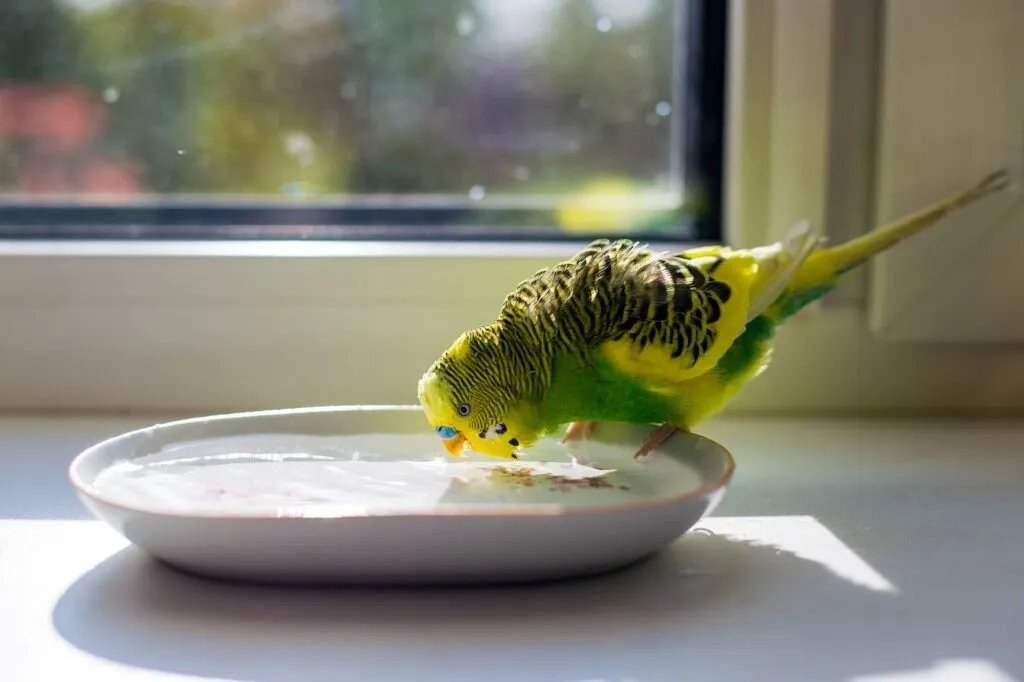
How Much Water Does a Budgie Drink Per Day? In ml
If you have searched how much water does a budgie drink per day, you have met a genuinely confusing set of answers: 1.5 ml on one page, 50 to 60 ml on another, and several figures in between — sometimes on the same website. For a bird that weighs 30 to 40 grams in total, a 40-fold disagreement is not a detail. The budgerigar (Melopsittacus undulatus) is a desert-adapted Australian granivore, built to survive on very little water, and that biology explains both the real number and why owners so often worry that their bird never seems to drink at all.
Direct answer: A healthy adult budgie drinks about 5 ml of water per day — roughly 1 teaspoon — for a typical 35 gram bird. As a rule, expect drinking water of about 5 to 10% of body weight per day: around 3 to 4 ml for a small 30 gram budgie and 6 to 8 ml for a large 45 gram English budgie. Intake rises in hot weather, on a dry seed-only diet, and during breeding, and falls when the bird eats a lot of fresh vegetables. Offer far more than this in the dish — a budgie should always have unlimited clean water — but do not expect the level to drop by much.
The rest of this guide shows where that number comes from, how to read it by weight, why you rarely see your budgie drink, and how to spot the two problems that actually matter: drinking far too little, and drinking far too much. If you are wondering how much water does a budgie drink per day, the short answer is about 5 ml.
How Much Water Does a Budgie Drink Per Day by Weight?
Budgies drink in proportion to their size, so body weight is the honest way to state the amount. Weigh your bird on a gram scale with a perch — weekly weighing is good practice anyway — and read across the table. These figures are drinking water only, for a healthy adult at a normal room temperature of about 18 to 24°C, eating a mixed diet of pellets, seed, and some fresh food. Knowing how much water does a budgie drink per day helps you spot changes early.
| Budgie weight | Drinking water per day | In teaspoons | What it looks like |
|---|---|---|---|
| 30 g (small pet budgie) | 3–5 ml | About ½–1 tsp | A few beakfuls across the day |
| 35 g (typical adult) | About 5 ml | About 1 tsp | The standard figure most vets quote |
| 40 g (large adult) | 5–7 ml | About 1–1½ tsp | Noticeably more in warm rooms |
| 45–55 g (English budgie) | 6–10 ml | About 1½–2 tsp | Larger body, larger crop, more intake |
Now you can see where the internet’s confusion comes from. Pages quoting 1.5 ml are usually counting only a fraction of the day or applying a 5% figure to the smallest bird. Pages quoting 15 to 20 ml are often describing how much water to offer, or copying figures for much larger parrots. The question of how much water does a budgie drink per day comes up in almost every new-owner group.
And the 50 to 60 ml figure that appears on templated sites would mean a 35 gram budgie drinking more than its own body weight in water every day — a physical impossibility for a healthy bird, and a useful reminder to check any number against the weight of the animal. If you want the maths done for your own bird, the bird water intake calculator works it out from weight and conditions. Vets are often asked how much water does a budgie drink per day, and the answer surprises most owners.
Two adjustments matter more than any others. Heat: above about 30°C, or in a hot, dry room, intake can roughly double as the bird pants and loses water through breathing — a budgie has no sweat glands, so evaporation from the respiratory tract does the cooling. Diet: a bird eating fresh vegetables, soaked seed, or chop gets a large share of its water from food, because leafy greens are mostly water. That bird may drink only 2 to 3 ml and be perfectly hydrated. A bird on dry seed alone drinks at the top of the range — one more reason the measured, mixed ration in the budgie daily food portion calculator matters.
Why You Almost Never See Your Budgie Drink
New owners often post the same worry: “my budgie never drinks.” In most cases the bird drinks fine — you are simply not watching at the right second. A budgie drinks fast. It dips its beak, takes one or two small sips, lifts its head to let the water run down the throat — birds cannot swallow the way mammals do and use gravity to help — and is done in a few seconds, a handful of times a day. There is no long session at the dish to notice. Once you know how much water does a budgie drink per day, the dish level starts to make sense.
Wild biology explains the habit. Budgies come from arid inland Australia, where waterholes are dangerous places patrolled by predators, including falcons. A wild budgie drinks quickly, in a flock, and leaves. It also conserves water superbly: its kidneys produce concentrated, mostly solid urates — the white part of the dropping — instead of liquid urine, so very little water is wasted. A pet budgie keeps all of that equipment. Five millilitres a day is not a bird failing to drink. It is a desert bird working exactly as designed. Guides disagree on how much water does a budgie drink per day because they mix up species and ages.
The evidence is in the dish and the droppings, not in your sightings. Water that is lower and dirtier each evening — budgies dunk food and bathe in dishes — is water being used. Droppings with a clear white urate portion and a formed dark centre are the droppings of a hydrated bird. Track those, weigh weekly with the budgie weight tracking calculator, and you have a better hydration picture than an hour of watching the cage. Weighing your bird is the best way to check how much water does a budgie drink per day for your bird.

Bowls, Bottles, and Keeping Water Safe
Because a budgie drinks so little, water quality matters more than quantity. A dish that looks almost untouched can still grow a bacterial film within a day, fed by dunked seed, droppings, and food from the beak. Season and diet change how much water does a budgie drink per day, so expect some variation.
Open bowls and dishes. Stainless steel or ceramic dishes are the natural choice: the bird drinks in its normal head-up posture, can bathe, and you can see the water level and cleanliness at a glance. The cost is contamination — expect to wash the dish with hot water and a brush, and refill it, at least once a day, and twice a day in warm weather or if your bird dunks food. Place the dish away from perches above it, so droppings do not fall in. A healthy adult shows how much water does a budgie drink per day in stable droppings and steady weight.
Water bottles. A ball-bearing bottle keeps water cleaner for longer and is a reasonable backup, especially if you are out all day. The risks are mechanical: the ball can stick, the nozzle can block with seed or mineral scale, and a bird that has never used one may not learn without training. Check a bottle daily by tapping the ball and confirming a drop appears, scrub the nozzle weekly, and never rely on a bottle as the only source until you have seen the bird drink from it many times.
Whichever you use, plain fresh tap water that is safe for you is the standard choice in most areas; let heavily chlorinated water stand briefly if your bird is fussy about taste. Never add vitamin drops to the water as a routine — they feed bacterial growth, change the taste, and can put a bird off drinking altogether. Vitamins belong in food, planned as part of the diet; the Merck Veterinary Manual’s overview of nutritional diseases of pet birds explains how unbalanced diets, not water additives, drive most pet bird deficiencies. Lafeber’s pet bird care resources give the same practical guidance on fresh water and daily dish hygiene.
Too Little and Too Much: The Changes That Matter
The daily figure matters less than a change in the figure. Learn your bird’s normal — roughly a teaspoon a day, a dish dirtied in a familiar way — and treat a clear shift in either direction as information. If you track how much water does a budgie drink per day, a sudden change stands out at once.
Drinking much less, or stopping. A budgie that truly stops drinking is in trouble within 24 hours, and dehydration in a 35 gram bird moves fast. Warning signs: dry, sticky droppings with dark, reduced urates; sunken or dull eyes; lethargy and fluffed posture; loss of skin elasticity; and a bird sitting quietly instead of feeding. Causes range from the simple — a blocked bottle nozzle, a new dish in a new place, water that tastes of a cleaning product — to illness. The short version of how much water does a budgie drink per day is about a teaspoon.
Check the equipment first, offer a familiar clean dish at once, and if the bird will not drink or shows any of the signs above, contact an avian vet the same day. Do not try to force water into the beak; a bird can inhale it into the airway. Knowing how much water does a budgie drink per day helps you judge whether the dish is the problem.
Drinking much more. A budgie suddenly emptying its dish, with watery droppings where the urine portion floods the paper, is showing polydipsia — excessive drinking — and it has medical causes vets take seriously, including kidney and liver disease, diabetes, and some infections. Stress, a salty diet, and hot weather can raise intake temporarily, and hens in breeding condition drink more, but a sustained doubling of intake that lasts more than a day or two in a cool room deserves a vet visit with your notes on how much is being drunk.
This is where the treat rules matter too: salty human food has no place in the cage, and measured treats such as the portions in our guide to how much millet a budgie can eat per day keep the dry-food load predictable, which keeps drinking predictable.
The crop and the chick exception. Hand-reared chicks and birds being given soft or soaked foods take in most of their water from food held in the crop, the storage pouch in the neck, and drink very little separately — normal for that stage, and not a reason to add water to food beyond the recipe. Breeding hens feeding chicks are the opposite: expect intake to climb well above 5 ml, and simply keep the dish full and fresh.
Frequently Asked Questions
How often should I change my budgie’s water?
At least once a day, every day — wash the dish with hot water and a brush, then refill with fresh water. Change it twice a day in hot weather, if the bird dunks food or bathes in the dish, or if you see any film or debris. A water bottle buys cleanliness, not days: check it daily and scrub it weekly. Fresh water is a daily task even though the bird drinks only about a teaspoon of it.
My budgie never seems to drink. Is that normal?
Usually, yes. A budgie drinks in a few seconds, a handful of times a day, and most owners simply miss it. Judge by evidence instead: a water level that drops slightly, a dish that gets dirty, normal droppings with white urates, and stable weight. If the level never moves, the droppings dry out, or the bird is quiet and fluffed, check the bottle nozzle or dish placement and see an avian vet the same day.
Can a budgie drink tap water?
In most areas, yes — tap water that is safe for people is safe for budgies, offered fresh daily. If your supply is heavily chlorinated and the bird seems reluctant, let the water stand for a few hours or use a standard water filter. Avoid distilled water as the sole source long-term, because it contains no minerals at all, and never add vitamin drops or medicines to the dish unless an avian vet has prescribed them.
How long can a budgie go without water?
Far less time than without food. A budgie in a warm room can be in serious trouble within 24 hours without water, and sooner in heat. Never test it: water must be available at all times, including in a travel carrier and a sleep cage. If you come home to a spilled or blocked water source and a quiet, fluffed bird, offer fresh water at once and contact an avian vet the same day.
Do budgies need more water when they eat only seeds?
Yes. A seed-only diet is dry, so the bird must drink at the top of its range — around 5 to 10% of body weight per day — to compensate, while a budgie eating vegetables and other fresh foods gets much of its water from the food itself and drinks less. It is one more reason to move toward a mixed diet of pellets, measured seed, and daily vegetables rather than dry seed alone.