Why Is My Horse Lying Down More Than Usual?
You walk into the field and your horse is down. Not dozing on its feet, but flat out on its side in the grass. It is a sight that stops every owner in their tracks, because horses spend so much of their lives standing up. A horse that is lying down more than usual can be perfectly fine, or it can be in serious trouble, and the difference is in the details.
So why is my horse lying down more than usual? Most often it is deep sleep, rest after hard work, or a horse that finally feels safe enough to lie flat out. But lying down more than usual can also be one of the first signs of colic, laminitis, or another painful problem. This guide shows you how to tell the difference in a few minutes, what is normal, and when to pick up the phone to your vet.
Direct answer: A horse lying down more than usual is usually sleeping deeply or resting after work, especially if it gets up easily, looks bright, and eats and drinks normally. It becomes a worry when the horse lies down for more than about two hours at a time, gets up and lies down again repeatedly, rolls, paws, sweats, or will not eat or drink. A horse that cannot get up at all is an emergency — call your vet at once and keep the horse calm and warm while you wait.
Why Is My Horse Lying Down More Than Usual? The Main Reasons
The fastest way to judge your horse is the pattern table below. Find the row that matches what you see, then read the section that follows for the full detail. A single quiet lie-down is rarely a problem. A change in the pattern is what matters.
| What you see | Most likely reason | What to do first |
|---|---|---|
| Lies flat for 20 to 30 minutes, then gets up bright and eats | Deep sleep | Nothing — this is normal and healthy |
| Lies down after a hard ride or a long day, gets up stiff but fine | Tiredness and rest | Let it rest, offer water and hay, check legs |
| Lies down and gets up again and again, rolls, paws, looks at its belly | Colic | Call the vet now; keep the horse walking gently |
| Lies down a lot, shifts weight, will not stand on one foot, hot feet | Laminitis or foot pain | Call the vet; keep the horse on soft ground, no grain |
| Down on its side, legs against a wall or fence, cannot get up | Cast horse | Help it roll free safely, then call the vet if hurt |
| Down and will not or cannot rise, dull, sweating, breathing fast | Down horse emergency | Call the vet at once; keep it warm, do not force it up |
| Foal or old horse lying down more than the others | Age and growth | Normal in foals; in old horses, watch for stiffness and pain |
Keep this table in mind as you read on. The rest of the article explains each row, so you can watch your horse and know which one you are looking at.
How Much Lying Down Is Normal?
Healthy adult horses lie down for only a small part of the day. Research on stabled and pastured horses puts the figure at roughly 5 to 12 percent of the day, which works out at about one to three hours in total, split into short bouts. Most of that time is spent lying on the chest with the legs tucked under, which is called sternal recumbency.
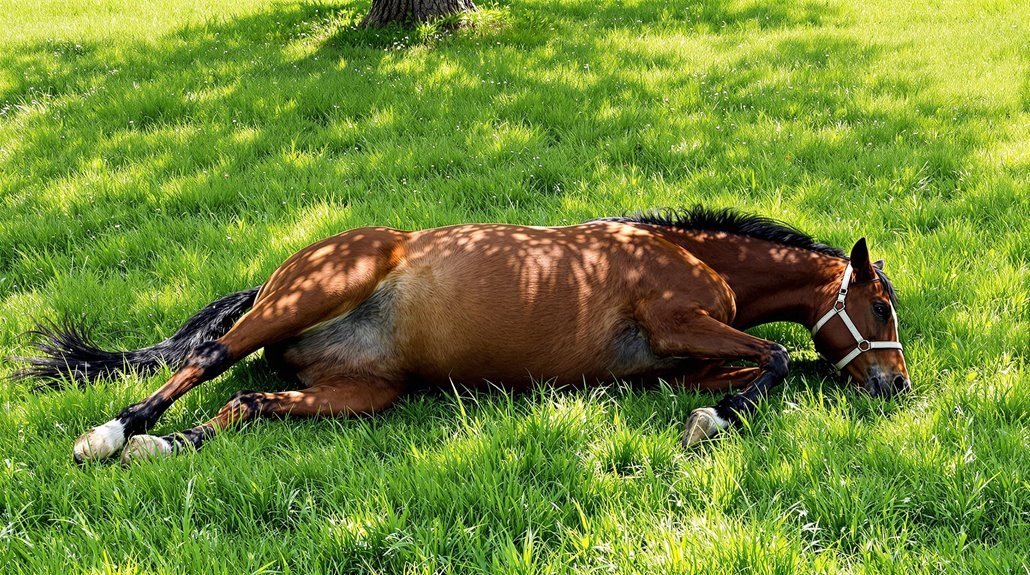
Only a small share of lying down is spent flat out on one side, which is called lateral recumbency. A horse usually lies flat for ten to thirty minutes at a time. That is the position it needs for deep sleep, and it is also the position that worries owners most, because a horse flat out in a field can look, at first glance, like a horse that has collapsed.
Sleep: The Deep Sleep Horses Can Only Get Lying Down
Horses are famous for sleeping standing up, and it is true that they doze on their feet. A system of tendons and ligaments called the stay apparatus locks the leg joints, so the horse can rest its muscles without falling over. But standing sleep is only light sleep. For deep sleep, the kind the brain needs to recover, a horse must lie down.
Deep sleep, or REM sleep, lasts only a short time in horses. An adult horse needs roughly 30 to 60 minutes of it in a day, usually in bouts of ten to thirty minutes. That is why a healthy horse lies down at least once a day, often in the quiet of the early afternoon or the middle of the night, when the yard is still and it feels safe.
Rest and Tiredness After Hard Work
Hard work makes horses tired, just as it makes people tired. A horse that has had a long ride, a competition day, or a first day back in work after a break may lie down more that evening. This is normal recovery, and it is a good sign that the horse is comfortable enough to rest.
Tiredness shows in other small ways too. The horse may be slow to come to the gate, eat its hay more slowly than usual, or stand with its head low for a while after work. As long as it is drinking, passing droppings normally, and bright the next morning, tiredness is the most likely explanation.
Heat is a common trigger for extra lying down. In hot weather, a horse may lie down in the shade to rest and cool off, and it may drink more and eat less. Make sure there is always clean water within easy reach. If you are unsure how much your horse should be drinking, our horse water intake calculator gives a quick estimate for its size and workload.
Colic: The Reason to Act Fast
Colic is the word horse owners fear most, and it simply means belly pain. It is the most serious common reason for a horse to lie down more than usual. A horse with colic lies down because the pain makes standing uncomfortable, and it gets up again because lying down does not help either. That restless cycle of down, up, down again is the classic warning sign.
Look for the other signs that go with it. A horse with colic may paw at the ground, roll, look round at its belly, stretch out as if trying to urinate, sweat in patches, and refuse food and water. Its droppings may stop, or become small and dry. Its heart rate may rise above its normal resting rate of about 28 to 44 beats per minute.
If you see this pattern, call your vet straight away. Do not wait to see if it passes. While you wait, keep the horse walking gently if it is safe to do so, and take away grain and hay so it cannot eat. Do not give it any medicine unless your vet tells you to. Note when the signs started, when it last passed droppings, and whether it has drunk anything, because your vet will ask.
Some horses with colic lie quietly instead of rolling. This is easy to miss, and it is why a horse that lies down more than usual and will not eat should always be checked, even if it looks calm. A quiet horse that refuses its feed is telling you something. If your horse has gone off its hay, our guide to how long a horse can go without hay explains why forage gaps matter and when they become dangerous.
Pain in the Legs, Feet and Back
A horse in pain lies down to take the weight off the sore part. This is most common with foot and leg problems. Laminitis, the painful swelling inside the hoof, is the classic example. A horse with laminitis lies down a lot, rocks back on its heels when it does stand, and is reluctant to walk or turn. Its feet feel hot, and the pulse in the fetlock is strong and bounding.
Arthritis is another common cause, especially in older horses. A horse with sore joints may lie down more in cold or damp weather, and be stiff for the first few minutes after getting up. It may also lie down because getting up and down is painful, so it stays down longer once it is there. This is different from the restless up-and-down of colic, and the distinction helps your vet a great deal.
Back pain can have the same effect. A horse with a sore back may lie down after being ridden, or flinch when you press along its spine. Saddle fit is a common cause, and a saddle that pinches or bridges can make a horse reluctant to work and keen to lie down afterwards. If the behaviour started after a new saddle or a change in work, check the fit first.
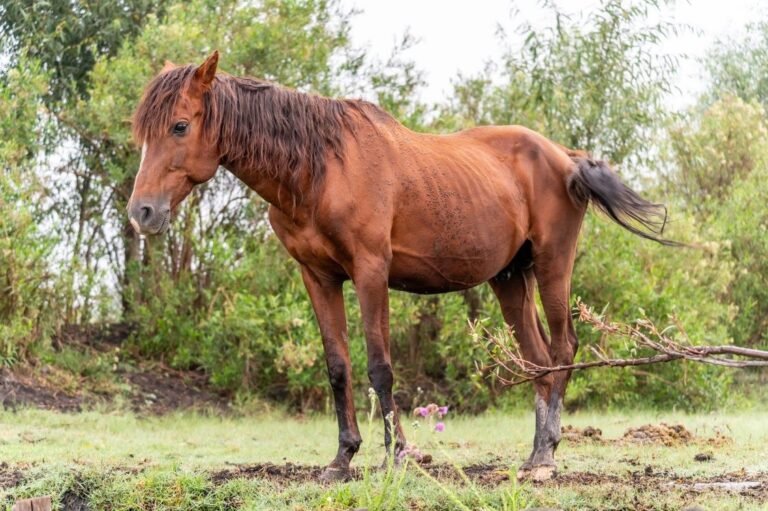
Whatever the source of the pain, the first step is the same. Look at the horse’s weight and condition, because a horse that is losing condition may be in pain it has been hiding for weeks. Our horse body condition score page shows how to score your horse at home. Then check the legs and feet for heat, swelling, and cuts, and call your vet if the lying down continues or the horse is lame.
The Cast Horse: Stuck Against a Wall
A cast horse is a horse that has rolled too close to a wall or fence and cannot get its legs underneath it to stand up. It is stuck, not sick, but it is still urgent. A horse that is cast will struggle, panic, and can injure itself badly if it is left too long. The legs against the wall have no room to push, and the horse may thrash and cut itself on the stable fittings.
Small stables are the most common cause. A stable that is too small for the size of the horse leaves no room to roll safely. Deep bedding that banks up against the walls makes it worse, because the horse rolls into the bank and gets wedged. A horse that rolls a lot, such as a horse with an itch or a horse that has just been worked, is more likely to get cast.
If you find a cast horse, stay calm and keep your own safety first. A frightened horse can kick hard. If you can do so safely, pull the horse away from the wall by its headcollar and a rope, or roll it over by pushing on its legs and body with a helper. Some owners use a rope around the hind legs to pull them clear of the wall. Once the horse is free, let it get up in its own time, then check it over for cuts, swelling, and lameness.
Prevention is simple. Give the horse a stable big enough to roll in, keep the bedding level rather than banked high against the walls, and fit anti-cast strips or a rounded bank of bedding that helps the horse roll back. If your horse gets cast more than once, look at the stable size first, because that is almost always the cause.
The Down Horse That Cannot Get Up
A down horse is a horse that is lying down and cannot rise. This is different from a cast horse, which is stuck against something. A down horse cannot get up because it is too weak, too painful, or too ill, and it is one of the most serious situations an owner can face. Veterinary researchers at the University of Minnesota describe recumbency as a sign that usually means a severe problem, and they stress that a down horse needs rapid, careful assessment.
The dangers build quickly. A horse’s own weight presses on the muscles and nerves on the down side, and after a few hours the muscle can be damaged. The gut slows down, which raises the risk of colic. The lung on the down side does not work as well, because blood pools there under gravity. That is why vets say a horse that has been down for more than a day has a poor outlook, and why early action matters so much.
If your horse is down and cannot get up, call your vet at once and do not try to force it up by dragging it. Keep the horse warm with rugs, keep it calm, and if you can do so safely, roll it onto the other side every two to three hours to take the pressure off the down side. Offer water in a bucket it can reach without standing. Your vet may use a sling or a team of helpers to lift the horse, and will check for the cause, which can range from a fracture or severe laminitis to a nerve problem or an infection.
There is a useful rule of thumb here. If a horse has been lying in one position for more than two hours without getting up or changing position, treat it as a problem, not a nap. A sleeping horse shifts position and gets up. A horse that has not moved for two hours needs checking, and a horse that tries to rise and fails needs a vet immediately.
Foals and Older Horses Lie Down More
Age changes everything about lying down. Foals lie down far more than adult horses, and that is completely normal. A newborn foal may spend half the day lying down, because it needs the rest to grow, and its legs are not yet strong enough to stand for long. It will lie flat out on its side, legs stretched, looking for all the world like it has collapsed. As long as it gets up to nurse, moves well, and is bright, there is nothing to worry about.
Older horses go the other way. A horse in its twenties may lie down more because its joints are stiff, its muscles are weaker, and getting up takes more effort. Some older horses lie down longer simply because it is comfortable. Watch for the difference between a comfortable old horse and a painful one. A comfortable old horse gets up when you bring feed, eats well, and moves freely once it is up. A painful one is stiff, slow, and reluctant to move even after standing.
For senior horses, the winter months are the hardest. Cold, damp weather stiffens old joints, and a senior horse may lie down more and drink less, which raises the risk of impaction colic. Our guide to senior horses not drinking enough water in winter covers the warm-water and mash tricks that keep an old horse drinking when the weather turns.
What to Do When You Find Your Horse Lying Down
The first thing to do is watch before you act. Stand quietly for a minute and look. Is the horse breathing normally? Are its ears relaxed or pinned? Is it sweating? Are there droppings nearby, and do they look normal? A calm, slow-breathing horse with relaxed ears is most likely asleep. A sweating, restless horse that keeps looking at its belly is not.
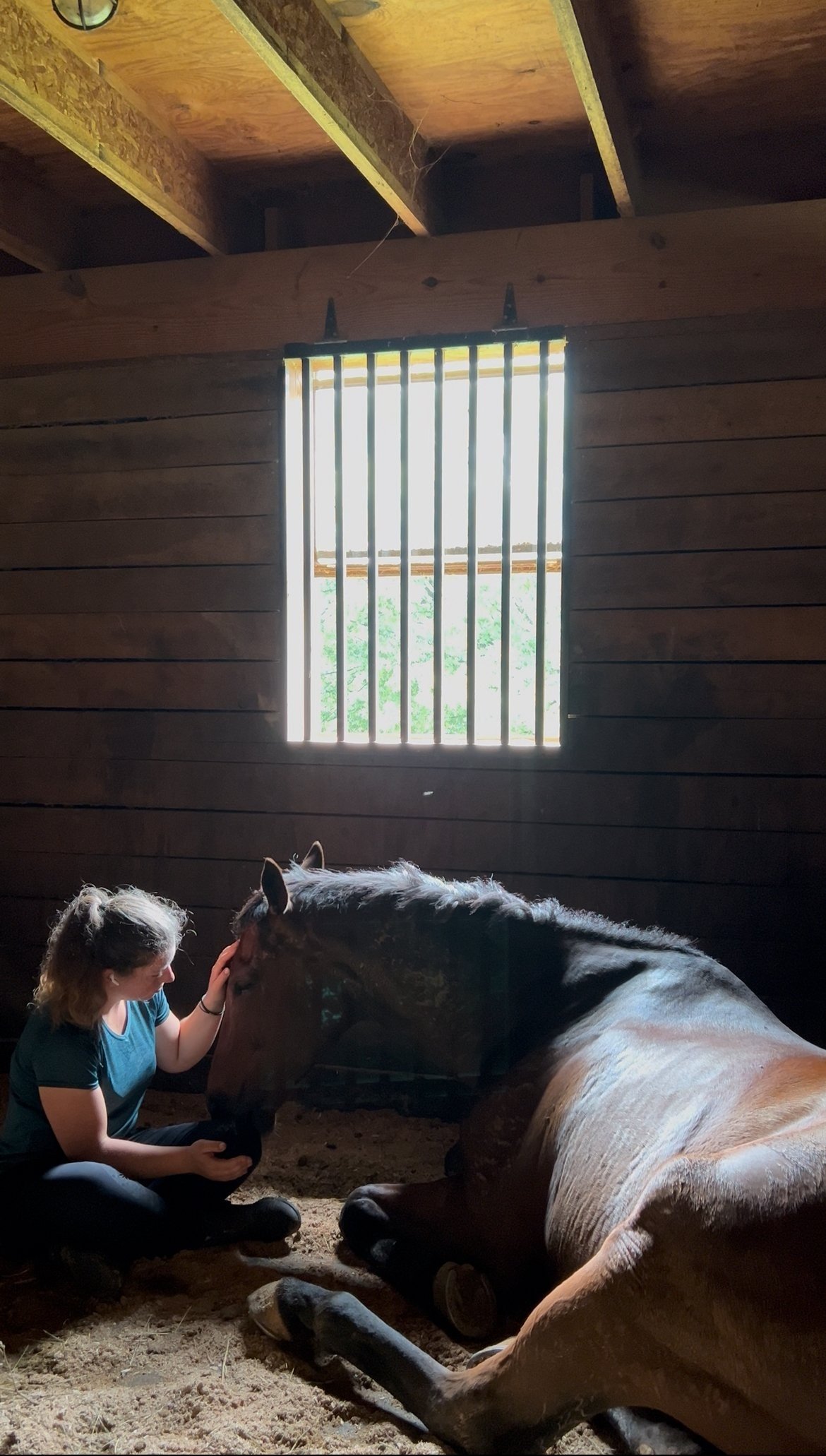
Next, approach and speak to the horse. A sleeping horse will usually lift its head and look at you, then get up when you encourage it. Offer a small amount of feed or a carrot. A horse that gets up and eats is almost certainly fine. A horse that stays down, or gets up and lies down again straight away, needs a closer check.
Run a quick hands-on check. Feel the feet for heat, look at the gums, pinch the skin on the neck, and take the temperature if you have a thermometer. Count the droppings in the stable or field. Listen for gut sounds by putting your ear to the belly: a healthy gut gurgles regularly, while a silent gut is a warning sign. Write down what you find, because your vet will ask for exactly these details.
When to Call the Vet
Call your vet straight away if your horse cannot get up, has been down in one position for more than two hours, is rolling or thrashing, is sweating and looking at its belly, has stopped eating and drinking, or has no droppings. These are the signs that the lying down is a symptom, not a rest.
Call the same day if the horse is lying down more than usual for a second day running, is stiff or lame when it gets up, has hot feet or a strong pulse in the fetlock, or is dull and off its feed. Early treatment for laminitis and colic makes a real difference, and a day’s delay can turn a manageable problem into a serious one.
When you call, have the facts ready. Tell the vet when the behaviour started, how long the horse stays down, whether it rolls or paws, what it has eaten and drunk, when it last passed droppings, and its temperature and heart rate if you have them. A clear, short report gets you the right advice faster than a long, worried description.
Do not be embarrassed about calling for what turns out to be a nap. Vets would far rather be called for a sleeping horse than called too late for a colic. The cost of a phone call is nothing, and the peace of mind is worth it. Every vet has a story about an owner who waited too long, and none about an owner who called too soon.
Frequently Asked Questions
How many hours of sleep does a horse need each day?
A horse needs about three to five hours of sleep in total each day, but only 30 to 60 minutes of that is deep sleep. The rest is light sleep, much of it taken standing up. The total varies with age, workload, and weather. Foals sleep far more, and horses in hard work may sleep a little more too. What matters is not the exact number but whether your horse gets its deep sleep lying down each day.
How long can a horse go without lying down?
Most horses lie down at least once a day, and a horse that does not lie down for several days is a concern. Research on sleep-deprived horses shows they can go roughly seven to fourteen days without deep sleep before they start to collapse in sudden sleep attacks, where their legs buckle while they are standing. If your horse has not lain down for days, check that it feels safe enough to do so, and ask your vet for advice.
Why does my horse lie down in the sun?
Horses lie down in the sun for the same reason people stretch out on a beach: it is warm, comfortable, and relaxing. A horse that lies flat out in the sun, often with its legs stretched and its eyes half closed, is usually enjoying itself. The warmth helps stiff muscles relax, and the sun dries the coat. As long as the horse gets up easily, is bright, and has shade and water nearby, sunbathing is nothing to worry about.
Should I wake my horse up if it is lying down?
There is no need to wake a horse that is lying down quietly and breathing normally. Let it sleep. The only time to wake a horse is when you need to check it, for example if it has been down for a long time, if it is sweating, or if it is lying in an awkward place. Approach quietly, speak to it, and let it get up in its own time. A horse that is woken suddenly can scramble up in a panic and injure itself or you.
A horse lying down more than usual is usually telling you something simple: it is tired, it is catching up on deep sleep, or it finally feels safe. Learn what is normal for your horse, watch for the pattern changes that mean pain or illness, and act quickly when the signs point to colic or a down horse. That habit, more than any single test, is what keeps a horse safe. For more on the warning signs that go with lying down, see our guide to why a horse sweats in cold weather and our article on loose manure in horses, which covers another early sign that something is wrong inside.