How Often Should I Change My Fish Tank Filter Cartridge?
If you are asking how often should i change my fish tank filter cartridge, the box your filter came in probably gave you a confident answer: every four weeks. The shop that sold it to you probably said the same. It sounds simple, and it sounds official. The trouble is that it is wrong for most tanks, and following it blindly can do real harm to your fish.
A filter cartridge is not like a light bulb that burns out on a schedule. It is a home for the good bacteria that keep your fish alive. Those bacteria live on the cartridge’s fibres, and they turn deadly ammonia into nitrite, then into much safer nitrate. Throw the cartridge away, and you throw a large part of your bacteria colony away with it.
That does not mean you should never change a cartridge. It means the right question is not “how many weeks has it been?” but “is this cartridge still doing its job?” This guide gives you the honest schedule, the rinse-instead-of-replace method, and the signs that tell you when a cartridge is truly finished.
Direct answer: Change your fish tank filter cartridge every 4 to 6 weeks only if it is falling apart or water no longer flows through it after rinsing. In most tanks, the right routine is to rinse the cartridge in old tank water every 2 to 4 weeks and keep using it for 6 to 12 months. Never throw a cartridge away just because the calendar says so: it holds the beneficial bacteria that convert ammonia and nitrite, and replacing it all at once can crash your cycle and spike ammonia. The only part that truly expires on a schedule is the activated carbon inside, which stops working after about 3 to 4 weeks.
How Often Should I Change My Fish Tank Filter Cartridge? The Honest Schedule
The honest answer depends on your tank, not on a date printed on a box. Filter makers sell cartridges, so their advice leans toward replacing them often. Your fish would rather you kept the bacteria. Here is a schedule based on what actually happens in real tanks.
| Tank type | Rinse the cartridge | Replace the cartridge |
|---|---|---|
| Small tank under 20 gallons | Every 2 to 3 weeks | Only when it falls apart, usually after 6 to 12 months |
| Medium tank, 20 to 55 gallons | Every 3 to 4 weeks | Only when it falls apart, usually after 6 to 12 months |
| Large tank over 55 gallons | Every 4 to 6 weeks | Only when it falls apart, often after a year or more |
| High bioload: goldfish, cichlids | Every 2 weeks | When flow stays slow after rinsing, often sooner |
| Low bioload: betta, tetras, shrimp | Every 4 to 6 weeks | Rarely, sometimes after a year or more |
| New tank under 3 months old | Only if flow drops badly | Never, unless it physically breaks |
Notice the pattern. Rinsing is frequent. Replacing is rare. That is the opposite of what the box tells you, and it is the way experienced keepers actually run their tanks. A cartridge that is rinsed regularly and looks dirty is doing its job. Dirt on the floss is mostly trapped waste and bacteria, not a problem. The problem is only when water cannot get through it any more.
New tanks deserve a special warning. In the first two or three months, your bacteria colony is still young and fragile. It lives mostly on the cartridge and the filter sponge. Replacing the cartridge in a new tank can wipe out the colony before it is strong enough to recover. If the cartridge clogs in a new tank, rinse it gently and put it straight back. Do not replace it.
Goldfish keepers need the opposite warning. Goldfish produce a huge amount of waste for their size. Their cartridges clog fast, and a clogged cartridge slows the flow, which starves the bacteria of oxygen and lets ammonia climb. If you keep goldfish, rinse every two weeks without fail. Our goldfish tank calculator helps you check whether your tank is big enough for the fish you keep, which is the first step in keeping waste under control.
What a Filter Cartridge Actually Is
Most disposable cartridges are a simple sandwich. The outside is a pad of white filter floss. Inside that is a pocket of black granules, which is activated carbon. The floss catches solid waste. The carbon soaks up dissolved chemicals, smells, and some medicines. Both parts sit in the filter box, and water is pushed through them.
But there is a third job that the box never mentions. Within days of going into a running tank, the floss becomes coated in a thin, slimy layer of beneficial bacteria. These are nitrifying bacteria, mainly Nitrosomonas and Nitrospira. They eat ammonia and nitrite, the two most dangerous wastes your fish produce. Without them, ammonia would climb to lethal levels within days.
That is why a cartridge is not just a filter. It is a living surface. The dirtier it looks, the more bacteria it usually holds. Rinsing it gently removes the trapped waste while leaving most of the bacteria in place. Throwing it away removes the waste and the bacteria together, and the tank has to grow a new colony from scratch.
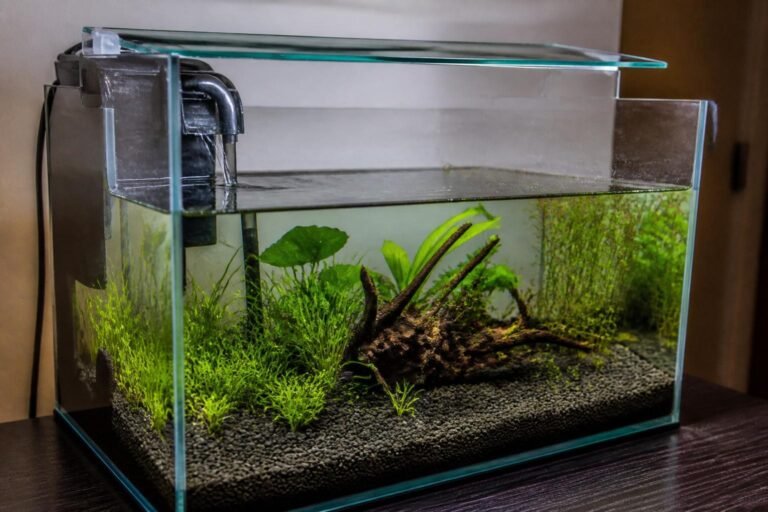
Different filter types handle this differently. A hang-on-back filter usually runs on one or two cartridges. A canister filter uses separate baskets of sponge, ceramic rings, and carbon, and the ceramic rings are never meant to be replaced at all. An internal filter often uses a sponge that lasts for years. The cartridge advice in this guide applies to hang-on-back and internal filters that use disposable cartridges. If your filter uses separate media, the same principle applies even more strongly: rinse, do not replace.
The Mistake Almost Everyone Makes
The most common cartridge mistake is also the most damaging one. A keeper buys a new cartridge, takes the old one out, throws it in the bin, and slots the new one in. The water looks cleaner. The filter flows faster. Then, two days later, the fish are gasping at the surface and the ammonia test reads 0.5 ppm or higher.
What happened is simple. The old cartridge held most of the tank’s bacteria. The new cartridge holds none. The tank’s cycle has crashed, and the fish are now swimming in their own waste while a new colony slowly grows. In a heavily stocked tank, that crash can kill fish within days.
The fix is called seeding, and it takes five minutes. When the old cartridge is truly finished, do not throw it away yet. Cut a piece of the old floss off and tuck it into the filter box next to the new cartridge. Or run the old cartridge and the new cartridge side by side for a week or two. The bacteria spread from the old media to the new media, and the colony survives the change.
If your filter only holds one cartridge, there is another trick. Cut the old cartridge open, scoop out the spent carbon, and keep the floss frame. Rinse it, and put it back in with the new cartridge if there is room. If there is no room, run the old floss in the tank in a mesh bag for a week, near the filter intake. It looks untidy, but it saves your cycle.
Never replace all your filter media at once. If you have two cartridges, replace one, wait a month, then replace the other. If you have a sponge and a cartridge, never clean both on the same day. Always leave one home for the bacteria. This one rule prevents more cycle crashes than any product on the shelf.
And never rinse a cartridge in tap water if you can avoid it. Tap water contains chlorine and chloramine, and both kill bacteria on contact. Always rinse in a bucket of old tank water that you removed during a water change. If you want to plan that change properly, the aquarium water change calculator works out the right size for your tank. For more on filter care generally, see our guide to whether you can turn off your fish tank filter at night — the short answer is no, and the reason is the same bacteria.
Rinse or Replace? The Decision Table
Use this table when you are holding a dirty cartridge and wondering what to do. It covers the situations keepers actually face.
| What you see | What it means | What to do |
|---|---|---|
| Brown floss, water still flows well | Normal, healthy bacteria at work | Nothing. Leave it alone. |
| Floss clogged, flow slower than usual | Trapped waste is blocking the water | Rinse gently in old tank water, put it back. |
| Flow still slow after a good rinse | Fibres are worn and matted | Replace it, and seed the new one from the old. |
| Floss torn, falling apart, or full of holes | The cartridge is physically finished | Replace it, and seed the new one from the old. |
| Carbon inside is more than a month old | Carbon is exhausted and does nothing | Cut it out or replace the carbon only, keep the floss. |
| Bad smell from the cartridge | Trapped waste is rotting | Rinse well. If the smell stays, replace and seed. |
| Ammonia above 0 ppm after a cartridge change | The cycle crashed | Test daily, change water, add old media back if you still have it. |
The key row is the first one. A brown cartridge with good flow is a good cartridge. New keepers often mistake that brown colour for dirt that must go. It is mostly bacteria and trapped food, and it is exactly what a working filter looks like. If the water is clear and the tests read zero, the brown cartridge is doing its job beautifully.
How to Clean a Cartridge, Step by Step
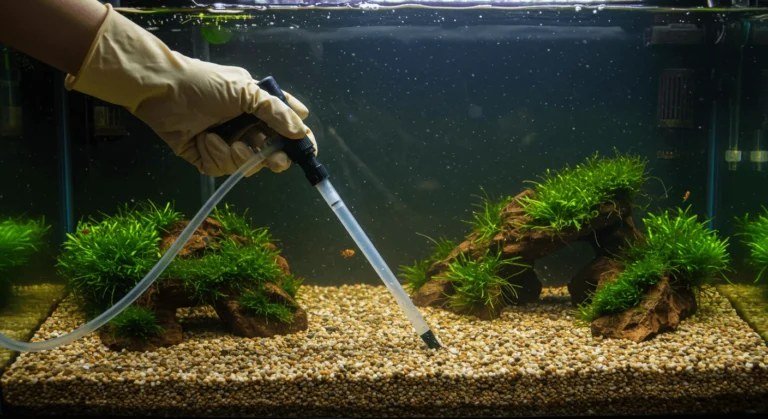
Cleaning a cartridge is a five-minute job, and it is the single most useful maintenance skill in fishkeeping. Do it during your regular water change so you already have a bucket of old tank water ready.
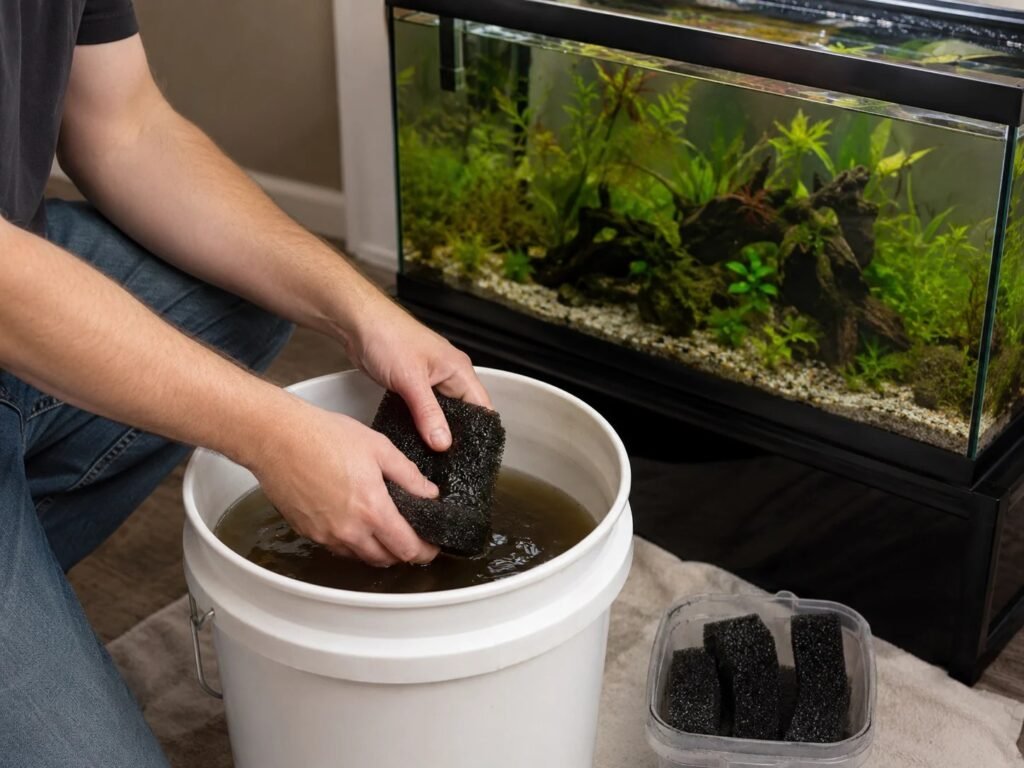
First, switch the filter off. Never pull a cartridge out of a running filter if you can avoid it. The pump can run dry for a few seconds, and that short dry run wears the impeller. Unplug the filter, then lift the cartridge out gently. Hold it over the bucket, not over the tank, so the loose waste does not fall back in.
Second, swish the cartridge in the bucket of old tank water. Squeeze it gently, a few times, like wringing out a sponge. Do not scrub it. Do not use a brush. The goal is to knock the trapped waste out of the fibres, not to strip the bacteria off. The water in the bucket will turn brown and murky. That is the waste leaving, and it is exactly what you want to see.
Third, rub the floss side lightly with the palm of your hand. This clears the surface layer where most of the waste collects. If your filter has a pre-filter sponge on the intake, you can clean that one more firmly, because it holds very few bacteria. The cartridge itself deserves a gentle touch.
Fourth, check the carbon. If the cartridge is more than a month old, the carbon inside is spent. You can cut a small slit in the floss, tip the old carbon out, and either leave the pocket empty or refill it with fresh carbon. The floss keeps working either way. Many keepers run their cartridges without carbon most of the time, and only add it when they need to remove a smell or a medicine.
Fifth, put the cartridge back and switch the filter on. Watch the flow for a minute. It should be strong and steady. If the flow is still weak, the cartridge may be worn out, and it is time to replace it using the seeding method above. Check the water tests the next day, just to be sure the rinse did not disturb anything.
One more tip saves a lot of trouble. If your filter holds two cartridges, clean one this week and the other next week. If it holds one, clean only half of it at a time when you can: rinse one side this month, the other side next month. Spreading the cleaning out means half the bacteria always stay untouched, and the cycle never wobbles.
Carbon: The Part That Really Does Expire
Activated carbon is the confusing part of the cartridge story, because it genuinely does wear out on a schedule. Carbon works by adsorption, which means dissolved chemicals stick to its huge surface area. After three to four weeks, that surface is full, and the carbon stops working. It does not become harmful. It just becomes useless, like a sponge that cannot hold any more water.
That is the one part of the cartridge where the four-week rule is roughly right. But the fix is not to throw the whole cartridge away. The fix is to replace the carbon and keep the floss. Cut the cartridge open, empty the old carbon, and refill it with fresh carbon from a bag. It costs very little, and it keeps the bacteria where they belong.
Many keepers skip carbon entirely, and their tanks are fine. Carbon is useful for removing smells, yellow tints, and leftover medicine after a treatment. It is not needed for day-to-day filtration. The bacteria and the floss do the real work. If you run a planted tank, some keepers avoid carbon altogether because it can absorb the liquid fertiliser they add for their plants.
There is one time carbon matters a lot: after medicating the tank. Most fish medicines say to remove carbon during treatment, because carbon soaks the medicine up before it can work. After the treatment ends, fresh carbon helps pull the leftover medicine out of the water. That is a good use for it, and it is the main reason to keep a bag of carbon in the cupboard.
Signs Your Cartridge Needs Attention Right Now
Most cartridge problems announce themselves before they become emergencies. Learn the signs, and you will catch them early.
The most obvious sign is flow. If the water coming out of the filter is a trickle instead of a steady stream, the cartridge is clogged. If the filter box is overflowing, or water is spilling over the top of the cartridge instead of through it, the blockage is serious. Rinse it the same day. A filter that cannot move water cannot keep the tank clean, and the bacteria inside it start to starve for oxygen.
The second sign is cloudy water that does not clear. A working filter polishes the water. A clogged one lets fine particles drift around the tank. If the water goes cloudy and stays cloudy for more than a day, check the cartridge before you reach for a chemical clarifier. Our guide to cloudy water after a water change covers the other causes, but a clogged cartridge is one of the first things to rule out.
The third sign is smell. A healthy filter smells faintly earthy, like a pond. A cartridge full of rotting waste smells sour or swampy. If you can smell the filter from across the room, rinse it now, and check whether uneaten food is piling up in the gravel. Our guide on how often to clean your fish tank gravel helps you deal with the waste at its source.
The fourth sign is the test kit. Ammonia or nitrite above zero in an established tank is an emergency, and a clogged or crashed filter is a common cause. Test first, then act. If you changed a cartridge in the last few days, the crash is almost certainly the cause, and the fix is daily water changes until the bacteria recover.
A Simple Cartridge Routine for the Whole Year
Here is a routine that keeps the filter working and the bacteria safe all year. It takes ten minutes a month, and it replaces the throwaway habit for good.
Every two to four weeks, at water-change time, rinse the cartridge in the bucket of old tank water. Squeeze it gently, rub the floss side, and put it straight back. Test ammonia and nitrite once a month, or any time the fish behave strangely. Both should read zero.
Every three to four weeks, if you use carbon, replace just the carbon. Cut the cartridge open, tip the old granules out, and refill with fresh carbon. Keep the floss. If you do not use carbon, skip this step entirely.
Every six to twelve months, inspect the cartridge properly. Hold it up to the light. If the floss is thin, torn, or full of holes, or if the flow stays weak after a good rinse, it is time for a new one. Seed the new cartridge from the old one, run them together for a week or two, and only then throw the old one away.
Keep one spare cartridge in the cupboard, unopened, for emergencies. If a cartridge tears suddenly, or a filter clogs while you are away, the spare saves the day. But do not open it on a schedule. Let it sit there until you actually need it. Your fish and your wallet will both be better off.
If you are planning a new tank, the aquarium stocking density calculator helps you avoid overstocking, which is the main reason cartridges clog fast. And if you ever worry that something in the tank is making your fish sick, the Merck Veterinary Manual guide to disorders and diseases of fish is a trusted place to check symptoms. The RSPCA’s fish care advice is another good reference for everyday care.
Frequently Asked Questions
What happens if I never change my filter cartridge? Nothing terrible, as long as you rinse it regularly and it is not falling apart. A cartridge that is rinsed every few weeks can work for a year or more. The risk of never changing it is that the floss eventually wears thin and stops catching waste, so the water gets cloudy and the flow drops. Replace it when it is physically worn out, not on a date.
Can I run my filter without a cartridge? You can for a short time in an emergency, but not as a routine. Without the cartridge, the filter moves water but catches almost no waste, and the bacteria lose their main home. If you must run without one for a day, keep the old floss in a mesh bag near the intake so the bacteria survive. Fit a replacement as soon as you can.
Should I change the cartridge and do a water change on the same day? It is better not to do both at once. A water change and a cartridge change are both small shocks to the bacteria, and doing them together doubles the shock. Rinse the cartridge at water-change time, but save a full replacement for a different day, when the tank is settled. Always seed the new cartridge from the old one.
Do sponge filters have cartridges? No. A sponge filter is a sponge with an air lift tube, and it has no disposable cartridge at all. You rinse the sponge in old tank water every few weeks and use the same sponge for years, until it physically falls apart. The same principle applies: the sponge is a bacteria home, so rinse it gently and never replace it all at once.
How long does a filter cartridge last in a betta tank? A long time. A single betta in a 5-gallon tank produces very little waste, so the cartridge clogs slowly. Rinse it every four to six weeks, and the same cartridge can easily last a year or more. The carbon inside will be spent after a month, but the floss and the bacteria are what matter, and they last far longer.