Why Is My Betta Fish Flaring at His Reflection?
If you are asking why is my betta fish flaring at his reflection, you have probably watched it happen. Your betta swims up to the glass, spreads his gill covers wide, and fans his fins out like a peacock. He holds the pose. He stares at the glass. And the fish in the glass stares right back.
It looks like a fight. In a way, it is. Your betta cannot tell his own reflection from a rival male. To him, there is another male betta in his tank, and that male never backs down, never leaves, and never loses. So your betta keeps flaring.
The good news is that a little flaring is normal and even healthy. A short flare is how a male betta shows he is alert, strong, and in charge of his space. The problem starts when the flaring never stops. A betta that flares at his reflection all day is not exercising. He is stuck in a fight he cannot win, and that steady stress wears him down.
Direct answer: Your betta fish is flaring at his reflection because he thinks it is a rival male. Male bettas are territorial, and a mirror image has the same colours, fin shape, and posture as a real intruder. A few short flares a day, each lasting a minute or two, are normal. Flaring for hours, or flaring every time he passes the glass, means the reflection is always visible and you need to remove it.
Start by checking the lighting. Glass turns into a mirror when the room is darker than the tank, which happens most evenings once the tank light is on. Turn a room light on, add a solid background to the back and sides of the tank, and move shiny objects away from the glass. Most constant flaring stops within a day or two of fixing the reflection.
Why Is My Betta Fish Flaring at His Reflection?
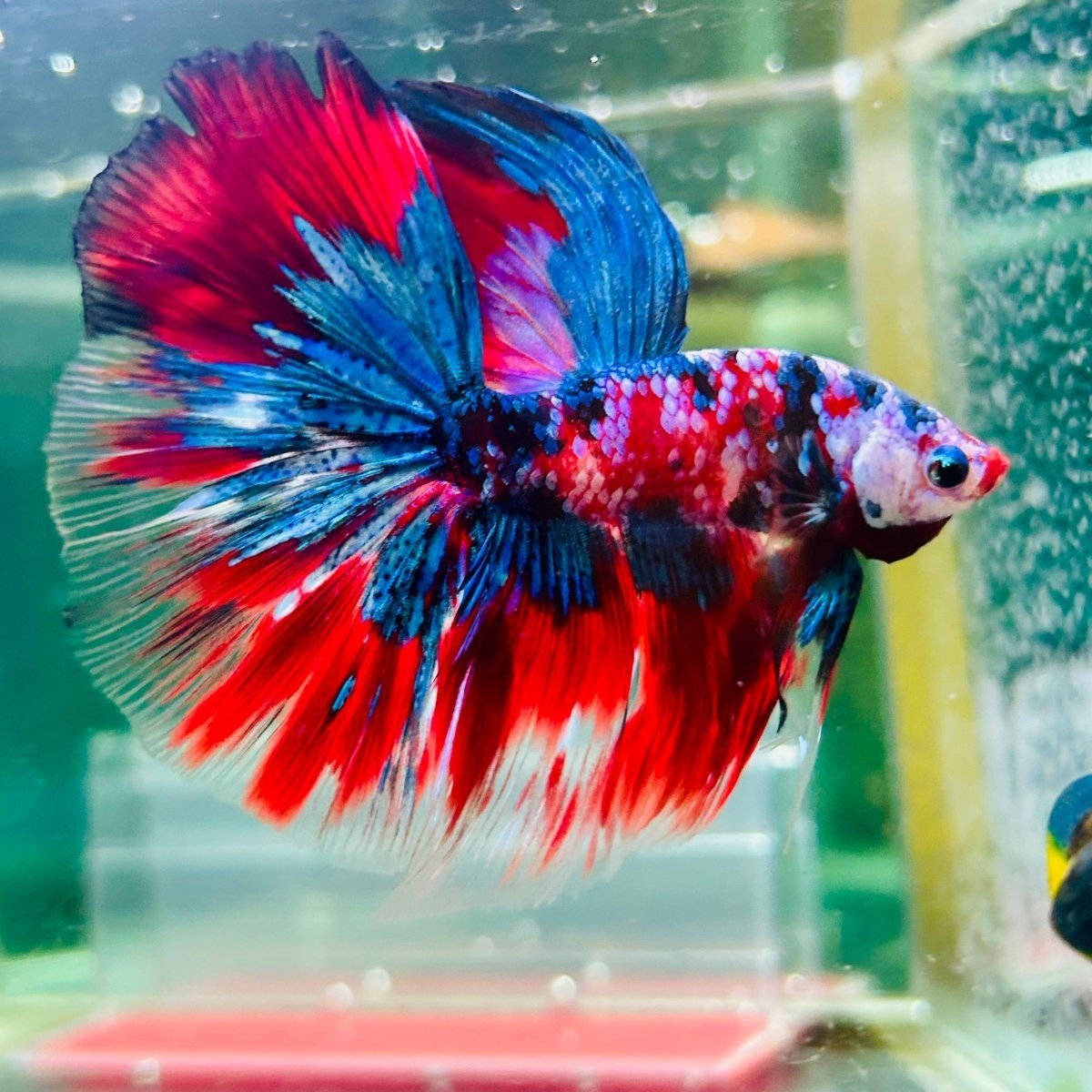
Flaring is a threat display, and it is built into every male betta. When he flares, he pushes his gill covers, called opercula, out to the sides. The red membrane underneath shows. At the same time, he spreads his fins as wide as they will go. The whole point is to look bigger and stronger than the other fish.
In the wild, this display usually works. The smaller or weaker male backs off, and the fight ends without anyone getting hurt. Flaring is a way to settle arguments without biting. That is why it is so common. It is the betta’s first move, not his last resort.
The trouble in a tank is that the “other fish” is a reflection. It copies every move your betta makes. When he flares, it flares. When he charges, it charges. There is no way for him to win, because there is no real fish to scare away. So a betta that can always see his reflection can end up flaring for hours.
That is the key difference to watch for. A normal flare ends. A reflection flare often does not, because the trigger never goes away. The table below shows how to tell the two apart at a glance.
| What you see | Normal display | Warning sign |
|---|---|---|
| How long each flare lasts | A few seconds to about two minutes | Ten minutes or more without stopping |
| How often it happens | A few times a day, then he moves on | Every time he passes the glass, all day |
| What he does after | Swims away, eats, explores, rests | Stays at the glass, ignores food, hides after |
| His breathing | Settles back to normal within a minute | Fast gill movement for minutes after he stops |
| His colour | Bright, returns to normal quickly | Stays dark or washed out for hours |
| His fins | Spread wide, then relaxed and smooth | Clamped tight, torn, or held half open |
If your betta matches the left column, relax. He is doing what male bettas do. If he matches the right column on three or more rows, the reflection is a real problem, and the fixes later in this guide will help. If he is also off his food or sitting on the bottom, check the water first. Our guide to why your fish is hiding all the time covers the other causes to rule out.
What Flaring Actually Costs Your Betta
Flaring looks like showing off, but it is hard physical work. Holding the gill covers open changes how water flows across the gills. While he flares, your betta takes in less oxygen through his gills, so he has to swim to the surface for air more often. A short burst is fine. Twenty minutes of non-stop display leaves him winded.
The cost is not just oxygen. Every flare is a stress response, and a stress response releases cortisol, the stress hormone. In short bursts, cortisol is useful. It sharpens the fish and gets him ready to act. When it stays high for hours, it starts to cause harm. It suppresses the immune system, which is the body’s defence against disease.
That is why constant flaring is linked to the illnesses that follow it. A betta that flares all day is more likely to develop fin rot, to catch ich, and to go off his food. The flaring did not cause the disease directly. It wore down the defences that would normally have kept the disease away.
Why the Glass Turns Into a Mirror
Most owners are surprised to learn that the reflection is not there all day. It comes and goes with the light. Aquarium glass acts like a mirror when the water inside the tank is brighter than the room outside it. That is exactly what happens in the evening, when the room lights are off or dim and the tank light is on.
During the day, with daylight in the room, your betta can see out through the glass. The reflection is weak or gone. In the evening, the balance flips. The tank becomes the brightest thing in the room, and the glass turns into a mirror on the inside. That is why so many owners first notice the flaring after dinner, when the tank light is the only light on.
The tank’s own light makes it worse in another way. A bright light above dark water creates a sharp reflection on the side glass. Tanks with no background are the worst for this, because the fish can see his reflection on three or four sides at once. A tank sitting near a window can have the same problem at night, when the window goes dark and reflects the room.
Shiny objects inside the tank add more mirrors. A glossy ornament, a metal thermometer clip, a bright heater, or a polished stone can throw a reflection your betta reacts to. If your betta flares at one fixed spot rather than the whole glass, look for something shiny at that spot.
The fix starts with the light, not the fish. Turn a room light on when the tank light is on, so the room is never much darker than the tank. Add a solid, dark background to the back of the tank, and to the sides if the flaring is bad. Move shiny objects away from the glass. These three changes remove most reflections in minutes, and they cost almost nothing.
The Mirror-Exercise Myth
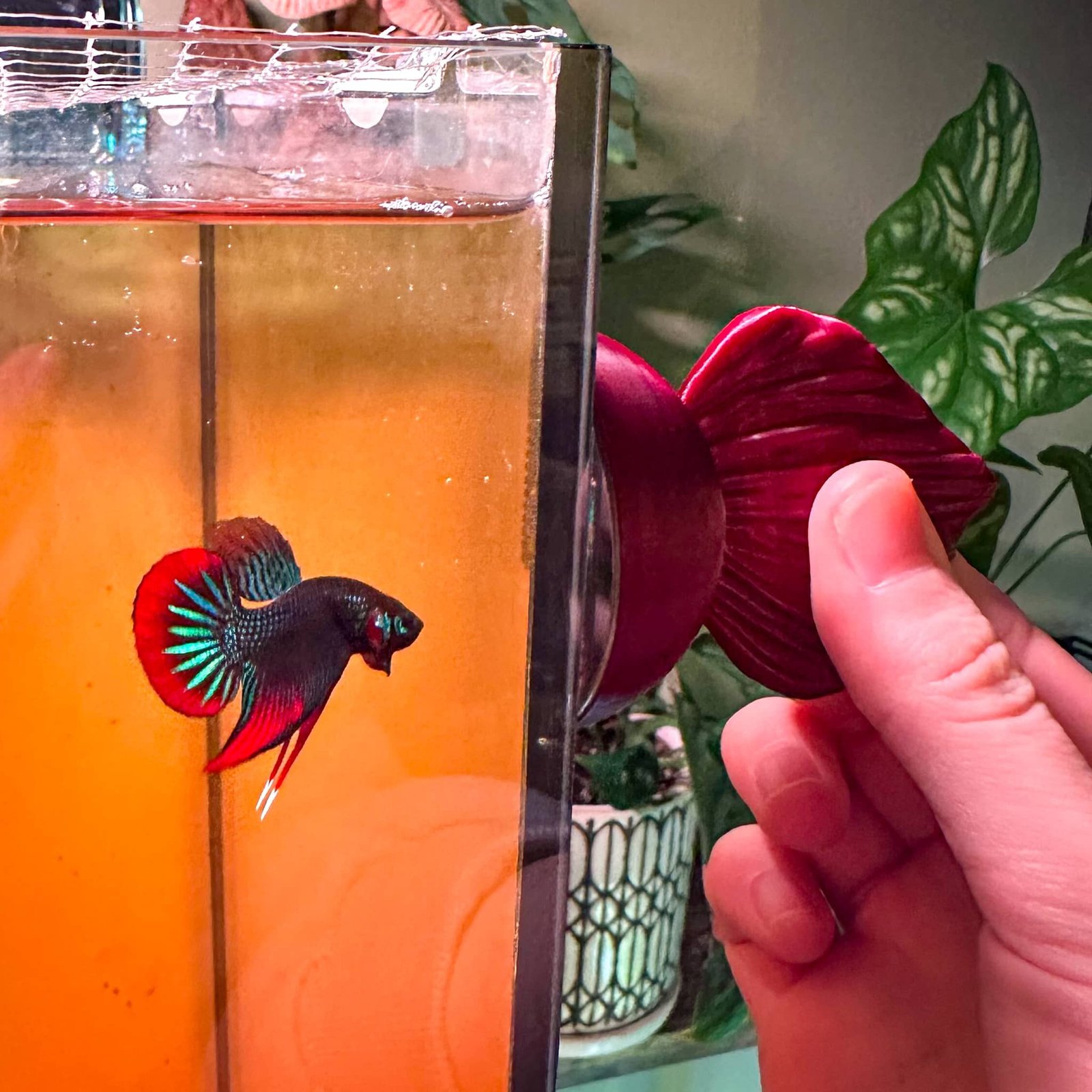
You may have read that showing a betta a mirror is good exercise. Pet shops sell small “betta exercise mirrors” for exactly this purpose. The idea is that a short flare keeps the fins spread, works the muscles, and stops boredom. There is a grain of truth in it. A brief, controlled mirror session does give a betta something to do, and many bettas swim straight over to meet the reflection.
But the mirror advice is easy to get wrong, and the mistakes matter. The first mistake is time. A mirror session should last under two minutes, and most experienced keepers keep it to 30 to 60 seconds. Two or three short sessions a week is plenty. A mirror left against the glass for ten minutes, or used every day, is no longer exercise. It is the same chronic stress as a permanent reflection.
The second mistake is thinking a mirror is needed at all. A betta in a well-set-up tank does not need a mirror to stay active. Plants to explore, a leaf to rest on, gentle flow, and a regular feeding routine give him plenty to do. The mirror is optional enrichment, not a health requirement. If you never use one, your betta will be fine.
The third mistake is using a mirror to “test” a betta’s spirit or to show him off to friends. A betta that flares hard at a mirror is not showing courage. He is showing stress. The harder and longer he flares, the more stressed he is. There is nothing to prove, and pushing him to flare longer only tires him out.
Research on mirror exposure backs up the short-session rule. Studies measuring stress hormones found that a mirror triggers the same hormonal response as a live rival, including a rise in cortisol. Bettas exposed to a mirror for more than 15 minutes a day over several days showed higher stress markers and less exploring behaviour than bettas without one. The mirror is not a toy. The dose makes the difference.
If you do use a mirror, follow three rules. Keep each session under two minutes. Do it no more than two or three times a week. And stop at once if his breathing stays heavy for several minutes after the mirror is gone, if his colour stays dark, or if he hides afterwards. Those are signs the session cost him more than it gave him.
How to Stop the Reflection in Six Steps
Work through these steps in order. Most constant flaring is fixed by the first three, and you should see a change within a day or two. Do not buy anything until you have tried the free fixes.
Step 1: balance the light. Turn a room light on whenever the tank light is on. The room should never be much darker than the tank. This one change kills most evening reflections, because the glass only mirrors when the tank is far brighter than the room.
Step 2: add a background. Put a solid, dark background on the back of the tank. A sheet of dark card, a purpose-made aquarium background, or even a dark towel taped flat will do. If he flares at the side glass too, cover the sides as well. The background blocks the mirror effect and gives your betta a calmer view.
Step 3: remove shiny objects. Look for anything glossy near the glass: metal clips, a shiny heater, a polished ornament, a reflective thermometer. Move each one away from the glass or swap it for a matt version. If he flares at one fixed spot, the cause is usually sitting right there.
Step 4: break up the open water. A bare tank with a lot of open glass gives a betta nothing to do but stare at his reflection. Add a tall plant, a piece of driftwood, or a floating plant near the surface. Plants break the line of sight and give him places to rest that are not in front of the glass. A broad leaf near the surface is a favourite resting spot for bettas, and it keeps him away from the mirror.
Step 5: check the tank size and layout. A betta in a very small tank sees his reflection everywhere, because the glass is always close. A tank of 5 gallons or more gives him room to turn away from the glass and settle somewhere calm. If you are unsure what size your tank is, or what size your betta needs, the fish tank size calculator works it out from your measurements.
Step 6: give it two days, then reassess. A betta that has been flaring all day may keep checking the glass out of habit for a day or so after the reflection is gone. That is normal. If he is still flaring constantly after two days with the background on and the lights balanced, something else is going on, and the next section covers what to check.
When Flaring Means Something Else
Not all flaring is about reflections. A betta can flare at a tank mate, at his food, at your hand, or at nothing you can see. Knowing which trigger you are looking at tells you what to fix.
Flaring at tank mates. Male bettas should live alone. If your betta shares a tank, he may be flaring at a colourful tank mate he reads as a rival. Male guppies with long, bright tails are the classic trigger, because they look like another male betta. Snails and shrimp rarely cause flaring, but a brightly coloured fish often does. If he flares only when a certain tank mate swims past, the tank mate is the problem, not the glass.
Flaring at food. Some bettas flare at large food items, especially freeze-dried bloodworms or big pellets, before they eat them. This is normal. He is treating the food as something strange that needs a warning first. It only matters if he flares and then refuses to eat, meal after meal. A betta that will not eat at all needs a water test first. Our guide to how long aquarium fish can go without food explains how long a healthy betta can safely fast while you work out the cause.
Flaring at your hand. A betta that flares when you put your hand near the glass is usually reacting to movement and size. He sees a large shape and answers with a display. This is normal, and it often fades as he learns that your hand means food, not danger. Move slowly near the tank, and do not tap the glass. Tapping startles him and can turn a calm betta into a flaring one.
Flaring with other symptoms. This is the case that needs a water test, not a background. If your betta flares and also has clamped fins, faded colour, rapid breathing, white spots, or torn fins, the flaring is probably a symptom of something else. Poor water quality is the most common cause. Test ammonia and nitrite first. Both should read zero. If either reads above zero, do a partial water change with dechlorinated, temperature-matched water. The aquarium water change calculator works out how much to change for your tank size.
Temperature matters too. Bettas need warm, steady water, around 78 to 80°F. A tank that drops below 76°F at night makes a betta sluggish and stressed, and a stressed betta flares more easily. Check the temperature with a thermometer, not just the heater dial, which can drift. If you need to size a heater for your tank, the fish tank heater calculator gives the right wattage for your volume.
What to Do If He Will Not Stop
If you have balanced the light, added a background, removed shiny objects, and given it two days, and your betta is still flaring all day, work through this short checklist. Do it in order, and stop at the step that fixes the problem.
First, test the water. Ammonia and nitrite should both be zero, nitrate under 20 ppm, and the temperature steady at 78 to 80°F. A betta in poor water is a betta on edge, and no background will fix that. Do a 25 to 50 percent water change if any reading is off, and test again the next day.
Second, check the flow. A strong filter current pushes a betta around, and a betta that cannot rest gets stressed. Baffle the filter outflow with a sponge or a piece of filter foam, or turn the flow down if your filter allows it. He should be able to swim and rest without fighting the current.
Third, look at the room. A tank next to a television, a busy walkway, or a window with passing movement gives a betta constant stimulation. If he flares whenever someone walks past, the tank may be in too busy a spot. Moving the tank is a big job, so try covering the sides first. If that helps, the location was part of the problem.
Fourth, consider his age and history. Young males flare the most, because they are at their most territorial. A betta that has flared at his reflection for weeks may also have learned the habit, and habits take a few days to fade even after the reflection is gone. Give him a calm week with the background on before you decide the fix failed.
Finally, know when to get help. If your betta stops eating for more than a few days, lies on the bottom and does not react to you, breathes fast at the surface, or shows raised scales, white cotton-like patches, or red streaks, the problem has moved past reflections. Take clear photos, note your water test results, and ask an aquatic veterinarian. The Merck Veterinary Manual guide to disorders and diseases of fish and the RSPCA’s fish care advice are both worth reading while you wait for advice.
The short version is simple. A little flaring is a healthy betta being a betta. All-day flaring is a betta asking for help, and the help he needs is usually a room light and a dark background. Fix the reflection, and most bettas settle back into their normal routine within days.
Frequently Asked Questions
Do female bettas flare too? Yes, but less often and less dramatically. Female bettas have smaller fins and no long, flowing display to show off, so their flare is a quick gill-cover lift rather than a full fan. Females usually flare at other females or at a tank mate, not at their reflection. A female that flares constantly is usually reacting to a tank mate or to poor water, so test the water and watch who she flares at before you change anything else.
Why is my betta flaring at me when I walk past the tank? He is reacting to a large moving shape, not to you personally. Bettas have good eyesight for movement, and a person walking past the glass looks like a big animal passing his territory. Most bettas learn that people mean food and calm down within a week or two. Walk slowly past the tank, avoid sudden movements, and never tap the glass. If he flares every time you pass, covering the side glass that faces the walkway usually settles him.
Why does my betta flare at his food? Some bettas flare at food that looks strange to them, especially large freeze-dried bloodworms, big pellets, or anything that moves in the current before it sinks. It is a warning display aimed at an unfamiliar object, and it is normal if he eats the food a moment later. It only matters if he flares and then refuses the food every time. In that case, try a smaller pellet, soak dry food for a minute before feeding, and check the water, because a betta that will not eat at all usually has a water or health problem underneath.
Why did my betta suddenly start flaring after months of calm? Something changed, even if you did not change it on purpose. The most common causes are a new light schedule, a room light that burned out, a background that fell off, a new shiny ornament, or a seasonal change in daylight through a window. Check what is different about the tank and the room, and look for a new reflection first. If nothing changed in the room, test the water. A heater that failed, a filter that started running harder, or a slow rise in nitrate can all make a calm betta edgy enough to flare.
Can flaring damage my betta’s fins? Flaring itself does not tear fins, because the fins are built to spread wide. The damage comes from what follows constant flaring: stress weakens the immune system, and a weakened betta is more likely to develop fin rot, which does eat away at the fin edges. A betta that flares all day and then shows ragged, shortening, or black-edged fins needs clean water first and a reflection fix second. Keep ammonia and nitrite at zero, change the water regularly, and remove the reflection. The fins usually regrow over a few weeks once the stress is gone.