Why Is My Horse Sweating in Cold Weather? Causes & Fixes
It is a cold morning, the air is sharp, and your horse is standing in the field with sweat on its neck. It makes no sense at first. Horses sweat when they are hot, not when it is freezing. Yet a horse sweating in cold weather is more common than most owners think, and the reason is usually simple. So why is my horse sweating in cold weather? Most often it is an over-heavy rug or a cool-down that finished too soon. But sweat in cold weather can also be pain, fever, or a hormone problem, and knowing which one you are looking at is the difference between changing a rug and calling the vet.
This guide works through the causes in order, from the harmless to the serious, and gives you a simple pattern table so you can sort them out in a minute. It explains how horses stay warm, why rugs cause more sweating than cold does, and the signs that mean the sweat is a symptom, not a wardrobe problem.
Direct answer: A horse usually sweats in cold weather because it is too warm under its rug, because it has not cooled down properly after exercise, or because it is in pain, has a fever, or has PPID (Cushing’s disease). Sweat under a rug on a cold day almost always means over-rugging. Sweat at rest with no rug, especially with restlessness, pawing, or a dull coat that will not shed, needs a vet. Check the horse’s temperature first: a normal temperature is 99 to 101.5°F (37.2 to 38.6°C).
Why Is My Horse Sweating in Cold Weather? The Main Causes
The table below is the fastest way to sort the causes. Find the row that matches your horse, then read the section that follows for the detail.
| What you see | Most likely cause | What to do first |
|---|---|---|
| Sweat under the rug, warm and damp skin, horse otherwise well | Over-rugging | Remove a layer or take the rug off; check again in an hour |
| Sweat after exercise, horse still warm, breathing hard | Cool-down finished too soon | Walk until dry, use a cooler rug, do not rug a wet horse |
| Sweat in patches, restless, pawing, looking at belly, not eating | Pain or colic | Call the vet now; this is an emergency |
| Sweat with a fever, dullness, cough, or runny nose | Infection | Take the temperature, isolate the horse, call the vet |
| Sweat with a long curly coat that will not shed, older horse | PPID (Cushing’s disease) | Vet examination and blood test; clip the coat |
| Sweat on the neck and flanks after a short ride in cold air | Normal exercise sweat, slow to dry in cold | Walk out, dry with a cooler, check the rug weight |
Keep the table in mind as you read on. The rest of the article explains each row, so you can watch your horse and know which one you are looking at.
How Horses Keep Warm — and Why They Sweat
Horses are far better at handling cold than people are. A healthy adult horse with a full winter coat is comfortable between about 5°C and 25°C (41 to 77°F), which is its thermoneutral zone, the range in which it can hold its body temperature steady without shivering or sweating. Below 5°C, the horse starts to work to stay warm, but it has good tools for the job.
The coat is the first of them. Each hair has a tiny muscle at its base, and when the horse is cold, those muscles lift the hairs upright, trapping a layer of warm air against the skin. It is the same effect as a puffed-up jacket, and it works remarkably well. A dry horse with a thick coat can stand in snow without feeling cold at all.
The second tool is food. Fibre fermenting in the hindgut produces heat, almost like a furnace, and a horse eating plenty of hay is warming itself from the inside. That is why forage matters more than hard feed in winter, and why a horse that has run out of hay overnight is a cold horse by morning.
Sweating is the cooling tool, and horses are extremely good at it. A square centimetre of horse skin can sweat three to four times as much as the same area of human skin, and a horse can lose litres of sweat in a hard session. The system is designed to dump heat fast, and it does not switch off just because the air is cold.
The Rug Problem: Over-Rugging
The most common reason a horse sweats in cold weather is also the most avoidable: too much rug. Owners rug by how cold they feel, and people feel cold at temperatures a horse finds comfortable. A horse in a heavyweight rug with a neck cover, standing in a sheltered stable with a full hay net, can easily become too hot, and it will sweat under the rug where nobody can see it.
A study at Sparsholt College in England found the scale of the problem. Researchers put humidity sensors under horses’ rugs and found that the horses started to sweat at around 25°C under the rug, which is the top of the thermoneutral zone. Every horse in the study was over-rugged, but only one showed sweat that could be felt by hand.
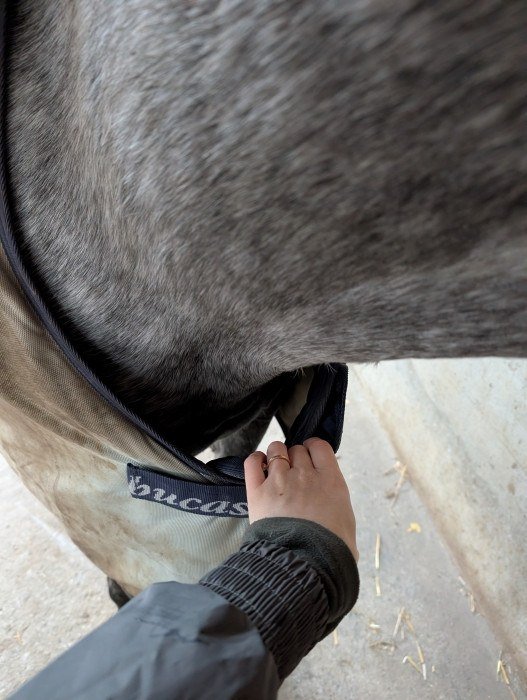
The hand test is still the best check you have. Slide your hand under the rug behind the withers, where the skin should feel comfortably warm and dry. If it feels hot, damp, or sweaty, the rug is too heavy. If it feels cold, the horse may need more cover. Check every day, and check again at midday, because a rug that is right at 7 a.m. can be far too warm by 11 a.m. when the sun comes out.
Over-rugging does more than cause sweat. A warm, damp layer under a rug is ideal for bacteria and fungi, and it can lead to rain scald, mud fever, and other skin infections. It flattens the coat, so the horse loses its natural insulation and becomes more dependent on the rug.
The fix is simple and it costs nothing. Rug by the horse, not by the thermometer, and not by how cold you feel. A healthy, unclipped horse with a good coat and shelter often needs no rug at all until the temperature drops below 5°C at night, and many hardy types never need one. When you do rug, use the lightest rug that keeps the horse comfortable, take it off regularly to check the body underneath, and remove it when the weather warms up.
After Exercise: The Cool-Down That Didn’t Happen
The second common cause is a cool-down that ended too soon. A horse that has worked hard sweats, and in cold weather that sweat does not evaporate quickly. The coat is thick, the air is cold and damp, and the horse stays wet for far longer than it would in summer. If the horse is rugged while still wet, or put back in a cold stable with a damp coat, it will keep sweating as its body tries to lose the heat from exercise.
The rule is simple: walk the horse until it is dry, or at least until it has stopped sweating and its breathing is back to normal. In winter, that takes longer than in summer, and it is tempting to cut it short. Do not. A proper cool-down in cold weather can take 20 to 30 minutes of walking, and a horse with a thick winter coat can take longer still.
Use a cooler rug while the horse dries. A cooler is a light, breathable rug that wicks moisture away from the coat while keeping the chill off, and it is one of the most useful pieces of kit a winter rider owns. Put it on for the walk-out, leave it on until the horse is dry to the touch, and only then put the normal rug on. Never put a heavy turnout rug straight onto a wet horse, because it traps the moisture against the skin and the horse will sweat more, not less.
Pain and Colic Sweating
Sweat that comes with pain looks different from sweat that comes from a rug, and it is the pattern every owner should know. A horse in pain sweats in patches, often on the neck and flanks, and it is restless. It paws at the ground, looks round at its belly, lies down and gets up again, rolls, or stands stretched out as if it is trying to urinate. It may stop eating, and it may pass little or no manure.
That combination is colic until proven otherwise, and it is an emergency. A horse sweating from pain in cold weather is not too warm. It is in trouble, and it needs a vet, not a lighter rug. Do not wait to see if it settles, and do not give painkillers without veterinary advice, because they can mask the signs the vet needs.
Pain can also come from a severe injury, a twisted gut, or a mare in the early stages of foaling. The common thread is that the sweat comes with behaviour that is wrong for the horse. A horse that is sweating and behaving normally is usually a rug or cool-down problem. A horse that is sweating and behaving strangely is a vet problem, and the sooner you call, the better the outcome.
Fever and Infection
A horse with a fever sweats because its body temperature is high, whatever the weather is doing outside. The usual culprits in winter are respiratory infections: equine influenza, equine herpesvirus, and strangles, all of which spread easily when horses are stabled close together and mixed at competitions.
The signs to look for are a temperature above 101.5°F (38.6°C), a dull or depressed manner, a poor appetite, a cough, and a nasal discharge that starts clear and turns thick and yellow or green. A horse with a fever often sweats on the neck and behind the ears.
If you suspect a fever, take the temperature and write it down with the time, isolate the horse from others, and call your vet the same day. Use separate buckets and grooming kit, and wash your hands between horses, because respiratory infections travel on hands and equipment as easily as through the air.
PPID (Cushing’s Disease) and the Coat That Won’t Shed
If your horse is older, has a long curly coat that does not shed in spring, and sweats in cold weather, ask your vet about PPID, short for pituitary pars intermedia dysfunction, also known as equine Cushing’s disease. It is a hormone disorder of the pituitary gland, and it is one of the most common diseases of older horses, affecting roughly one in five horses over the age of 15.
The classic sign is hypertrichosis, a long, thick, wavy coat that fails to shed normally. That coat makes the horse overheat easily, because it cannot lose heat through a coat that is built for deep winter all year round. Affected horses sweat excessively, even in cool weather, and they often sweat in patches, on the neck and flanks, after only light work or no work at all.
Other signs include increased drinking and urination, muscle wasting along the topline, a pot-bellied shape, and lethargy. Laminitis is also common, and it is often the problem that brings the horse to the vet in the first place.
Diagnosis is a blood test, measuring the hormone ACTH, and treatment is usually a daily medicine called pergolide, which controls the hormone imbalance. It is not a cure, but it manages the signs well, and clipping the heavy coat helps the horse stay comfortable and sweat less. If your older horse is sweating in cold weather and its coat looks wrong for the season, a blood test is money well spent.
Anhidrosis: The Horse That Cannot Sweat
It is worth knowing about the opposite problem, because it is sometimes confused with it. Anhidrosis is the inability to sweat properly, and it is most common in hot, humid climates. A horse with anhidrosis overheats during exercise because it cannot cool itself, and it may pant, breathe hard, and seem exhausted after light work.
In cold weather, anhidrosis is less of a problem, because the horse does not need to sweat much to stay cool. But a horse that cannot sweat and is rugged heavily can still overheat, because the rug traps the heat the body cannot shed. If your horse never seems to sweat, even in hard work on a warm day, mention it to your vet.
What to Do Right Now
If you find your horse sweating in cold weather, work through these steps in order. First, take the horse’s temperature. A normal temperature is 99 to 101.5°F (37.2 to 38.6°C). If it is above that, stop and call the vet, because the sweat is probably a fever, not a rug.
Second, check the behaviour. Is the horse eating, drinking, and moving normally? Is it pawing, rolling, looking at its belly, or lying down more than usual? If the behaviour is wrong, call the vet. If the horse is bright and well, the problem is almost certainly the rug or the cool-down.
Third, slide your hand under the rug behind the withers. If the skin is hot and damp, take the rug off or swap it for a lighter one, and check again in an hour. If the horse has just been worked, put a cooler rug on, walk it until it is dry, and only then rug it normally.
Fourth, look at the coat. Is it long, curly, and out of season? Is the horse older, drinking more than usual, and losing muscle along its topline? If so, book a vet visit to talk about PPID, even if the horse seems well otherwise.
Fifth, write it down. Note the date, the weather, the rug the horse was wearing, whether it had been worked, and what its temperature was. A horse that sweats once on a mild day is a rug problem. A horse that sweats repeatedly, in different rugs, in cold weather, is a horse with something else going on.
When to Call the Vet
Call your vet the same day if the horse has a temperature above 101.5°F, if it is sweating with signs of colic, if it is dull, off its feed, or not drinking, or if the sweat comes with laboured breathing or a thick nasal discharge. These are not rug problems, and they need a vet, not a lighter blanket.
Call within a few days if the sweating keeps happening even after you have changed the rug and improved the cool-down, if the horse is older and its coat is not shedding normally, or if the horse is losing condition, drinking far more than usual, or showing any of the other signs of PPID. Early treatment makes a real difference with PPID, and the blood test is simple.
Watch and wait if the horse is bright, eating and drinking well, has a normal temperature, and the sweat clears up when you take the rug off or finish the cool-down properly. Clean up the rugging, walk the horse out until it is dry, and see whether the problem comes back. If it does not, you have found your answer.
The Horse Water Intake Calculator gives a daily water target, which matters here because a sweating horse loses water it needs to replace, even in winter. A horse that sweats under a rug and then does not drink is a horse heading for dehydration, and our guide to senior horses not drinking enough water in winter covers the horses most at risk. The Horse Body Condition Score page helps you check condition under the rug, because a rug hides weight loss just as easily as it hides sweat.
A horse sweating in cold weather is usually telling you something simple: the rug is too heavy, or the work finished too soon. Fix those two things first, and most cases disappear. But a horse that sweats at rest, with no rug, or with a fever, or with a coat that will not shed, is telling you something else, and that something needs a vet. Learn your horse’s normal, check under the rug every day, and trust the pattern: the sweat is a clue, and the rest of the horse tells you what it means.
Penn State Extension’s equine winter wellness tips cover blanketing, water, and the temperature ranges that decide when a rug is needed, and the RSPCA’s winter care guide for horses gives the same practical advice on rugging and checking under the rug. Both are worth reading before the cold sets in.
Frequently Asked Questions
Why is my horse sweating and shivering at the same time?
Sweating and shivering together usually means the horse’s temperature control is confused, and it is most often seen with a fever. The body is hot inside, so it sweats, and at the same time the muscles shiver to generate heat because the brain thinks the body is cold. It can also happen when a wet horse is put back into a cold stable: the coat is damp, the horse chills, and it shivers while the skin is still damp from sweat. Take the temperature first. A fever above 101.5°F means a vet call the same day. If the temperature is normal, dry the horse, put a cooler rug on, and walk it until it is dry and warm.
Can a horse get sick from being sweaty in cold weather?
Yes, a wet horse in cold air can chill, and a chilled horse is more vulnerable to respiratory infection. The risk is not the sweat itself but the damp coat losing its insulation: wet hair cannot trap warm air, so the horse loses heat fast, and its immune system is under strain at the same time. A horse that is left wet and rugged, or turned out wet in wind and rain, is the one that gets sick. Dry the horse properly after work, use a cooler rug until the coat is dry, and never put a heavy rug onto a wet horse. A horse that is dry and rugged correctly rarely gets sick from the cold alone.
Is sweating in cold weather a sign of laminitis?
It can be, but it is not the usual sign, and sweat alone does not mean laminitis. The laminitis picture is a horse that is reluctant to move, shifts its weight from foot to foot, lies down more than usual, and has hot feet with a strong digital pulse. Sweating appears when the pain is severe, and it usually comes with that reluctance to move. If your horse is sweating and will not walk, or rocks back onto its heels, call the vet at once. If the horse is sweating but walking and moving freely, laminitis is unlikely and the rug or the cool-down is the more likely cause.
How long should it take a horse to dry after sweating in winter?
A horse with a full winter coat can take one to two hours to dry fully in cold weather, and sometimes longer if the coat is thick and the air is damp. Walking the horse out for 20 to 30 minutes after work, with a cooler rug on, gets most of the moisture out, and the rest dries once the horse is back in a dry, draught-free stable with hay.
Do not rug the horse until the coat is dry to the touch under the belly and behind the ears, which are the last places to dry. If the horse is still wet after two hours, check the stable: poor ventilation and damp bedding slow drying far more than most owners realise.