Why Does My Cat Sleep With Her Paws Over Her Face?
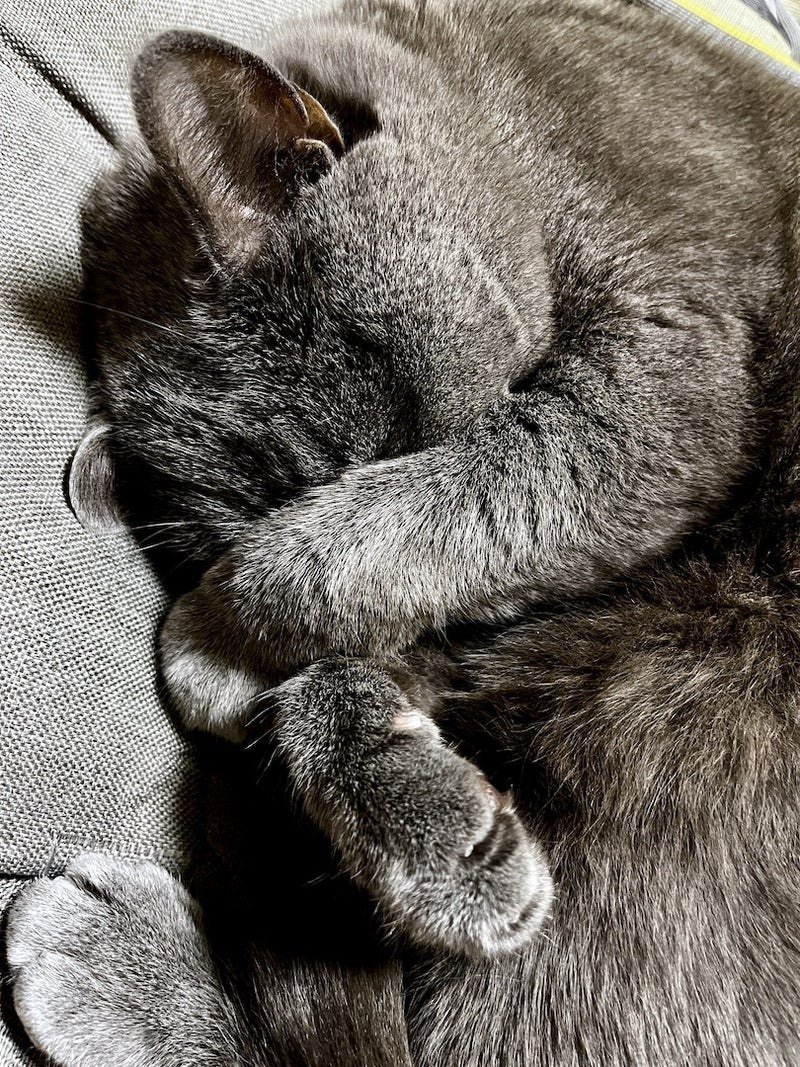
You glance across the room, and your cat is fast asleep with one paw draped over her eyes. Her nose is tucked under the other paw, and her whole face has vanished behind a little wall of fur. It looks adorable, and it looks a little bit silly.
If you have ever wondered why does my cat sleep with her paws over her face, the answer is mostly simple. She is blocking out light, keeping her nose warm, and settling into a position that feels safe. It is one of the most common sleeping poses in cats, and it is usually a sign that she is comfortable.
But the pose can mean more than one thing, and the details matter. A cat that covers her face in a sunny room is doing something different from a cat that covers her face and hides all day. This guide explains the six real reasons, what each sleeping position means, and the three changes that should send you to the vet.
Direct answer: Your cat sleeps with her paws over her face mainly to block out light, keep her nose and face warm, and feel safe while she sleeps. Cats nap during the day, when rooms are bright, so a paw works like a built-in sleep mask. The pose is normal and healthy in a cat that eats, plays, and grooms normally. See a vet if face-covering starts suddenly and comes with hiding, appetite loss, eye discharge, or pawing at the face.
Why Does My Cat Sleep With Her Paws Over Her Face? The 6 Real Reasons
Most cats cover their faces for more than one reason at a time. Light brings the paw up, warmth keeps it there, and comfort turns it into a habit. The six reasons below cover almost every face-covering cat, and the first two explain most cases on their own.
1. Blocking out the light
This is the most likely reason, and the one behaviour experts mention first. Cats sleep for twelve to sixteen hours a day, and much of that sleep happens in daylight. A sunny room, an overhead light, or a glowing television can make a nap less restful, so the cat pulls a paw over her eyes like a sleep mask.
Certified cat behaviour consultant Stephen Quandt has put it simply: covering the eyes is like wearing an eye mask. The paw does not block all light, but it cuts enough of it to help the cat settle into a deeper sleep. Cats that nap in bright window spots are the most likely to use the pose, while cats that sleep in dark cupboards rarely bother.
You can test this easily. If your cat covers her face in bright rooms but sleeps with her face open in dim ones, light is the reason. Try dimming the lights or closing the curtains near her favourite nap spot, and watch whether the paw comes down.
The light explanation also fits the time of day. Cats that cover their faces during afternoon naps and sleep openly at night are simply managing daylight. It is a practical solution to a practical problem, and it needs no fixing.
2. Keeping her nose warm
A cat’s nose, ears, and paws lose heat faster than the rest of her body, because they have thin fur and little fat underneath. When a cat curls up and tucks her nose under a paw, she traps warm air around her face and slows that heat loss.
This is why the pose is more common in cold rooms and in winter. A cat that sleeps curled in a tight ball, with her tail wrapped around her body and a paw over her nose, is building a small warm shelter out of herself. The shape is efficient: it exposes as little skin as possible to the cold air.
Kittens do it most of all. Young cats lose heat quickly because they are small, and they often sleep in a tight pile with their littermates, faces tucked away. Adult cats keep the habit, especially short-haired breeds such as Siamese and Orientals, which feel the cold more than long-haired cats.
If your cat covers her face mainly on cold days, warmth is the reason. A heated bed, a warm blanket, or simply turning the heating up a degree will often make the paw come down.
3. Feeling safe and protected
Sleep is the most vulnerable time in a cat’s day. A sleeping cat cannot run, cannot fight, and cannot see danger coming. Covering the face is one small way to feel less exposed, and it is an instinct left over from wild ancestors that slept in burrows and dense brush.
The face is the most sensitive part of a cat’s body. The eyes, nose, and whiskers are all packed with nerves, and covering them feels protective, even in a safe home. A cat that tucks her face away is not necessarily afraid. She is simply choosing the most sheltered position she can find.
This reason shows up most in new or nervous cats. A cat that has just moved house, or that lives with a new pet or a new baby, may cover her face more often while she settles in. The pose is a coping strategy, a way to create a little privacy in a home that still feels new.
As she settles, the behaviour usually fades. Give her a covered bed or a box in a quiet corner, keep routines steady, and let her choose her own hiding spots. A cat that feels safe sleeps with her face open far more often.
4. Settling into deep sleep and dreaming
Cats sleep in two stages, just like people: light sleep and deep sleep. In light sleep, a cat is ready to wake in an instant, with ears twitching and eyes half open. In deep sleep, the body relaxes fully, the breathing slows, and the cat dreams. Covering the face often marks the shift from light sleep into deep sleep.
During deep sleep, cats enter REM sleep, the dreaming stage. Their paws twitch, their whiskers flick, and their eyes move behind closed lids. A paw that was resting near the face may drift across the eyes as the muscles relax. Sometimes the cat simply falls asleep in the position she was grooming in, and the paw stays where it was.
This is also why a cat that covers her face is often the hardest to wake. She is not ignoring you. She is in the deepest part of her sleep cycle, and her brain is busy dreaming. Let her sleep. A cat that is woken from deep sleep too often becomes grumpy, and nobody benefits.
If your cat twitches, flicks her ears, or moves her paws while she sleeps with her face covered, she is almost certainly dreaming. It is normal, healthy, and a good sign that she feels safe enough to sleep deeply.
5. She fell asleep mid-groom
Cats spend up to half their waking hours grooming, and grooming often happens right before sleep. A cat will lick a paw, wipe it across her face, and repeat the motion until she grows drowsy. Sometimes she simply runs out of energy mid-groom, and falls asleep with the paw still resting on her face.
This is the most charming explanation, and it is also one of the most common. Look for the clues: a damp paw, a half-finished grooming session, and a cat that wakes up, finishes the grooming, and then goes back to sleep. The pose is not a message. It is a cat that got sleepy in the middle of a wash.
Kittens are especially prone to this, because they tire quickly and fall asleep wherever they happen to be. An adult cat that falls asleep mid-groom is usually just very relaxed, and very tired.
6. It is simply comfortable
Sometimes the simplest explanation is the right one. Cats have individual sleeping preferences, just like people do. Some cats always sleep curled in a ball. Some sleep on their backs with all four paws in the air. Some sleep with a paw over their face, every single day, for their whole lives.
The pose may have started for a practical reason — light, or warmth — and then become a habit. Cats are creatures of routine, and a position that once felt good becomes the default. There is no deeper meaning, and there is nothing to fix.
As behaviour consultant Joey Lusvardi has noted, a cat may cover her face simply because it feels comfortable in the moment. If your cat has always slept this way, and she is healthy and happy in every other way, the pose is just her style. Enjoy the photo opportunity.
What Each Sleeping Position Means: A Quick Decoder
Cats use several sleeping positions, and each one says something about how they feel. Use this table to read your cat’s whole body, not just the paws.
| Sleeping position | What it usually means | How deep is the sleep? |
|---|---|---|
| Paw over the face, curled up | Blocking light, keeping warm, feeling safe | Deep sleep, hard to wake |
| Curled in a tight ball, tail wrapped around | Keeping warm, feeling secure | Deep sleep |
| Loaf, paws tucked under the body | Relaxed but ready to move | Light sleep, wakes easily |
| On her side, legs stretched out | Comfortable and trusting | Deep sleep |
| On her back, belly up, paws in the air | Very safe, very trusting, often warm | Deep sleep |
| Head up, eyes half open | Doozing, not fully asleep | Very light sleep |
| Hidden in a cupboard or under the bed | Wants privacy, may be stressed or unwell | Varies — check for other signs |
No single position tells the whole story. A cat that sleeps belly-up every day is confident, but a cat that suddenly hides to sleep is a cat worth watching. Always read the position together with appetite, grooming, and energy.
How Much Sleep Is Normal?
Cats sleep a lot. An average adult cat sleeps twelve to sixteen hours a day, which is more than half her life. Kittens and senior cats sleep even more, up to twenty hours a day, because growing bodies and ageing bodies both need extra rest.
The total matters less than the pattern. A cat that sleeps sixteen hours in a steady routine, eats well, plays daily, and grooms normally is healthy. A cat that suddenly sleeps far more, or far less, than usual is telling you something has changed. Pain, thyroid trouble, kidney disease, and depression can all change sleep patterns.
Age changes sleep too. Kittens sleep in short bursts between wild play sessions. Adult cats settle into a rhythm of naps and activity around dawn and dusk. Senior cats sleep more deeply and for longer, and they may choose warmer, softer spots. The cat sleep calculator gives a quick check of whether your cat’s sleep hours are normal for her age, and the cat age calculator can help you work out her age in human years.
If your cat’s sleep has changed suddenly, look at the whole picture. Is she eating less? Is she grooming less? Is she hiding more? Is she using the litter tray differently? One change on its own is rarely a problem, but two or three together deserve a vet visit. Good food helps too: the cat food calculator gives daily portions based on weight and activity, so you can check she is getting the right amount for her age.
For more on where cats choose to sleep, read our guide on why cats sleep between your legs, and our guide on why cats sleep on your clothes. The reasons overlap, but each spot has its own story.
When Face-Covering Needs a Vet
Face-covering on its own is almost never a problem. It becomes a concern only when it starts suddenly, or when it comes with other changes. Use these three questions to decide.
First, did it start suddenly? A cat that has covered her face for years is fine. A cat that never did it before and suddenly starts sleeping with her face buried, and will not uncover it, may be in pain or feeling unwell. Cats hide pain well, and a sudden change in sleeping position is one of the few clues they give.
Second, is anything else different? Watch for eating less, drinking more, grooming less, hiding more, or using the litter tray differently. A cat that covers her face and also has weepy eyes, sneezing, or discharge from the nose may have a cold or an eye infection. A cat that paws at her face, rubs it on furniture, or shakes her head may have an ear infection, dental pain, or an allergy.
Third, can you wake her easily? A cat in deep sleep takes a few seconds to wake, and then stretches and walks off normally. A cat that is hard to wake, confused, wobbly, or unresponsive needs a vet the same day. The same applies to a senior cat that suddenly stares blankly, wanders, or forgets where the litter tray is, which can be an early sign of cognitive dysfunction.
Eye problems deserve special attention. A cat that keeps one eye shut, has a cloudy eye, or has discharge that is yellow or green should be seen promptly. Eye problems can worsen fast, and a vet can check the eye with a simple stain test. Do not use human eye drops on a cat without vet advice.
As a rule, book a vet visit if face-covering is new and comes with any other change, or if it comes with eye discharge, face pawing, appetite loss, or hiding. Take a short video of the behaviour, and note when it started. The ASPCA’s guide to common cat behavior issues is a useful reference for telling a quirk from a warning sign, and International Cat Care’s guide to understanding your cat explains how small behaviour changes can be the first sign of illness.

Frequently Asked Questions
Why does my cat sleep with its eyes open?
Some cats sleep with their eyes half open, or even fully open, and it can look unsettling. It is usually a light sleep, sometimes called a catnap, in which the cat is resting but still partly aware of her surroundings.
Cats have a third eyelid, a thin membrane that can cover part of the eye during light sleep, which is why the eye can look cloudy or half shut. It is normal in a cat that wakes easily and behaves normally. It becomes a concern if the eye looks dry, cloudy, or injured, or if the cat seems unable to close the eye at all, which can be a sign of nerve damage or an eye problem that needs a vet.
Why does my cat cover its face with its tail instead of its paws?
The tail is simply another tool for the same job. A cat that wraps her tail across her eyes is blocking light and trapping warmth, just like a cat that uses a paw. Tail-covering is more common in long-haired cats, because the tail is thick and fluffy enough to work as a blanket. It is also more common in cold weather, when the cat is curled in the tightest possible ball. There is no meaningful difference between paw-covering and tail-covering. Both are normal, and both mean the cat is comfortable enough to sleep deeply.
Why does my cat twitch and move its paws while sleeping?
Twitching during sleep is almost always dreaming. During REM sleep, a cat’s brain is active, and the paws, whiskers, and ears move as the cat dreams about hunting, playing, or exploring. Kittens twitch the most, because their brains are still developing and they spend more time in REM sleep. The twitching should be brief and gentle, and the cat should wake normally. It is a concern only if the twitching is violent, lasts for minutes, or comes with drooling, stiffness, or confusion on waking, which can be a seizure. Film the episode if you can, because a video helps a vet tell a dream from a seizure.
Is it bad to wake a cat that is sleeping with its paws over its face?
It is not dangerous, but it is unkind to do it often. A cat with her face covered is usually in deep sleep, and waking her suddenly can startle her. A startled cat may scratch or bite without meaning to, and she will be grumpy for a while afterwards. If you need to wake her, do it gently: say her name softly, and let her wake in her own time. Never wake a sleeping cat by touching her belly or her face. Let her stretch, yawn, and come to you. She will be far better company for it.
Why does my cat bury her face in a blanket when she sleeps?
Blanket-burying is the same instinct as paw-covering, with a softer tool. The blanket blocks light, traps warmth, and carries your scent, which makes it the perfect sleep aid for a cat. Some cats burrow completely under a blanket, while others just tuck their nose into the folds. It is normal and safe, as long as the blanket is light and the cat can get out easily. Never cover a sleeping cat with a heavy blanket, and never tuck her in so tightly that she cannot move. If she burrows suddenly and also hides all day, check for stress or illness, but a cat that has always burrowed is simply a cat that likes her comfort.
Your cat is not hiding from you when she sleeps with her paws over her face. She is blocking out the light, keeping her nose warm, and settling into the deepest, safest sleep she can find. It is a small, quiet compliment: she trusts her home enough to close her eyes completely. Give her a dim corner, a warm blanket, and a little peace, and she will keep showing you that trusting little pose for years to come.