Why Is My Corn Snake Not Eating? 9 Causes & Fixes
If you are asking why is my corn snake not eating, take a breath first. Corn snakes are famous for being reliable eaters, so a refusal feels alarming. But a skipped meal is rarely an emergency on its own.
Healthy adult corn snakes can fast for weeks, and sometimes months, without harm — as long as they stay hydrated and hold their weight.
Direct answer: The most common reasons a corn snake stops eating are shedding, temperatures that are too cool, stress from a new home, the breeding season, or prey that is the wrong size or temperature. Check the setup first: warm side 85–88°F (29–31°C), cool side 70–75°F (21–24°C), humidity 40–60%.
If the setup is right and the snake is still refusing food after three weeks (one week for a baby), or it is losing weight, see a reptile vet.
Corn snakes (Pantherophis guttatus) are North American rat snakes with slow metabolisms. In the wild they eat a mouse, then may not eat again for a week or more. That slow pace is normal.
This guide gives you the normal fasting limits by age, the nine causes in check order, a step-by-step plan to tempt your snake back to food, and the red flags that mean a vet visit.
Why is my corn snake not eating?
The first thing to work out is whether the fast is normal. A corn snake that skips one meal is not a problem. A snake that skips five meals in a row is. The table below gives you the safe fasting limits by age, so you can tell which side of the line your snake is on.
| Snake’s age | Normal feeding gap | Safe fast limit | Worry if |
|---|---|---|---|
| Hatchling (under 6 months) | Every 3–4 days | About 1 week | No food for 7 days, or weight loss |
| Juvenile (6–18 months) | Every 5–7 days | About 3 weeks | No food for 3 weeks |
| Adult (18 months and older) | Every 7–14 days | 2–3 months | No food for 4–5 weeks plus weight loss |
| Adult in brumation or breeding season | — | 2–3 months | Weight loss over 10%, or illness signs |
Weight matters far more than the calendar. A snake that has not eaten for a month but holds its weight is usually fine. A snake that has lost more than 10% of its body weight is not. Weigh your snake once a week on a kitchen scale, in grams, and write the number down.
A slow, steady weight is the best proof that a fast is safe. A falling weight is the clearest sign that something is wrong.
Also check the water. A snake that is not eating still needs to drink. A corn snake can survive weeks without food, but only a few days without water. If your snake is not drinking either, that is urgent — check the water bowl is full and clean, and offer a shallow soak if the snake looks dehydrated.
Cause 1: Shedding — the most common reason
Most corn snakes stop eating 5–7 days before they shed. As the old skin loosens, the snake’s eyes turn cloudy blue, its skin looks dull, and its vision gets poor. A snake that cannot see well feels vulnerable, so it hides and refuses food. This is completely normal, and appetite usually returns within a few days of the shed finishing.
Do not offer food while the snake’s eyes are cloudy. It will almost always refuse, and a dead mouse left in the enclosure can stress the snake or foul the bedding. Wait until the shed is complete and the eyes are clear again, then offer a meal a day or two later.
If the shed comes off in pieces, the humidity may be too low — check it is 40–60%, and raise it to around 70% during the shed.
Cause 2: Temperatures too cool to digest
Temperature is the number one husbandry cause of food refusal. Corn snakes are ectotherms, and their digestion only works when they can warm up. If the warm side is below about 80°F (27°C), the snake’s metabolism slows, its gut cannot process a mouse, and it will refuse food rather than risk a meal rotting in its stomach.
The warm side should read 85–88°F (29–31°C), measured on the surface with a digital thermometer or infrared gun, not a stick-on dial. The cool side should be 70–75°F (21–24°C). Night temperatures can drop a few degrees, but not below about 65°F (18°C).
Check the heat source itself — a burned-out bulb or a failed heat mat is a common surprise cause. You can work out the right gradient with our reptile temperature gradient calculator.
Cause 3: Stress from a new home
A newly bought corn snake often will not eat for the first one to two weeks. Everything is new: the enclosure, the smells, the sounds, the handling. In the wild, a snake that has just moved is exposed and careful. It will hide, stay still, and refuse food until it feels safe. This is normal, and patience is the fix.
Give a new snake a full week of quiet before offering food. Do not handle it during that week. Make sure it has at least two tight hides — one on the warm side, one on the cool side — so it can feel hidden wherever it rests. Offer the first meal after dark, when corn snakes naturally hunt.
If it refuses, wait five days and try again. Most new snakes eat within two or three attempts.
Stress can also come later. A recent enclosure change, new decor, loud noises, a move to a different room, or handling every day can all put a snake off food. If the refusal started after a change, undo the change or give the snake a quiet week, and the appetite usually returns.
Cause 4: Brumation and the breeding season
As autumn days shorten and temperatures drift down, many adult corn snakes slow into brumation, the reptile version of hibernation. Their metabolism drops by more than half, and they may eat little or nothing for weeks or months. This is normal for a healthy adult — as long as it was in good condition before it slowed down.
Breeding season has a similar effect. Adult males often lose interest in food for weeks in late winter and spring, when their attention turns to finding a mate. Females carrying eggs may also refuse food. These are seasonal, not sick, fasts. The key test is the same: weight and behaviour.
A brumating or breeding snake should stay alert, drink water, and lose weight only very slowly.
Do not let a snake drift into brumation by accident. If you do not plan to brumate your snake, keep the temperatures and the light cycle steady through autumn — 12 hours of light, warm side at 85–88°F.
A snake that cools down slowly without a plan can end up too cold to digest, which is different from a proper brumation. Our reptile brumation calculator can help you decide and plan.
Cause 5: The prey is the wrong size
A mouse that is too big will be refused. Corn snakes judge prey by width: the mouse should be about the same width as the snake’s widest body section, and never more than 1.5 times that width. A prey item that is too large is hard to swallow, risks regurgitation, and the snake knows it.
Offer a smaller mouse next time.
The opposite problem is rarer but real. A snake that has outgrown pinkies will lose interest in tiny prey that is not worth the effort. If your snake has grown, move up a size: pinky, fuzzy, hopper, then adult mouse, matched to the snake’s girth.
Use our snake prey size calculator to match the prey to your snake’s weight and length.
Cause 6: The prey is the wrong temperature, or the wrong type
Corn snakes hunt by heat and smell. A frozen-thawed mouse that is still cold in the middle will often be ignored, because it does not smell like live prey. Thaw the mouse fully in the fridge, then warm it in warm water until it reaches about 98–100°F (37–38°C) — roughly body temperature.
Offer it with tongs, and wiggle it gently to mimic movement.
Some snakes are fussy about prey type. A snake raised on mice may refuse a rat pup, and a snake used to live prey may ignore frozen-thawed mice at first.
If your snake has only ever eaten live mice, switching to frozen-thawed takes patience: warm the mouse well, offer it at dusk, and leave it in the enclosure overnight in a small dish. Never leave a live mouse unattended with a snake that is not eating — a hungry mouse can bite and seriously injure a snake.
Cause 7: Too much handling
Handling is fun for owners and stressful for snakes. A corn snake that is picked up every day, especially just before feeding time, may be too stressed to eat. Young snakes are the most sensitive.
As a rule, do not handle your snake for 48 hours after a meal, and do not handle it on feeding day until after it has eaten.
If your snake has stopped eating, cut handling back to the minimum for two weeks: only what is needed for cleaning and health checks. Offer food in the evening, in the snake’s own enclosure, with the room quiet and the lights low. Many snakes that refuse food in a busy living room will eat happily in a dark, quiet room.
Cause 8: Low humidity or a bad shed cycle
Humidity that is too low causes more than bad sheds. A dry snake is often a thirsty snake, and a thirsty snake will not eat. Corn snakes need humidity of 40–60%, measured with a digital hygrometer.
If the air is very dry, the snake may also soak in its water bowl — a habit that looks odd but is the snake trying to fix its own humidity.
Check the water bowl is large enough for the snake to soak in, and full of clean water. Add a humid hide — a small box lined with damp sphagnum moss — on the warm side.
If your snake has been soaking a lot, read our guide on why a corn snake soaks in its water bowl, because soaking and not eating often share the same cause.
Cause 9: Illness and parasites
If the setup is right, the snake is settled, and it still will not eat after three weeks, illness is the likely cause. Respiratory infections are common: watch for wheezing, bubbles at the nose or mouth, open-mouth breathing, or a snake that holds its head up oddly. Mouth rot shows as red, swollen gums or cheesy deposits in the mouth.
Internal parasites cause weight loss, runny droppings, and regurgitation.
Regurgitation is a red flag on its own. A snake that eats and then brings the meal back up is not just fussy — something is wrong with its digestion, its temperatures, or its health. Wait at least two weeks before offering food again after a regurgitation, and see a vet if it happens twice.
Never try to force-feed a snake yourself. Force-feeding can injure the jaw, cause aspiration, and make the snake fear food even more.
How to tempt a corn snake to eat again: try this in order
When a corn snake refuses food, work through these steps one at a time. Do not change five things at once — if the snake eats, you will not know what fixed it, and you may repeat the mistake. Wait at least five days between attempts, and keep a simple log of each offer: date, prey size, temperature, and result.
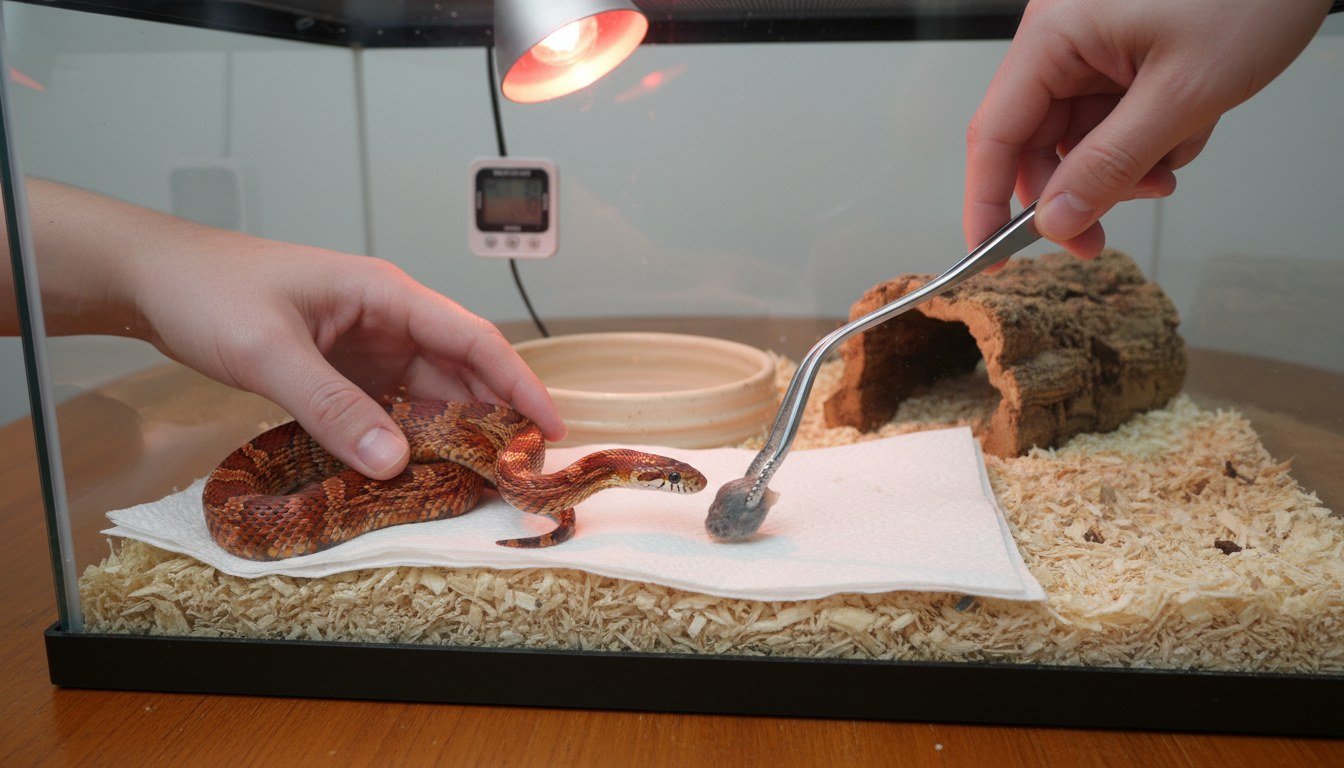
The 7-step tempting plan
Step 1 — Fix the temperatures. Measure the warm side, cool side, and night temperature with a digital thermometer. Correct anything that is off, and wait 24 hours for the enclosure to settle before offering food. A cold snake will not eat, however tempting the mouse is.
Step 2 — Check the shed cycle. Look for cloudy eyes, dull skin, and a pink belly. If the snake is in shed, stop offering food and wait until the shed is complete, then offer a meal a day or two later.
Step 3 — Warm the prey properly. Thaw the mouse fully, then warm it in warm water to about 98–100°F. Dry it lightly, then offer it with tongs at dusk. Wiggle it gently, a few inches from the snake’s nose. A warm mouse that moves smells like food. A cold, still mouse smells like nothing.
Step 4 — Try a smaller prey item. If the usual size is refused twice, go one size down. A small mouse that is eaten is better than a perfect mouse that is refused. You can move back up once the snake is eating regularly again.
Step 5 — Change the scent. Some snakes respond to a different scent. Rubbing the mouse on a shed skin, or warming it with a little tuna water, can trigger a feeding response. Keep it simple and clean — one scent trick at a time.
Step 6 — Feed in the dark, in the enclosure. Offer the mouse after dark, in the snake’s own home, with the room quiet and the lights off. Leave the mouse in a small dish overnight if it is refused at first. Many snakes eat when nobody is watching. Remove any uneaten mouse in the morning.
Step 7 — Leave the snake alone. If the snake is new, or has been handled a lot, give it a full week of quiet — no handling, no enclosure changes, no visitors tapping the glass. Then try again at dusk. Patience fixes more feeding refusals than any trick.
What NOT to do
Do not offer food every day. A snake that is offered food daily learns to ignore it, and the owner gets stressed watching the refusals pile up. Five days between attempts is the minimum.
Do not leave a live mouse in the enclosure with a snake that is not eating — live mice bite, and a bite can cause a serious wound or infection. Do not force-feed, and do not try assist-feeding without a vet’s instruction. Both can injure the snake and destroy its trust in feeding.
When to see a vet: the red-flag checklist
Most corn snake fasts end on their own once the cause is fixed. But some are medical. Use this checklist — if your snake ticks any box, call a reptile vet.
| Sign | How urgent |
|---|---|
| Hatchling with no food for 7+ days | Vet within 24 hours |
| Weight loss over 10% of body weight | Vet within 24 hours |
| Regurgitation, especially twice | Vet within 24 hours |
| Wheezing, bubbles at the nose, open-mouth breathing | Vet today — respiratory infection |
| Lethargy, cannot lift its head normally | Vet today |
| Swelling, lumps, or discharge anywhere | Vet within 24 hours |
| Adult refusing food for 4–5 weeks with no clear cause | Vet — full health check |
| Adult, bright and holding weight, fast under 3 weeks | Home care first, monitor weight weekly |
Finding a reptile vet matters, because not every vet treats snakes. The Association of Reptile and Amphibian Veterinarians keeps a find-a-vet directory that lists reptile vets by area. At the visit, the vet will weigh the snake, check its mouth and breathing, and may test a faecal sample for parasites.
Most feeding problems turn out to be husbandry, and the vet can confirm the setup is right and rule out illness in one visit.
How to keep your corn snake eating regularly
Prevention is mostly routine. Feed on a steady schedule matched to the snake’s age, and keep the prey size matched to its girth as it grows. Weigh the snake monthly once it is an adult, and weekly while it is young.
A weight log is the single best early warning system you have — it catches a problem weeks before the snake looks thin.
Keep the enclosure stable. Corn snakes are creatures of habit, and they eat best when nothing changes. Keep the temperatures steady, the humidity in range, and the handling gentle and brief.
Offer food at dusk, when the snake is naturally active, and always feed in the enclosure — moving a snake to a separate feeding tub is an old habit that adds stress and is not needed.
Finally, learn your snake’s seasonal rhythm. Many corn snakes eat less in winter and more in summer, and males often go off food in the breeding season. If you know that pattern, a winter fast stops being a panic and becomes a routine to manage.
The snake that worries you is the one that breaks its own pattern: a snake that always ate weekly and suddenly stops for a month, or a snake that is losing weight while it fasts.
Frequently Asked Questions
Can I feed my corn snake a live mouse if it will not eat frozen-thawed?
A live mouse can tempt a snake that refuses frozen-thawed, but it comes with a real risk. A live mouse can bite, and a snake that is not hungry will not kill it quickly — the mouse can cause serious wounds in minutes.
If you try live prey, never leave the mouse in the enclosure unattended, and remove it after 15–20 minutes if the snake does not strike. A safer first step is to warm the frozen-thawed mouse properly, offer it at dusk, and try scenting it. Many snakes that refuse a cold mouse will take a warm one.
Should I force-feed my corn snake?
No. Force-feeding should only be done by a vet, or under a vet’s direct instruction. Prying a snake’s mouth open can break teeth, injure the jaw, and push food into the airway, which can cause aspiration pneumonia. It also teaches the snake to fear feeding, which makes the problem worse.
If a snake has gone so long without food that force-feeding is being considered, it needs a vet visit first — the vet can check for illness, give fluids, and decide whether assisted feeding is safe.
Why does my corn snake regurgitate its food?
Regurgitation usually means the prey was too large, the temperatures were too cool to digest it, or the snake was handled too soon after eating. It can also be a sign of parasites or a gut infection. After a regurgitation, wait at least 14 days before offering food again, and offer a smaller mouse next time.
Keep the snake warm and quiet during that time. If it happens twice, see a reptile vet — repeated regurgitation is a medical problem, not a feeding quirk.
Can a corn snake starve itself to death?
A healthy adult corn snake will not starve itself to death from a normal fast — it will start eating again once the cause is fixed, long before its reserves run out. Adults can safely fast for two to three months.
The danger is different: a snake that is ill, very young, or losing weight fast can get into trouble much sooner. Hatchlings have almost no reserves, which is why a week without food is the limit for them. The real risk is not stubbornness, it is an undiagnosed illness.
That is why weight tracking and a vet visit matter more than the calendar.
For a vet-written reference on snake care and feeding, the Merck Veterinary Manual’s reptiles section is a reliable place to start. If your corn snake is not eating and the steps in this guide have not worked after three weeks — or one week for a baby — do not wait longer.
A reptile vet can rule out illness quickly, and most feeding refusals turn out to have a simple, fixable cause.