Why Is My Bearded Dragon Not Pooping? 7 Causes & Fixes
If you are asking why is my bearded dragon not pooping, you have probably been checking the enclosure for days, finding nothing, and wondering whether to worry. Bearded dragons are creatures of habit. When a dragon that usually poops every day or two suddenly stops, it is natural to feel anxious.
Direct answer: Most bearded dragons that stop pooping are dehydrated, too cold, or not eating enough. A healthy adult that has not pooped for 5–7 days but is still eating, alert, and active usually just needs a warm soak and a temperature check.
A baby that has not pooped for 2–3 days, or any dragon that is bloated, straining, lethargic, or not eating, needs a reptile vet. Never wait more than a week with a dragon that looks unwell.
Pooping is one of the easiest health checks you can do at home. A dragon’s droppings tell you about its hydration, its diet, and how well its gut is working.
This guide gives you the normal poop schedule by age, the seven causes in check order, a soak routine that fixes most cases, and the red flags that mean a vet visit.
Why is my bearded dragon not pooping?
The honest answer starts with the clock. A bearded dragon’s gut moves slowly, and how often it poops depends mostly on its age and how much it eats. Babies eat several times a day and poop just as often. Adults eat less and poop less.
The table below shows what is normal, so you can tell whether your dragon is late or actually in trouble.
| Dragon’s age | Normal poop frequency | Worry if |
|---|---|---|
| Baby (0–3 months) | Daily, sometimes twice a day | No poop for 2–3 days |
| Juvenile (3–12 months) | Daily to every other day | No poop for 4–5 days |
| Adult (1 year and older) | Daily to about once a week | No poop for 7–10 days |
| Adult in brumation | Rarely, or not at all for weeks | Weight loss, or no poop after waking |
| Any age, also not eating | — | No poop for 3–4 days plus no appetite — vet |
Notice how wide the adult range is. Some healthy adults poop every day, while others go once a week. Both can be normal. What matters is the change from your dragon’s own pattern. A dragon that always pooped daily and has now stopped for five days is more worrying than a dragon that has always gone weekly.
Also remember that a dragon cannot poop what it has not eaten. A dragon that has stopped eating will stop pooping too, and the real problem is the appetite, not the gut.
If your dragon is not eating either, read our guide on how long a bearded dragon can go without food alongside this one, because the two problems share most of the same causes.
Cause 1: Dehydration — the most common reason
Dehydration is the single most common cause of constipation in bearded dragons. When a dragon is short on water, its gut pulls moisture out of the droppings. The stool becomes hard and dry, and it gets stuck.
A 2025 veterinary webinar by zoo-medicine specialist Grayson Doss named dehydration as the top cause of bearded dragon constipation, often with a hard plug of urate blocking the vent.
Many dragons do not drink from a bowl. In the wild, Pogona vitticeps gets most of its water from food and morning dew. A pet dragon that eats mostly dry insects and few leafy greens can run low on water without its owner noticing. Low humidity in the enclosure, below about 30%, makes the problem worse.
Check the signs. A dehydrated dragon often has wrinkled skin, sunken eyes, and a thick, yellow or orange urate instead of a soft white one. Its droppings, when they do come, are small, hard pellets.
If you see these signs, the fix is water first: offer fresh water daily, mist the greens, and give a warm soak (see the soak routine below).
Cause 2: Basking spot too cold
Bearded dragons are ectotherms, which means they rely on outside heat to run their bodies. Digestion only works properly when the dragon can warm its gut to the right temperature. If the basking spot is too cool, food sits in the gut and ferments instead of moving through. The dragon feels full, stops eating, and stops pooping.
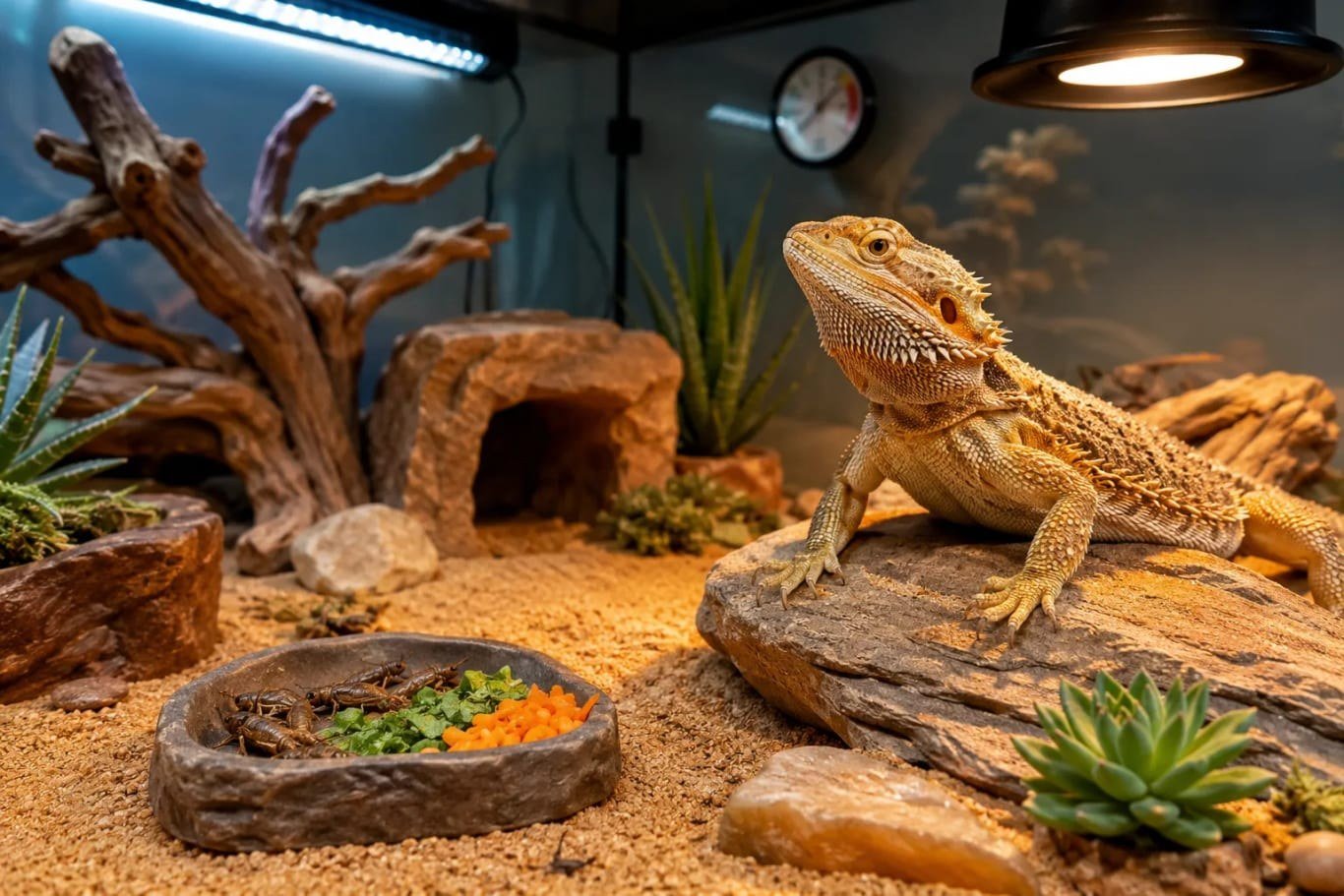
The basking surface should read 100–110°F (38–43°C) for adults, and up to 105–110°F for juveniles, measured with an infrared temperature gun on the rock itself. The cool side should sit at 75–85°F (24–29°C). A stick-on dial thermometer on the glass is not accurate enough — it measures the air near the glass, not the surface your dragon lies on.
Check the bulb too. Heat bulbs weaken with age, and a bulb that looks bright can still be putting out far less heat than it did when new. If you have not replaced the basking bulb in six months, measure the temperature before assuming anything else. You can check the right numbers with our reptile temperature gradient calculator.
Cause 3: Not eating enough, or eating the wrong food
A dragon that eats little will poop little. Babies need live insects three to five times a day, and adults need a diet that is about 70–80% leafy greens and vegetables. A dragon fed mostly insects and almost no greens is missing the fibre that keeps the gut moving.
Too much fruit can also cause trouble, because it is high in sugar and low in fibre.
Stress can kill the appetite too. A new home, a recent move, a loud household, or a tank placed where the dragon can see another dragon will all make a bearded dragon eat less. A dragon that has just been moved may refuse food for several days while it settles in.
That is normal, and the pooping will restart once the eating does.
Offer a mix of staple greens — collard greens, mustard greens, dandelion leaves, and squash — every day, and keep the insect meals regular. If your dragon is eating well but still not pooping, the problem is further down the list, not the food.
Cause 4: Brumation — the winter slowdown
In autumn and winter, many adult bearded dragons slow down into brumation, the reptile version of hibernation. Their metabolism drops, they eat less or stop eating, and they may sleep for days at a time. A brumating dragon can go weeks without pooping, and that is normal — as long as it was healthy before it slowed down.
Do not assume brumation on your own. A sick dragon looks very much like a brumating one: sleepy, not eating, not pooping. The difference is that a brumating dragon is a healthy weight, has clear eyes, and wakes up now and then to drink. A sick dragon loses weight, has sunken eyes, or shows discharge.
Vets advise having a dragon checked before letting it brumate, to rule out illness and parasites.
If your dragon is brumating, keep fresh water available and weigh it once a week. A brumating dragon should lose very little weight. If it is losing weight steadily, or it has not pooped for weeks after waking up, it needs a vet. Our reptile brumation calculator can help you plan the season safely.
Cause 5: Loose substrate and oversized insects — impaction
Impaction is a blockage in the gut, and it is the most serious common cause of a dragon not pooping. It happens when the dragon swallows something it cannot digest. The usual culprits are loose substrates such as calci-sand, crushed walnut shell, and fine gravel, which dragons lick up while hunting.
Oversized insects are the other classic cause, especially mealworms, whose hard chitin shells are difficult to digest.
A dragon with impaction often has a swollen belly, drags its back legs, or strains at the vent without passing anything. It may stop eating completely. This is different from simple constipation: constipation is slow, hard stool, while impaction is a physical blockage that home care cannot always clear.
Prevention is simple. Use a solid substrate such as reptile carpet, ceramic tile, or paper towel, especially for babies. Feed insects no wider than the space between the dragon’s eyes. If you suspect impaction — swollen belly, leg dragging, straining — do not wait. A vet can confirm it with an X-ray and clear it safely.
Cause 6: Weak or old UVB lighting
UVB light is the invisible half of bearded dragon care, and it affects digestion more than most owners realise. Without enough UVB, a dragon cannot make vitamin D3 or use calcium properly. Over weeks, its appetite drops, its gut slows down, and its bones weaken into metabolic bone disease.
A dragon with weak UVB often looks lethargic and eats less, which means it poops less too.
UVB bulbs fade long before they burn out. A tube that still glows can be putting out almost no UVB after six to twelve months, depending on the type. Replace UVB tubes every six months for compact coils, and every twelve months for quality T5 tubes, even if they still light up.
The bulb should sit 12–18 inches from the basking spot, with no glass or plastic between the bulb and the dragon. Check the right setup with our reptile UVB lighting calculator.
Cause 7: Illness and parasites
If the setup is right and the dragon still will not poop, illness is the likely cause. Parasites such as coccidia, pinworms, and flagellate protozoa are common in bearded dragons, and a heavy load can slow the gut, cause weight loss, and produce foul-smelling, runny droppings.
Respiratory infections, mouth rot, and metabolic bone disease can all reduce appetite and gut movement too.
Watch for the warning signs that point to illness rather than husbandry: rapid weight loss, a very smelly stool, blood or mucus in the droppings, a swollen belly that does not go down after a soak, or a dragon that is limp and unresponsive. Any of these means a vet visit, not another home remedy.
A faecal test at the vet will find parasites quickly, and most are easy to treat once identified.
How to help a bearded dragon poop: the warm-soak fix
For most constipated dragons, the warm soak is the single most useful home treatment. Warm water relaxes the gut muscles, softens hard stool, and encourages the dragon to drink. It works best when combined with a temperature check and more watery food. Follow these steps in order.
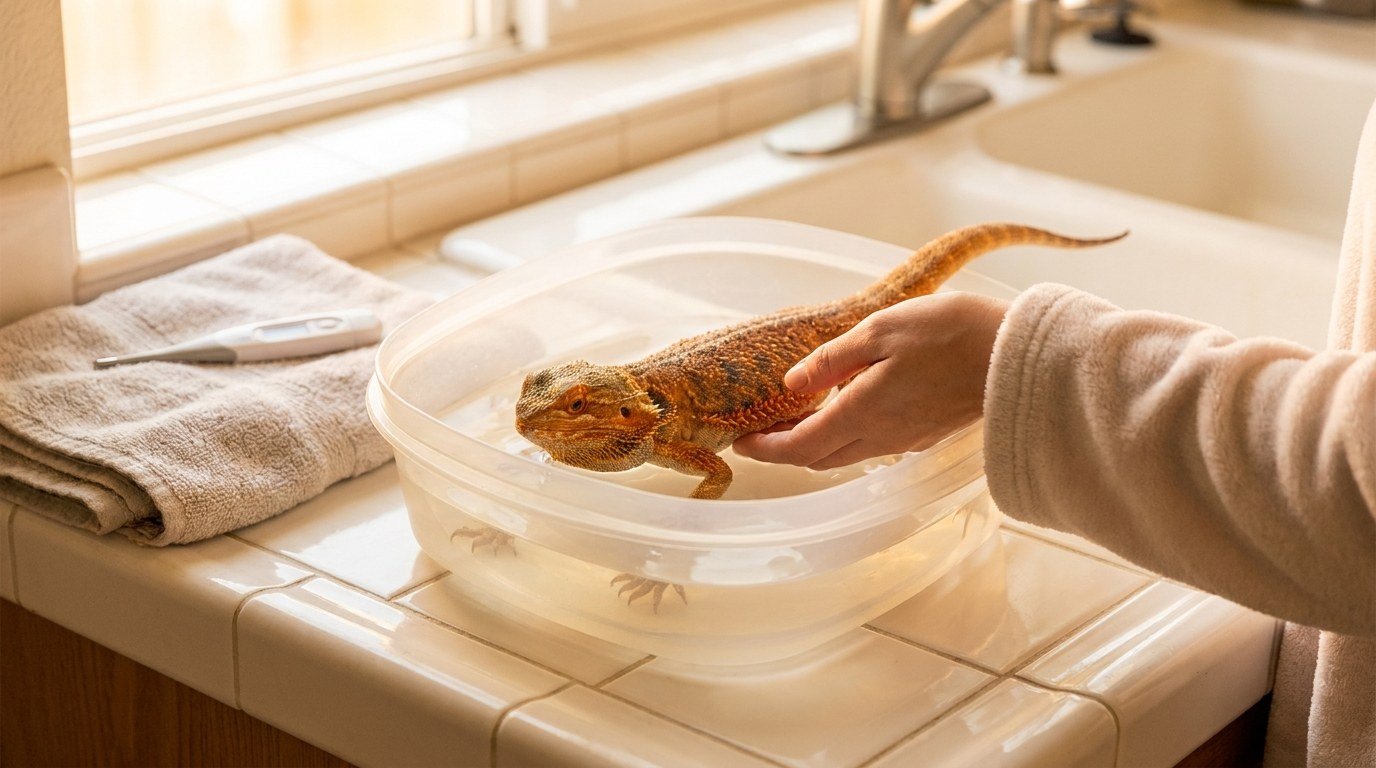
The 5-step warm soak routine
Step 1 — Prepare the water. Fill a clean tub or sink with lukewarm water at 85–95°F (29–35°C), deep enough to reach the dragon’s belly but not its chin. Test it on the inside of your wrist, as you would for a baby’s bath. Never use hot water.
Step 2 — Soak for 15–30 minutes. Place the dragon gently in the water and let it sit. Most dragons relax and start to move their legs. Keep the room warm so the dragon does not chill when it comes out. Offer the soak once or twice a day while the dragon is constipated.
Step 3 — Massage the belly gently. After about ten minutes in the water, stroke the dragon’s underside very gently from chest to vent, front to back, every five to ten minutes. Use light pressure only. Stop at once if the dragon flinches, puffs up, or tries to bite.
Step 4 — Offer watery food after the soak. Once the dragon is dry and warm again, offer hydrating foods: a little pureed squash, some finely chopped collard greens misted with water, or a few drops of water on the snout. Many dragons drink during the soak itself, which is exactly what you want.
Step 5 — Check the heat, then wait. After the soak, confirm the basking spot is at 100–110°F. A dragon that has just soaked needs to warm up to digest. If there is no poop within 24–48 hours of two or three soaks, move on to the vet — do not keep soaking for a week hoping it will work.
What NOT to do
Do not give your dragon olive oil, mineral oil, or human laxatives. These are often suggested in forums, but they can cause aspiration if the dragon inhales them, and they can damage the gut. Do not try to pull anything from the vent, and do not press hard on a swollen belly. Enemas and manual removal are vet-only procedures.
If home care does not work within two days, the next step is a professional, not a stronger home remedy.
When to see a vet: the red-flag checklist
Most cases of a bearded dragon not pooping are fixed at home. But some are emergencies. Use this checklist — if your dragon ticks any box, call a reptile vet today.
| Sign | How urgent |
|---|---|
| Baby (under 3 months) with no poop for 3+ days | Vet today |
| Swollen belly plus no poop for a week | Vet today |
| Straining at the vent with nothing coming out | Vet today |
| Dragging back legs or cannot move normally | Vet today — possible impaction |
| Not eating AND not pooping for 4+ days | Vet within 24 hours |
| Blood, mucus, or tissue sticking out of the vent | Vet today — emergency |
| Rapid weight loss or very smelly droppings | Vet within 24 hours — possible parasites |
| Adult, bright and eating, no poop for 7–10 days | Home care first, vet if no result in 2 days |
Finding a reptile vet matters. Not every vet treats reptiles, so look for an exotics vet with bearded dragon experience. The Association of Reptile and Amphibian Veterinarians keeps a find-a-vet directory that lists reptile vets by area. Call ahead and describe the symptoms, so the clinic can tell you whether to come in the same day.
At the visit, the vet will usually check the dragon’s weight, feel its belly, and may take an X-ray to look for a blockage. A faecal test checks for parasites. Treatment depends on the cause: fluids for dehydration, medication for parasites, or in serious impaction cases, a procedure to clear the blockage.
Most dragons recover well once the cause is found.
How to keep your bearded dragon pooping regularly
Prevention is mostly husbandry. Get the basics right and the gut usually takes care of itself. Offer fresh water every day, even if your dragon rarely drinks from the bowl. Mist the greens lightly before feeding, and give a warm soak once or twice a week as a routine, not only when there is a problem.
Keep the temperatures honest. Measure the basking surface with an infrared gun at least once a week, and replace heat and UVB bulbs on schedule. A dragon that can warm up properly will digest properly.
If you are unsure about your setup, work through our guide on why a bearded dragon stops basking — the same temperature problems that stop basking also stop digestion.
Feed for fibre. Adults should eat mostly leafy greens, with insects as the smaller part of the diet. Babies need the opposite: mostly insects, with greens offered daily so they learn to eat them. Keep the substrate solid, keep insects the right size, and keep a simple poop log — a note of the date each time your dragon goes.
A log turns a vague worry (“has it been a while?”) into a clear fact (“last poop was Tuesday, four days ago”).
Finally, watch the pattern, not the calendar. Every dragon has its own rhythm. Learn your dragon’s normal schedule when it is healthy, and act when it changes. A dragon that poops every day and suddenly stops for five days needs attention sooner than a dragon that has always gone once a week.
Frequently Asked Questions
What should healthy bearded dragon poop look like?
Healthy bearded dragon poop has two parts: a brown, formed stool and a white, chalky urate, which is the solid part of the pee. The stool should hold its shape but not be rock hard. A soft white urate is normal. A yellow, orange, or very hard urate usually means the dragon needs more water.
A single runny dropping after a juicy meal is usually nothing to worry about, but runny droppings that last more than two days need a vet check.
Can I give my bearded dragon olive oil to help it poop?
No. Olive oil, mineral oil, and other oils are often suggested online, but vets do not recommend them as home treatment. A dragon can inhale oil into its lungs while swallowing, which can cause aspiration pneumonia. Oil can also irritate the gut and make diarrhoea worse. The safe home treatments are warm soaks, correct basking temperatures, and hydrating foods.
If those do not work within 48 hours, see a reptile vet.
Why is my bearded dragon’s poop runny?
Runny droppings usually mean too much fruit or watery vegetables, a sudden diet change, or stress from a move or a new enclosure. Cut back on fruit, keep the diet steady for a week, and check the temperatures.
If the droppings stay runny, smell much worse than usual, or the dragon is losing weight, take a fresh faecal sample to the vet. Parasites are a common cause of persistent runny droppings in bearded dragons, and they need proper medication to clear.
How do I know if my bearded dragon has parasites?
The main signs are weight loss despite eating, very smelly or runny droppings, a swollen belly, and lethargy. But many dragons with parasites look fine at first, which is why a faecal test matters. Collect a fresh dropping in a sealed bag, keep it cool, and take it to a reptile vet within 24 hours.
The vet can check it under a microscope and prescribe the right treatment. New dragons should always have a faecal test in their first weeks home, and a yearly check is sensible for adults.
For more on bearded dragon digestion and general health, the Merck Veterinary Manual’s reptiles section is a reliable, vet-written reference.
If your dragon is not pooping and the home steps in this guide have not helped within two days, do not wait longer — a reptile vet can find the cause quickly, and most cases are very treatable once the cause is known.