Why Does My Cat Scratch the Floor Around Her Food Bowl?
You put down a fresh bowl of food, and instead of eating, your cat paws at the floor around it. She scratches at the tiles, digs at the mat, sometimes even drags a towel over the bowl — as if she is trying to bury the meal you just served. It looks strange, and a little insulting, like she thinks the food belongs in the bin.
If you have ever wondered why does my cat scratch the floor around her food bowl, the short version is that she is following an old instinct: wild cats bury leftover food to hide it and save it for later. Your cat is doing the same thing on your kitchen floor, even though there is no dirt to dig.
The behaviour has a name among behaviourists: food caching. It is one of the oldest instincts a domestic cat carries, left over from her wild ancestors. It is usually completely normal. But it is not always the same instinct at work — sometimes it means she dislikes the food, sometimes it means she has had enough, and sometimes it is the first sign that something is wrong.
The timing tells you which one it is, and this article will show you how to read it.
Direct answer: Your cat scratches the floor around her food bowl because of an instinct called food caching — wild cats bury leftover food to hide its scent from rivals and save it for later, and domestic cats do the same thing with imaginary dirt. The most common reasons are saving leftovers, hiding the food's scent, having too much food in the bowl, disliking a new food, or feeling stressed. It is normal and harmless in most cases.
It needs a vet visit if it is new and sudden, or if it comes with eating less, weight loss, vomiting, diarrhoea, drooling, or pawing at the mouth.**
Why Does My Cat Scratch the Floor Around Her Food Bowl? The Six Reasons
Most cats scratch around their food for one of six reasons. They overlap, and more than one can be true at the same time, but each one leaves a different clue behind. Watch what happens before and after the scratching, and the reason usually gives itself away.
1. She is saving it for later: the caching instinct
The oldest explanation is also the simplest. In the wild, a cat that catches more than she can eat in one sitting does not leave the rest lying around. She covers it with dirt or leaves, hides its scent, and comes back to it later. This is called caching, and it is how wild cats keep food safe from scavengers and rivals. Domestic cats carry the same programming, even though their food comes from a tin and there is nothing to steal it.
You will see caching most clearly after your cat has eaten part of a meal. She takes a few bites, walks a few steps away, then turns back and scratches the floor beside the bowl. Later, she may return and "uncover" the food by scratching in the other direction, then finish eating. That return trip is the giveaway: a cat that comes back to eat was saving the food, not rejecting it. Smaller, more frequent meals often reduce this behaviour, because there is less leftover to save.
2. She is hiding the scent
Cats are solitary hunters by nature, and in the wild they avoid other cats outside mating season. A cat that leaves food lying around is also leaving a scent signal that says "I was here, and there is food here." Burying the food hides that signal. Even in a house with no rivals, the instinct fires. Your cat is not thinking about it — she is doing what her ancestors did without being taught, because the behaviour is innate, present from birth.
Scent hiding also explains why some cats scratch around the bowl even when it is empty. The spot still smells of food, and the instinct says to cover the smell. The same logic applies to the water bowl: a cat that scratches around her water dish is treating the whole feeding area as a scent zone to manage. This is normal, and it does not mean she dislikes the food or the water.
Mother cats show this instinct most strongly. A queen with kittens will bury food to mask her scent and protect her litter from other cats. If your cat has recently had kittens, expect more scratching around the bowl than usual. It usually fades as the kittens grow and the household settles.
3. There is too much food in the bowl
Sometimes the message is simpler: she has had enough. Cats are clean animals, and many of them prefer to cover food they cannot finish rather than leave it sitting in the bowl all day. This is more common with wet food, which dries out, picks up fridge smells, and goes stale faster than dry kibble. A cat that eats half the portion and then scratches is often just tidying up after herself.
The fix is easy and it doubles as a portion check. Serve smaller meals, more often, and see whether the scratching fades. If you are unsure how much your cat should eat, our cat food calculator can work out her daily portion from her weight and activity level, and our cat calorie calculator can check whether the amount you serve matches what she actually needs. The ASPCA's cat care guidance also covers feeding routines and portion control. Over-serving is one of the most common causes of this behaviour, and it is also one of the easiest to fix.
4. She does not like the food
This is the reason owners worry about most, and it is real — but it is not the most common reason. A cat that dislikes her food will usually sniff it, scratch at the floor, and walk away without eating much at all. The key difference from caching is what she does next: a caching cat comes back to eat, while a cat that dislikes the food does not.
Food dislike usually starts the day you change something: a new brand, a new flavour, a new texture, or food that has been in the fridge and gone cold. Cats are famously picky about freshness, temperature, and texture. Wet food left out for hours can dry out or pick up smells from the fridge, and a cat may paw at it as if to cover something unpleasant. If the scratching started the day you switched foods, try going back to the old food and see whether the behaviour stops. If it does, you have your answer.
Warming refrigerated wet food briefly to room temperature also helps, because cold food smells less appealing to a cat.
5. She is stressed or feels crowded
Cats are creatures of routine, and stress often shows up first around food. A new pet in the house, a house move, building work, a new baby, or even a change in the feeding spot can switch the caching instinct back on. The cat is not necessarily afraid of the food. She is trying to make her feeding area feel safe again by covering the scent and hiding the resource.
Multi-cat homes are the classic case. If another cat watches her eat, or eats from a bowl nearby, she may scratch more, eat faster, or leave food uneaten and try to bury it. She is managing a resource in a shared territory. The fix is to feed cats separately, in quiet spots, with their own bowls and their own space. A cat that eats alone in a calm corner usually scratches less than a cat that eats in a busy hallway with another cat staring at her.
6. The bowl itself bothers her
This reason is easy to miss, because it looks like food behaviour when it is actually bowl behaviour. Some cats dislike deep, narrow bowls, because their whiskers brush the sides every time they eat. Whiskers are sensitive touch organs, and constant brushing can be uncomfortable — a problem often called whisker fatigue. A cat that scratches around the bowl may be reacting to the bowl, not the food.
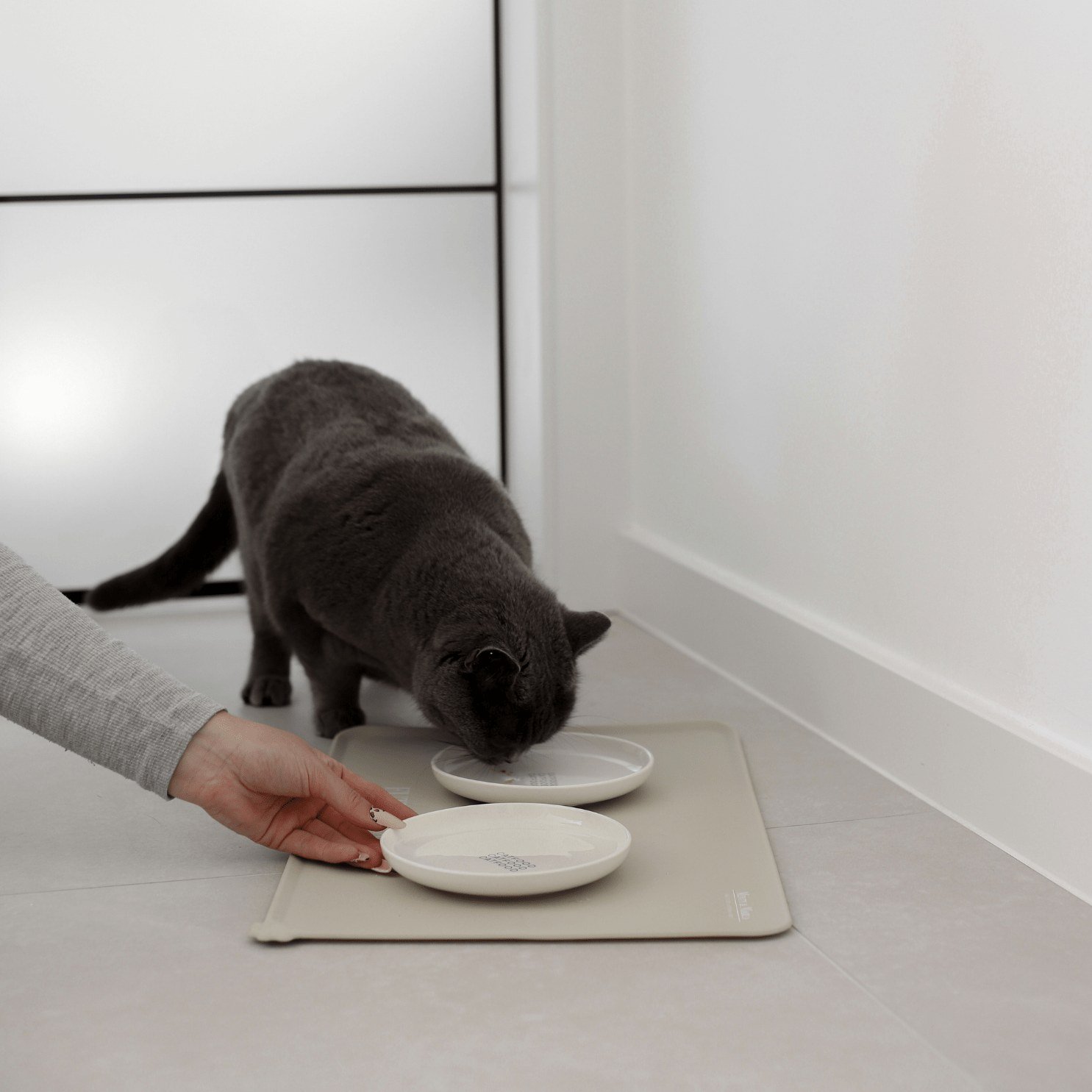
The clues are specific: she eats from a flat plate happily but scratches around a deep bowl, or she pulls food out of the bowl onto the floor and eats it there. The fix is a wide, shallow bowl or a flat plate, with the food spread out rather than piled in the middle. Stainless steel or ceramic is better than plastic, which can hold smells and cause chin acne. If the scratching stops after a bowl change, the bowl was the problem all along.
The Timing Test: Before, After, or Empty Bowl
When your cat scratches tells you more than how she scratches. Use this table like a diagnosis. Watch her for three days and note when the scratching happens, and the pattern will point to the reason.
| When she scratches | Most likely reason | What to do first |
|---|---|---|
| After eating part of the meal, then returns later | Caching — saving leftovers for later | Serve smaller, more frequent meals |
| Before eating, then eats happily | Scent hiding or routine — part of her eating ritual | Usually nothing; it is normal behaviour |
| After a few bites, walks away and does not return | Dislikes the food or has had enough | Try the old food; check portion size |
| Only with a new food or flavour | Food dislike | Go back to the previous food for a week |
| Only when the bowl is empty | Scent management — covering the smell of the spot | Wash the bowl and mat; nothing else needed |
| Only when another cat is nearby | Stress or competition over resources | Feed cats separately in quiet spots |
| Suddenly, after months of never doing it | Possible medical issue — pain, nausea, or stress | Vet visit, especially with appetite changes |
The table works because each reason has its own timing. Caching happens after eating. Rejection happens before eating much at all. Stress follows a change in the household. A sudden change in a cat that never did this before is the one pattern that always deserves a closer look, because it can be the first sign of dental pain, nausea, or gut trouble.
Scratching or Kneading? How to Tell Them Apart
Owners often confuse food-bowl scratching with kneading, and the two look similar at first glance. They are different behaviours with different meanings, and telling them apart matters, because kneading is a happy behaviour and scratching can be a warning.
Kneading, often called making biscuits, is a slow, rhythmic motion. The cat pushes one front paw forward, then the other, alternating in a steady rhythm, usually with claws sheathed or only partly out. She learned it as a kitten, pressing her mother's belly to stimulate milk flow, and adult cats do it when they feel safe and content. Kneading is usually paired with purring, half-closed eyes, and a relaxed body. Our guide to why does my cat knead and bite a blanket explains the full behaviour, including when blanket-biting crosses into pica.
Scratching around food is faster and less rhythmic. The cat scrapes at the floor with one paw or both, in short digging motions, often switching sides and changing direction. Her body is more alert, her ears are forward, and she is focused on the floor rather than relaxed. She may also drag a towel or mat toward the bowl, which kneading cats never do. The simplest test is the purr test: a kneading cat usually purrs, while a scratching cat usually does not.
If your cat does both — kneads the floor near the bowl before eating, then scratches after — she is likely doing two things in sequence. The kneading is comfort and anticipation, and the scratching is caching. That combination is normal, and it is common in cats that are very food-motivated.
The Feeding Station Fix
Most food-bowl scratching needs no fixing at all. But if the behaviour bothers you, damages your floors, or happens every single meal, a few small changes to the feeding station usually calm it down. Work through this checklist one item at a time, and give each change three or four days before judging it.
The feeding station checklist:
- Use a wide, shallow bowl. A flat plate or a wide ceramic dish stops whisker fatigue and lets your cat eat without her whiskers brushing the sides.
- Serve smaller portions. Split the daily amount into three or four small meals instead of one or two large ones, so there is less leftover to cache.
- Keep the spot quiet. Move the bowl away from washing machines, busy doorways, and the litter box. Cats prefer to eat in a calm, low-traffic corner.
- Feed cats separately. In a multi-cat home, each cat needs her own bowl in her own spot, out of sight of the others.
- Serve fresh food. Do not leave wet food out for more than a few hours. Throw away leftovers and wash the bowl daily.
- Warm refrigerated food. A few seconds at room temperature, or a short burst in the microwave, brings back the smell cats respond to.
- Use a washable mat. A rubber or silicone mat under the bowl protects the floor and gives your cat a surface she can scratch without damage.
- Keep water separate. Cats prefer their water bowl away from their food bowl, ideally in a different spot in the room. Our cat water intake calculator can check whether your cat drinks enough each day.
If the scratching continues after all of these changes, and your cat eats well and holds a steady weight, accept it as part of who she is. Some cats scratch around food their whole lives, and no feeding station change will stop an instinct that strong. It is harmless, and it is not a sign that she dislikes you or your cooking.
When Scratching Means a Vet Visit
Most scratching is normal instinct. But a vet interviewed by Rover put it plainly: if scratching around food is a new behaviour, it could indicate digestive issues, and owners should always consult a veterinarian if the behaviour suddenly changes. That advice is worth taking seriously, because cats hide illness well, and a change in feeding behaviour is often the first clue.
Book a vet visit if the scratching is new and sudden, or if it comes with any of these signs: eating much less than usual, dropping food from the mouth, drooling, pawing at the face, bad breath that is new, weight loss, vomiting or diarrhoea, hiding more than usual, or refusing to play.
A cat that suddenly eats less and scratches more may have dental pain, and scratching can be her way of avoiding a painful meal. A cat that scratches and also vomits or has loose stools may have a food allergy, inflammatory bowel disease, kidney disease, or another gut problem.
The vet will usually start with a mouth check, a weight check, and blood tests for thyroid and kidney values. Bring notes: when the scratching started, whether it happens before or after eating, what food you serve, and whether anything changed in the house at the same time. That timeline is the most useful thing you can give a vet, because it separates a behaviour problem from a medical one in minutes.
Frequently Asked Questions
Why does my cat scratch the floor around her water bowl too?
For the same reason she scratches around her food bowl: the feeding area is one scent zone to her, not two separate bowls. Wild cats manage the scent of their whole feeding spot, and domestic cats do the same. Scratching around the water bowl is usually caching and scent management, not a complaint about the water.
Check that the water is fresh and the bowl is clean, and keep the water bowl in a separate spot from the food bowl if you can. If she scratches the water bowl and also drinks much more or much less than usual, mention it to your vet, because thirst changes can signal kidney or thyroid problems.
Is it normal for kittens to scratch around their food?
Yes, and it is common. Kittens learn most feeding behaviour by watching their mother, but caching is innate — they do it without being taught. A kitten that scratches around her bowl is practising an adult instinct, much like a kitten that pounces on a toy is practising hunting. It usually becomes less frequent as she grows, because adult cats settle into a routine.
Make sure a kitten's bowl is wide and shallow, serve small meals often, and do not punish the scratching. If a kitten scratches and also refuses food, cries while eating, or has diarrhoea, see a vet promptly, because kittens become dehydrated faster than adult cats.
Why does my cat scratch the floor after using the litter box?
That is a different instinct, but a related one. After toileting, cats scratch the litter to cover their waste and hide its scent — the same scent-hiding logic as food caching, applied to a different problem.
Some cats also scratch the floor or the wall beside the litter box, especially if the litter is shallow or the box is small. That is usually normal. It becomes a concern if your cat scratches frantically for a long time, cries in the box, goes in and out repeatedly without producing anything, or starts toileting outside the box. Those signs can mean a urinary tract infection, constipation, or litter-box stress, and they deserve a vet visit.
Can scratching around the food bowl damage my floors?
It can, over time, especially on soft wood floors or vinyl. A cat's claws are sharp, and repeated scratching in the same spot wears the finish and leaves marks. The simplest protection is a washable mat under and around the bowl, large enough to cover the whole scratching area. Rubber-backed mats, silicone feeding mats, or a large ceramic tile all work.
Keep your cat's claws trimmed, and never declaw a cat to stop scratching — declawing is an amputation of the last bone of each toe, it causes lasting pain, and it is banned or restricted in many places. A mat and trimmed claws solve the floor problem without harming the cat.
Why does my cat only scratch around wet food, never dry kibble?
Because wet food triggers the caching instinct more strongly. Wet food smells stronger, dries out faster, and goes stale within hours, so it reads to your cat as fresh prey that needs hiding. Dry kibble smells faint, keeps for hours, and feels less urgent to cover. Some cats also dislike the texture of wet food on their whiskers, or the cold temperature of refrigerated wet food.
Try serving wet food at room temperature, in smaller portions, on a wide flat plate. If she still scratches only around wet food, it is almost certainly the smell and freshness driving it, not a health problem.