Why Does My Cat Chirp at Birds? 5 Reasons
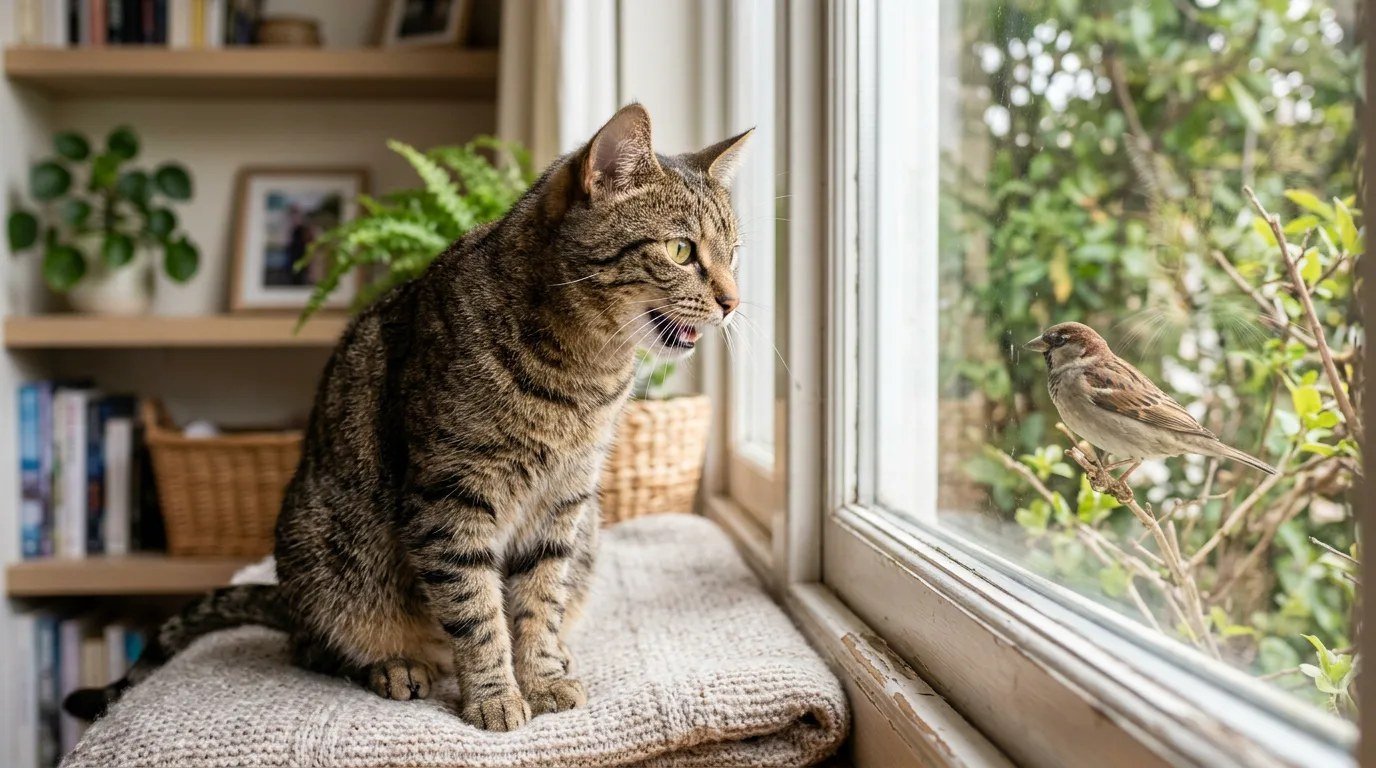
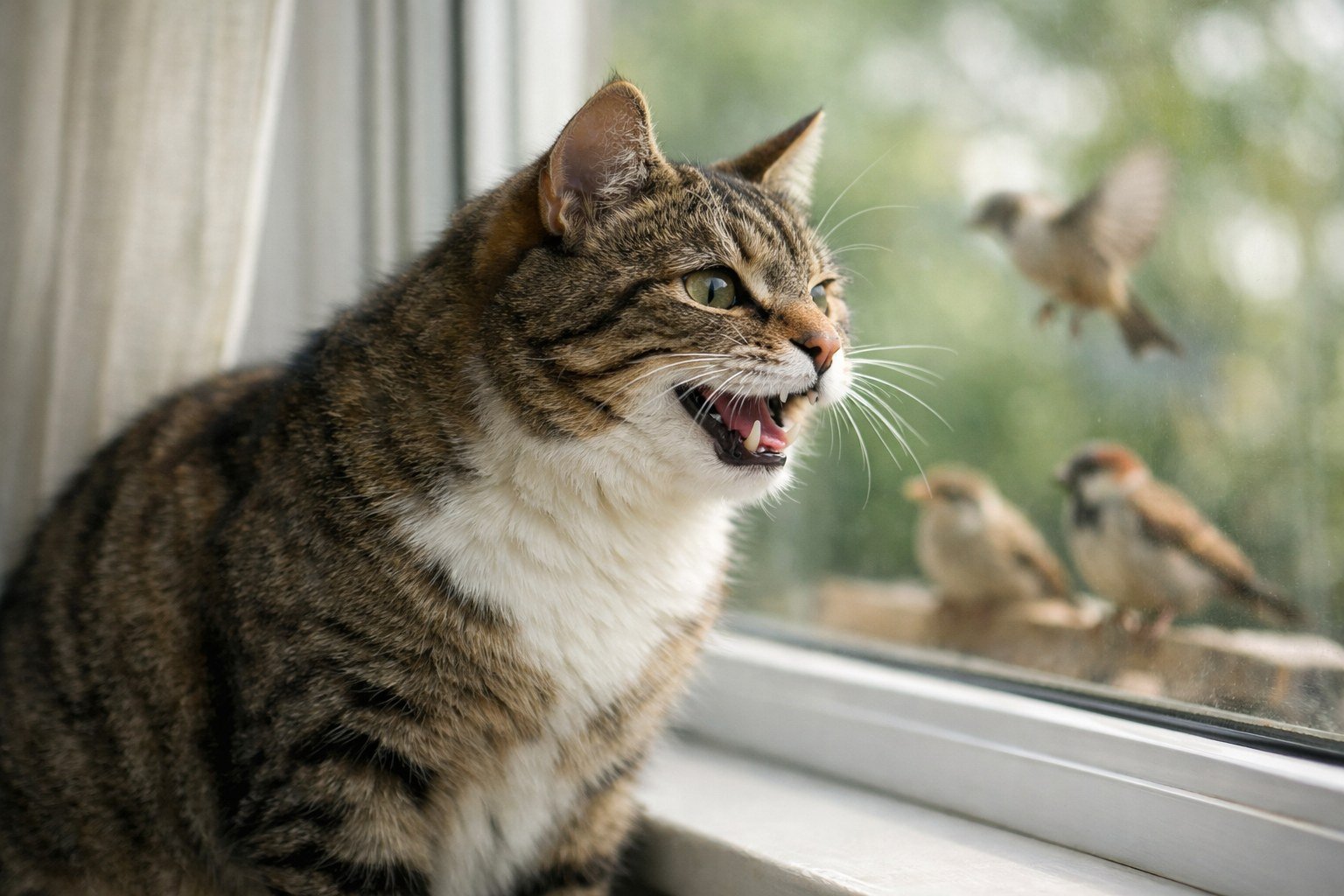
Your cat is sitting on the windowsill, locked on a sparrow outside. Her jaw starts clicking fast, ek-ek-ek, and a strange chirping sound comes out. She looks like she is trying to talk to the bird.
She is not talking to it. So why does my cat chirp at birds? The sound is a mix of hunting instinct, excitement, and frustration. Her brain is running the hunting sequence, but a pane of glass stands between her and the prey.
Your cat chirps at birds because seeing prey triggers her hunting instinct, and the chatter is the excitement and frustration of not being able to reach it. It is normal behaviour in most cases. It only needs a vet if it happens with no prey in sight, or comes with drooling, trouble eating, or mouth pain.
Cat owners hear many sounds: meows, purrs, trills, and this odd clicking chirp. The chirp is the least understood of them all, and scientists still debate exactly why it happens. The good news is that the main theories are simple, and you can tell a normal chirp from a worrying one in a few seconds.
This guide explains the five theories, shows you how to tell a chatter from a chirp and a trill, covers the dental warning sign that other guides skip, and gives you a window plan that turns frustration into healthy play.
Why Does My Cat Chirp at Birds? 5 Reasons
No single theory explains every chirp. Behaviour experts think it is a blend of several causes, and the mix changes from cat to cat. Here are the five theories, ranked from most to least likely.
1. Hunting Excitement
This is the most likely reason. Cats are obligate carnivores with a strong hunting sequence: search, stalk, chase, capture, kill, and eat. Seeing a bird fires up the first stages of that sequence.
The chirp is the sound of that energy with nowhere to go. The cat is excited, focused, and ready to pounce, but the prey is out of reach. The sound spills out of all that pent-up arousal.
You can see it in her body. Her eyes are wide, her whiskers point forward, and her tail may twitch. She is not relaxed. She is a hunter on hold, and the chirp is part of the performance.
2. Frustration at the Glass
A window is a wall a cat can see through. She can see the bird, hear it faintly, and smell nothing. But she cannot reach it. That gap between seeing and catching is frustrating.
Behaviourists describe the chatter as a frustrated vocalisation. It is the sound of an instinct that has been switched on and then blocked. The more the bird moves, the louder the chirping often gets.
This is why chirping is common in indoor cats. An outdoor cat would stalk, chase, or give up. An indoor cat sits at the glass and chirps, because the glass never lets her finish the hunt. Our guide on why cats run around at 3am covers the same pent-up hunting energy at night.
3. The Kill-Bite Rehearsal
Cats kill small prey with a precise bite to the back of the neck. The jaw moves fast to slip the teeth between the vertebrae. Some experts think the chattering jaw is that killing bite firing on autopilot, with no bird in the mouth.
Behaviourists call this a “vacuum activity.” It is an instinct running with nothing to act on, like a dog paddling its legs while it dreams of running. The jaw rehearses the bite it cannot deliver.
This theory is popular, but the UK charity Cats Protection calls it unlikely as the full explanation. It may be part of the picture, but it does not explain chirping on its own. Treat it as one ingredient, not the whole recipe.
4. Mimicry: Copying the Prey
Chirps sound a little like bird calls. Some observers think cats may be trying, badly and without thinking, to copy the sounds of their prey. The idea is that a bird-like sound might lure the bird closer, or confuse it.
There is no solid proof for this. Cats do not plan that far ahead, and the chirp is not a good copy of any bird song. But the idea survives because the sound is so bird-like, and because cats do copy sounds in other ways. Kittens learn calls from their mothers, and adult cats learn which sounds get a reaction from us.
Think of mimicry as the least likely theory. It is fun to imagine, but excitement and frustration explain the sound far better.
5. A Jaw Reflex
Some vets point to a simple body reflex. When a cat’s brain pictures the killing bite, tiny rapid movements fire in the jaw and face muscles. The clicking sound may be a reflex, not a choice.
This fits with what owners see. The chatter is fast, rhythmic, and hard for the cat to stop while she is watching the bird. When the bird flies away, the chattering stops at once. A reflex switches off when the trigger goes.
The reflex theory and the excitement theory work well together. Excitement switches the hunting brain on, and the reflex is what you hear. Either way, the sound itself is normal.
Chatter, Chirp, and Trill: What’s the Difference?
Owners mix these three sounds up, and the difference matters. A chatter aimed at a bird is normal. A chatter with no bird in sight can be a dental warning. Use this table to tell them apart.
| Sound | What it sounds like | When you hear it | What it means |
|---|---|---|---|
| Chatter | Fast “ek-ek-ek” clicking, teeth clacking, jaw opening and closing rapidly | Fixed on prey it cannot reach, usually a bird or squirrel outside a window | Hunting excitement and frustration. Normal if prey is present. |
| Chirp | Short, high “brrp” or “chirrup”, one or two notes | At prey, or at you — often when the cat wants something or is greeting you | Excitement, or a friendly “come here” call. Normal. |
| Trill | Rolling, musical “prrrt” or “brrrup”, like a purr mixed with a meow | Greeting you, asking to follow, or calling kittens | Happy, social greeting. Normal and a good sign. |
| Chatter with no prey | Same clicking jaw sound, but the cat is looking at nothing, or while eating | At mealtimes, or out of the blue with no bird around | Possible mouth pain. See the warning section below. |
The test is simple: is there a bird? If your cat chatters at a sparrow through the glass, that is a normal chatter. If she chatters at an empty wall, or while eating her dinner, that is a different sound with a different cause.
Trills deserve a special note. A trill is one of the friendliest sounds a cat makes. Mother cats use it to call kittens, and adult cats use it to greet people they like. If your cat trills at you, she is saying hello, not hunting you.
Do All Cats Chirp at Birds?
No. Some cats chirp every day, and some never make the sound in their lives. Both are normal. Whether a cat chirps depends on her breed, her age, and how much she watches the world outside.
Vocal breeds chirp more. Siamese, Oriental Shorthairs, and Burmese cats are famous talkers, and they often chirp at birds loudly and often. Quieter breeds, like British Shorthairs and Persians, may watch the same bird in silence. Neither cat is wrong. They just have different volumes.
Kittens learn the sound by watching. A kitten raised with a mother who chirps at windows will often copy her. A kitten raised indoors with no window access may never learn it, and may never chirp at all. That does not mean anything is wrong with her hunting instinct. She simply never had the trigger.
Age changes chirping too. Young adult cats chirp the most, because their hunting drive is at its peak. Senior cats often chirp less, because they move less and watch less. A senior cat who stops chirping is usually just slowing down, not losing a skill.
Outdoor cats chirp less than indoor cats, even though they see more birds. An outdoor cat can stalk, chase, and finish the hunt, so the frustration never builds. The chirp is mostly an indoor cat’s sound, made by a hunter behind glass.
If your cat never chirps, do not worry. Some cats hunt silently, some greet birds with a tail twitch, and some ignore birds entirely. The absence of chirping is not a health sign. What matters is the pattern: a cat who chirped daily and suddenly stops, or a cat who starts chattering with no bird around, is worth a vet check.
When Chirping Is a Warning Sign
Normal chirping always has a trigger: a bird, a squirrel, or a fly. The warning sign is chirping or jaw chattering with no trigger at all. That sound can mean mouth pain, and the most common cause is tooth resorption.
Tooth resorption is a painful condition where the body breaks down a cat’s tooth from the inside. It affects 28.5 to 67 percent of cats, and it is very painful. Cats with resorption may chatter their jaw when they eat, when a sore tooth is touched, or for no clear reason.
Watch for these signs together with the chattering. Drooling, dropping food while chewing, eating on one side of the mouth, and running away from the food bowl are all clues. So is a cat who walks to the bowl hungry, then leaves without eating.
Many cats hide dental pain completely. They keep eating, keep playing, and show nothing at all. That is why a vet dental check matters, and why chattering at mealtimes should never be ignored.
If your cat chatters while eating, book a vet visit and mention tooth resorption by name. Diagnosis needs an exam under anaesthesia and dental X-rays, because many lesions hide below the gum line. Treatment is usually removal of the affected tooth, which relieves the pain.
The Cornell Feline Health Center’s guide to feline dental disease explains how common dental problems are in cats and why home checks miss so much.
You can check your cat’s dental care needs with our cat dental calculator. It is a quick way to see whether your cat’s age and habits put her in a higher-risk group for dental problems.
How to Turn Window Watching Into Healthy Play
Chirping is normal, but hours of frustrated watching is not good for a cat. A cat who chirps at birds all day is a cat with hunting energy and no outlet. The fix is to give that energy somewhere to go.
Start with the window itself. A wide sill or a suction-cup perch gives your cat a comfortable seat. A bird feeder outside, placed a few feet from the window, gives her something worth watching. She will chirp, and that is fine, because the show is the point.
Next, add a daily play session that copies the hunt. Use a wand toy that moves like a bird: short bursts, pauses, and a final catch. Ten minutes twice a day is enough for most cats. End each session with a small treat, so the hunt ends with food, the way a real hunt would.
Puzzle feeders help too. They make your cat work for her food, which uses the same brain circuits as hunting. Scatter a few treats in a puzzle feeder after the window session, and the frustration drains away.
Rotate the toys. A toy that sits on the floor for a month is furniture, not prey. Put half the toys away and swap them each week. A “new” toy rekindles the hunting interest fast.
Some owners also use “cat TV” videos made for cats, with birds and squirrels moving across the screen. These work for many cats, and they chirp at the screen just as they would at a window. Keep sessions short, around 10 to 15 minutes, and always follow with a real play session. A screen bird can never be caught, so the frustration can build if the video is the only outlet.
Watch for signs that window watching has tipped into stress. A cat who paces between the window and the door, who over-grooms her belly, or who becomes grumpy when you close the curtain may be over-stimulated. In that case, cut the window time in half and double the play time. The goal is a cat who enjoys the show and then moves on, not one who cannot leave it.
Do not punish chirping. It is not bad behaviour, and punishing it teaches your cat to fear the window, not to stop the sound. If the chirping bothers you, close the curtain for a while and offer a play session instead.
Feeding matters here as well. A cat who hunts hard burns energy, and a cat who eats well plays better. Our cat food calculator can check the right daily amount for your cat’s weight and activity level. For training treats during play, our cat treat calculator keeps the rewards inside a healthy limit.
If your cat’s hunting play spills into the night, our guide on why cats bring toys at night explains the full predatory sequence, from search to the gift on your bed.
For a short, charity-written explainer of the same behaviour, Cats Protection’s guide to cat chattering and chirping covers the main theories in plain language.
Frequently Asked Questions
Are cats trying to talk to birds when they chirp?
No, they are not holding a conversation. Cats do not expect the bird to answer, and the bird does not understand the sound. The chirp is aimed at the hunting drive in the cat’s own brain, not at the bird.
What looks like talking is excitement with nowhere to go. The cat sees prey, her hunting sequence switches on, and the sound spills out. If the bird flew away, the cat would stop chirping at once, which tells you the sound was about the hunt, not a chat.
Why does my cat chirp at squirrels too?
Squirrels trigger the same response as birds. They are small, fast, and just out of reach, which is the exact recipe for chirping. Any small prey animal outside the window can set it off, including mice, lizards, and even large insects.
Some cats chirp at squirrels more loudly than at birds, because squirrels move in quick, jerky bursts that hold a cat’s attention longer. The cause is the same, and the sound means the same thing. It is hunting excitement, not a different behaviour.
Is it OK to let my cat chirp at birds all day?
A few sessions a day are fine, but all-day watching can build frustration. A cat who sits at the window for hours, chirping without a break, is not getting the payoff her brain expects. Over time, that can turn into stress, over-grooming, or irritability.
Limit window watching to a few sessions, and break them up with play. A 10-minute wand-toy session after a bird-watching spell lets your cat finish the hunt. If your cat will not leave the window, close the curtain for an hour and offer a puzzle feeder instead.
Why does my cat chirp at me?
A chirp aimed at you is a different sound with a different meaning. Cats chirp at people as a greeting, or to get your attention. It is a short, friendly “brrp” that often comes with the cat walking toward you with her tail up.
Mother cats chirp to call their kittens, and adult cats keep the sound for people they trust. If your cat chirps at you when you come home, she is saying hello. Answer her with a word and a stroke, and you will probably hear it again tomorrow.