Why Does My Cat Roll Around on the Floor?
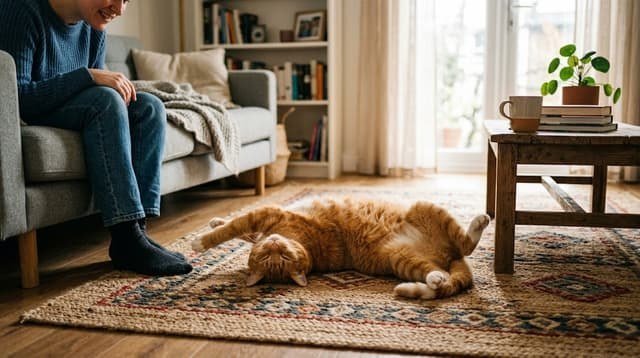
You walk through the door, and your cat flops onto her side and rolls across the floor. She twists onto her back, shows you her belly, kicks her back legs in the air, and then rolls again. It looks joyful, and it looks like an invitation.
If you have ever wondered why does my cat roll around on the floor, the short answer is that it is usually a happy sign. Rolling is one of the clearest ways a cat says she feels safe, content, and glad to see you. But it is not always a happy sign, and the details matter.
The same roll can mean trust, play, scent marking, cooling off, or a female cat in heat. It can also mean an itch she cannot reach, or a health problem that needs a vet. The trick is to read the whole picture: the time of day, the body language, and what happens just before and after the roll.
Direct answer: Your cat rolls around on the floor mostly because she feels safe and happy, and rolling lets her spread her scent, stretch, cool off, and invite play. A relaxed roll with a slow blink, soft ears, and a loose body is a sign of trust and contentment. But frantic rolling with yowling, scratching, or hair loss is not normal, and a sudden change in rolling, especially in an unspayed female or a senior cat, deserves a vet visit.
Why Does My Cat Roll Around on the Floor? The 7 Real Reasons
Most rolling has more than one cause at a time. Trust brings her down to the floor, scent marking keeps her rolling, and play turns the roll into a game. The seven reasons below cover almost every rolling cat, and the first three explain most cases on their own.
1. Trust, and the belly greeting
A cat’s belly is her most vulnerable area. It holds all her vital organs, with only thin skin and fur for protection. When a cat rolls onto her back and shows you her belly, she is making herself as defenceless as a cat can be. That is not an accident. It is a statement of trust.
This is why cats so often roll the moment they see their favourite person. You come home, you walk into the room, and she flops over in greeting. In cat language, that roll means, “I feel safe with you.” It is the feline version of a hug, and it is one of the warmest signals a cat can give.
Here is the trap that catches many owners: the exposed belly is almost never an invitation to rub it. Most cats enjoy the roll itself but dislike having their belly touched. A hand reaching for the belly often gets a grab, a kick, and a bite. That is not ingratitude. The roll was a greeting, not a request, and the bite is her way of saying the greeting is over.
If your cat rolls when she sees you, enjoy the compliment and respond with a slow blink or a gentle scratch behind the ears. That is the reply she actually wants.
2. Scent marking, and claiming the floor
Cats have scent glands all over their bodies: on their cheeks, chin, forehead, flanks, paws, and the base of the tail. When your cat rolls on the floor, she presses those glands against the surface and leaves her scent behind. She is signing her name on the room.
This is why cats often roll in the same spot again and again, or roll right after you clean the floor, move furniture, or bring something new into the house. The room smells different, and she is putting it right. A cat that rolls after a visitor leaves is doing the same thing: restoring her own scent to a space that now smells like a stranger.
Scent rolling is also social. In multi-cat homes, cats often roll in the same places, building a shared group scent that tells every cat in the house, “We belong together.” It is the same instinct behind headbutting, cheek rubbing, and sleeping in a pile with a bonded housemate.
You cannot stop scent marking, and you should not try. It is how your cat makes a house feel like home. Give her scratching posts and beds of her own, and she will mark those instead of your clean laundry.
3. Play, and the hunting sequence
Rolling is part of how cats play. The full hunting sequence runs through search, stalk, chase, pounce, catch, and kick, and the roll sits right in the middle of it. A cat that rolls during play is practising the moves she would use on real prey: the belly-up position lets her grab with her front paws and kick with her back legs at the same time.
Watch for the play signs. Dilated pupils, ears forward, a twitching tail tip, and a sudden pounce after the roll all mean she is playing. She may roll, kick at the air, and then dash off in a burst of energy. This is the same joyful energy behind the 3am zoomies, and it is completely normal in a healthy cat.
Play rolling peaks at dawn and dusk, because cats are crepuscular hunters, most active in the half-light. It also peaks after a nap, when a cat wakes up full of energy and needs to stretch and move. A short play session with a wand toy gives that energy somewhere useful to go.
If the roll turns into a full play attack on your ankles, do not use your hands or feet as toys. Redirect her to a wand toy or a kicker toy she can grab and kick safely.
4. Catnip, silver vine, and other scents
If your cat rolls wildly after smelling catnip, she is not broken. She is high. Catnip contains nepetalactone, a compound that binds to scent receptors in a cat’s nose and triggers a burst of playful, rolling, rubbing behaviour that lasts about ten minutes. Roughly two out of three cats respond to it, and the response is inherited, so some cats simply never react.
Silver vine, valerian root, and olive wood have a similar effect, and some cats that ignore catnip go wild for silver vine instead. The rolling, head rubbing, drooling, and happy wriggling are all part of the same response. It looks dramatic, and it is completely harmless when the plant is offered in moderation.
Scent rolling is not limited to catnip. Some cats roll on the floor after you come home wearing a new perfume, after you bring in shopping bags, or after you handle another animal. Strong new smells trigger the same rolling and rubbing, because the cat is investigating the scent and then covering it with her own.
Offer catnip once or twice a week at most, and in small amounts. Daily catnip loses its effect, because cats build up a short-term tolerance. A pinch of dried catnip on a scratching post, or a catnip-filled toy, is plenty.
5. Cooling off, stretching, and scratching an itch
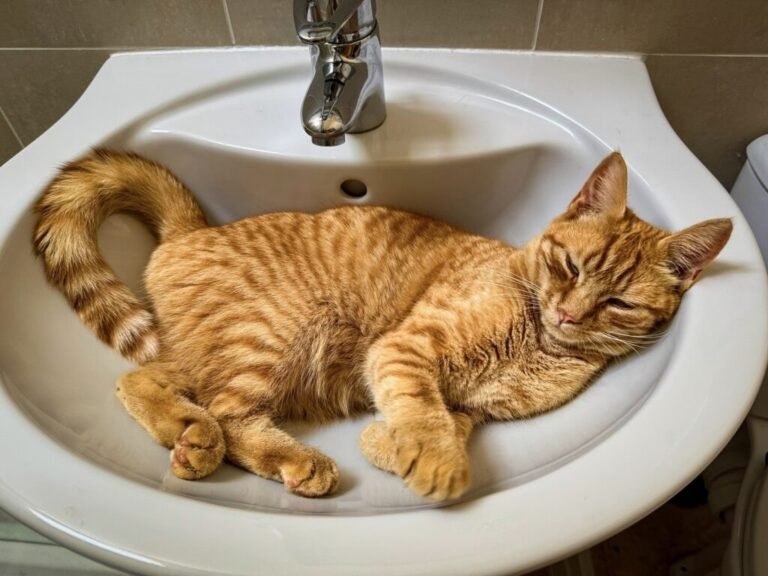
Sometimes rolling is practical, not social. On a hot day, a cat may flop onto a cool tile or concrete floor and roll to press her belly against the cold surface. The belly has thinner fur than the back, so it loses heat faster. Rolling spreads that cool contact across her whole body.
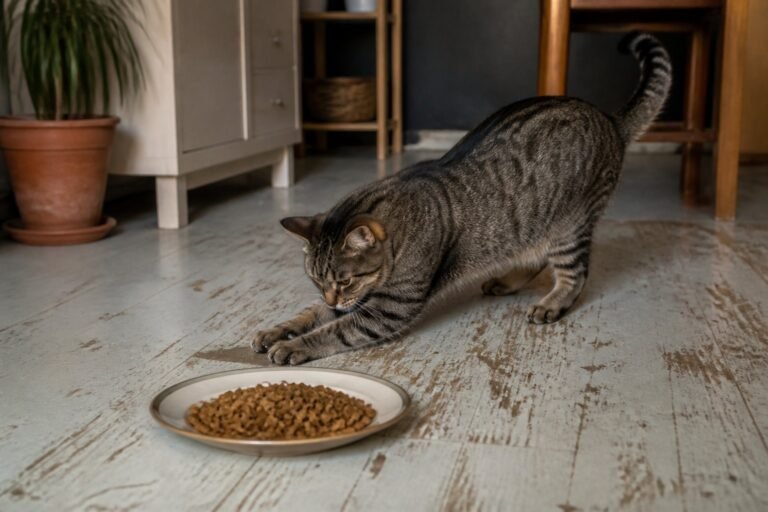
Rolling is also a stretch. After a long nap, a cat wakes stiff, and a full-body roll stretches the spine, shoulders, and hips in a way that a simple stretch cannot. Watch a cat after she wakes: she will often stretch, yawn, and then roll once or twice before she walks off. That is a cat loosening up for the day.
An itch is the third practical reason. A cat cannot scratch her own back, so rolling on a rough carpet or a hard floor is a good substitute. A brief roll that ends with a satisfied shake is usually just an itch. A roll that goes on and on, with frantic scratching, biting at the fur, or rolling the same spot raw, is not. That pattern points to fleas, mites, allergies, or dry skin, and it needs a closer look.
6. A female cat in heat
An unspayed female cat in heat, also called a queen in oestrus, rolls far more than usual. The rolling is dramatic: she flops, wriggles, rubs her face on everything, raises her hindquarters, and calls loudly, often at night. It can look playful, but it is a mating display, designed to attract a male.
Heat cycles repeat every two to three weeks in the breeding season, which runs roughly from spring to autumn, and each cycle lasts several days. If your unspayed female suddenly starts rolling constantly, yowling, and demanding attention, heat is the most likely explanation. Spaying ends the cycles completely, and it also removes the risk of unwanted litters and several serious health problems.
Do not mistake heat rolling for affection alone. A queen in heat is restless, vocal, and desperate to get outside. Keep her indoors, keep windows and doors shut, and talk to your vet about spaying. The behaviour will stop, and she will be calmer and healthier for it.
7. Attention, because it works
Cats are quick learners, and rolling is a behaviour that reliably gets a reaction. She rolls, and you laugh, talk to her, take a photo, or give her a treat. She files that away, and she rolls again tomorrow. Within weeks, rolling becomes her standard way of greeting you.
This is not manipulation in the human sense. It is simple learning: an action that brings a reward gets repeated. The same learning explains why cats meow at doors, sit on laptops, and follow owners into the bathroom. Each behaviour once produced a response, so the cat keeps doing it.
Attention rolling is easy to spot. It happens when you are watching, it stops when you leave the room, and it comes with soft body language: slow blinks, a relaxed tail, and an expectant look. It is a happy habit, and there is no reason to stop it. A cat that rolls for your attention is a cat that likes your company.
The Belly Trap: Why Rolling Is Not an Invitation
The single most common mistake owners make with a rolling cat is rubbing the exposed belly. The cat shows her tummy, the owner reaches for it, and the cat grabs the hand with all four paws and bites. The owner feels betrayed. The cat feels misunderstood.
The misunderstanding is about what the belly means. In dogs, a belly-up roll is often a request for a rub. In cats, it is not. A cat’s belly is sensitive, ticklish, and vulnerable, and most cats tolerate only a second or two of belly touch before the hunting reflex kicks in. The grab-and-kick response is automatic, not angry.
Some cats do enjoy a brief belly rub, but they are the exception, and they will tell you clearly: a loose body, a slow blink, and no tension in the legs. If the legs stiffen, the ears flatten, or the tail starts to lash, stop at once. You have about two seconds of warning.
The safest response to a rolling cat is a scratch behind the ears or under the chin, which are the spots cats groom on each other. If she rolls and shows her belly, admire it from a distance. That is the compliment she intended. Our guide on why cats bite when you pet their belly explains the reflex in full, and why even the friendliest cat has a limit.
If your cat is a regular belly-trapper, teach visitors the same rule. A guest who grabs the belly will get the same response you do, and the cat will be blamed for a perfectly normal reaction. A short warning — “she shows her tummy but does not like it touched” — saves everyone a scratch.
Roll Decoder: What Your Cat’s Roll Means
Use this table to read the roll. Look at the body language and the timing, not just the roll itself.
| What you see | What it usually means | What to do |
|---|---|---|
| Slow roll on seeing you, soft ears, slow blink | Trust and greeting | Slow-blink back, offer a chin scratch |
| Roll with dilated pupils, tail twitching, sudden pounce | Play and hunting practice | Offer a wand toy, not your hands |
| Roll in the same spot after cleaning or a visitor | Scent marking | Nothing — she is restoring her scent |
| Wild rolling after catnip, drooling, rubbing face | Catnip response | Enjoy it, offer catnip only once or twice a week |
| Roll on cool tile on a hot day, belly pressed flat | Cooling off | Offer shade, fresh water, and a cool resting spot |
| Roll with frantic scratching, biting at fur, bald patches | Itch, fleas, or allergy | Check for fleas, book a vet visit |
| Constant rolling with yowling in an unspayed female | Heat cycle | Keep her indoors, talk to your vet about spaying |
| Sudden frantic rolling, crying, or stumbling | Pain or neurological problem | Vet visit the same day |
When in doubt, film the roll on your phone. A short video is far more useful to a vet than a description, and it costs nothing to take.
When Rolling Needs a Vet
Most rolling is harmless, but a few patterns are warning signs, and they are worth knowing. The key difference is change: a cat that has always rolled happily is fine, but a cat that suddenly rolls differently, rolls far more, or rolls with other symptoms needs attention.
Frantic rolling is the clearest red flag. A cat that rolls over and over, cries, bites at her own fur, or cannot seem to settle may be in pain. Skin problems are the most common cause: fleas, mites, ringworm, and allergies can all make a cat roll to scratch an itch she cannot reach. Check her skin for redness, bald patches, scabs, or tiny black specks that look like pepper. Flea dirt turns red-brown on a damp tissue, which is a quick home test.
Ear problems can also cause rolling. A cat with an ear infection or ear mites may roll and tilt her head, shake her ears, or paw at one side. The rolling comes from discomfort and disorientation, not from play. A vet can check the ear canal in seconds and prescribe drops that fix it fast.
Neurological problems are rarer but more serious. A cat that rolls and then stumbles, walks in circles, stares blankly, or has a seizure needs a vet the same day. So does a cat that rolls with a head tilt and vomiting, which can signal an inner-ear or brain problem. Do not wait to see if it passes.
Senior cats deserve extra attention. A cat over twelve that suddenly starts rolling, staring, or behaving strangely may be showing early signs of cognitive dysfunction, the feline version of dementia. It can also be a sign of high blood pressure, thyroid trouble, or arthritis pain. The cat age calculator shows your cat’s age in human years, which helps you judge how closely to watch her.
As a simple rule, book a vet visit if the rolling is new, frantic, or comes with any of these: appetite loss, weight loss, vomiting, diarrhoea, hiding, yowling, bald patches, or a change in litter box habits. A short video of the rolling will help your vet enormously. The ASPCA’s guide to common cat behavior issues is a good reference for telling a quirk from a warning sign.
How Much Play Does a Rolling Cat Need?
A cat that rolls a lot is often a cat with energy to spend. Indoor cats need two play sessions a day, about ten minutes each, to stay healthy and calm. A wand toy that mimics a bird or a mouse is best, because it lets her stalk, chase, pounce, and catch, which is the full hunting sequence her body is built for.
End each play session with a small meal or a treat. In the wild, a hunt ends with food, and a cat that eats after play settles down to groom and sleep. A cat that plays without a meal at the end often stays wired and restless, and the rolling and the 3am zoomies continue. If your cat’s night-time energy is a problem, our guide on why cats run around at 3am explains the crepuscular rhythm and how to shift it.
Food matters too. A cat that is bored with her diet may roll and demand attention around mealtimes instead. The cat food calculator and the cat calorie calculator give daily portions based on weight and activity, so you can check whether she is getting the right amount.
Do not forget the environment. A tall cat tree, a window perch, a cardboard box, and a puzzle feeder give a cat things to do when you are not playing with her. International Cat Care’s guide to understanding your cat has practical ideas for enrichment that cost little and help a lot.
Frequently Asked Questions
Why does my cat roll in litter?
Rolling in litter is usually about scent. Cats like to surround themselves with their own smell, and fresh litter carries no scent yet, so a cat may roll in it to mark it as hers. Kittens do it for fun, and usually grow out of it. It becomes a concern only if the cat spends long periods lying in a dirty litter box, which can mean she feels stressed or unwell. Give her more scratching posts and beds to mark instead, and keep the box clean. If she lies in the box and also eats less or hides, book a vet visit.
Why does my cat roll in dirt outside?
Outdoor cats roll in dirt for scent, cooling, and camouflage. Dry dirt absorbs scent and covers the cat’s own smell, which wild cats use to hide from both prey and predators. Dirt also cools a hot cat and helps remove loose fur and parasites from the coat. A short roll in clean soil is normal. A cat that rolls obsessively in dirt, or that comes home with bald patches and sores, may have fleas or an allergy.
Why does my cat roll around after eating?
A post-meal roll is usually contentment. A cat that has just eaten well feels relaxed and safe, and rolling is a comfortable stretch that also spreads her scent around her feeding area. Some cats roll after eating because they want attention or a second helping, and they have learned that rolling gets a reaction. It is only a concern if the roll comes with vomiting, retching, or signs of pain, such as a hunched posture or crying. A cat that vomits after most meals, or that eats grass and vomits often, should be checked by a vet.
Why does my cat roll on my clothes?
Your clothes carry your scent at full strength, and your cat rolls on them to mix her scent with yours. It is the same instinct behind sleeping on your clothes and sitting on your laptop: she is building a shared group scent that says you belong together. The behaviour is harmless, though it does cover clean clothes in fur. Keep a blanket on your lap when you fold laundry, and give her an old T-shirt of yours in her bed, so she can roll on your scent without ruining the wash.
Why does my cat roll around on the floor at 3am?
Cats are crepuscular, which means they are naturally most active at dawn and dusk, and a 3am roll is usually just the start of the dawn hunting shift. Your cat wakes up full of energy, stretches, rolls, and then wants to play. It feels worse at 3am because the house is quiet and you are trying to sleep. Shift the energy earlier: play with her for ten minutes before bed, feed her a small meal afterwards, and leave a puzzle feeder out overnight. A tired, fed cat sleeps longer, and the 3am roll moves closer to a civilised hour.
Rolling is one of the happiest sights in a cat-owning home, even though it makes no sound at all. It is a cat saying, in the clearest way she knows, that she trusts you and feels safe enough to show you her belly. Enjoy the compliment, keep your hands away from the tummy, and give her a wand toy to chase. She will roll again tomorrow, and that is exactly how it should be.