Why Is My Chameleon Turning Brown? 6 Causes & Fixes
If you are asking why is my chameleon turning brown, you have probably watched your bright green pet fade to a dull brown and wondered whether it is sick. Chameleons change colour all the time, and brown is one of the most common colours they turn. Sometimes it means nothing at all, and sometimes it is the first sign of a real problem.
Direct answer: A chameleon turning brown is usually cold, stressed, about to shed, or dehydrated. A chameleon that is brown in the morning and bright green by lunchtime is simply warming up. A chameleon that stays brown all day, stops eating, or looks dull and sunken needs a setup check and possibly a reptile vet.
Brown is a warning colour, not a diagnosis. The same brown skin can mean a cold morning, a stressful day, or an illness, and the only way to tell them apart is to look at the time of day, the behaviour, and the setup together.
This guide gives you the six causes in check order, a brown-by-time decoder table, the right temperature and humidity numbers, and the red flags that mean a vet visit.
Why is my chameleon turning brown?
A chameleon changes colour using special skin cells, and brown is the colour those cells make when they are told to absorb heat or show stress. The table below shows the most common patterns, so you can work out which one fits your chameleon.
| When the brown appears | Most likely cause | What to do first |
|---|---|---|
| Morning, fades to green by midday | Cold overnight — warming up | Check the basking spot temperature |
| When you approach or handle it | Stress or fear | Give it space and cut back on handling |
| All day, with dull skin and closed eyes | Illness or chronic stress | Check the setup, then see a vet |
| Patchy brown with grey, flaky skin | About to shed | Raise the humidity and wait |
| With sunken eyes and dry skin | Dehydration | Mist more and check the drip system |
| Slowly over weeks, in an old chameleon | Old age, or a species with dull adult colours | Compare with the species’ normal colours |
How does the colour change actually work? A chameleon’s skin has layers of special cells. The top layer holds yellow and red pigment, the middle layer holds tiny crystals that reflect blue and green light, and the deepest layer holds dark melanin, the same pigment that tans human skin.
When the chameleon is relaxed and warm, the crystals spread out and reflect bright greens and blues. When it is cold or stressed, the crystals pack together, the dark melanin layer shows through, and the skin turns brown or black.
This system is why a chameleon can be bright green in the afternoon and dark brown at night. It is also why brown is never a single answer: the same brown skin can come from temperature, mood, shedding, or health, and only the pattern around it tells you which one.
Cause 1: Cold — the morning brown
Cold is the most common reason a chameleon turns brown, and it is also the least worrying. A chameleon that is cold darkens its skin to absorb more heat, the same way a dark car heats up faster in the sun than a white one.
Most pet chameleons are brown first thing in the morning. The enclosure has cooled overnight, the chameleon is cold, and it turns dark to soak up heat from the basking lamp. As it warms up over the morning, the bright colours come back. By lunchtime, a healthy chameleon is usually green again.
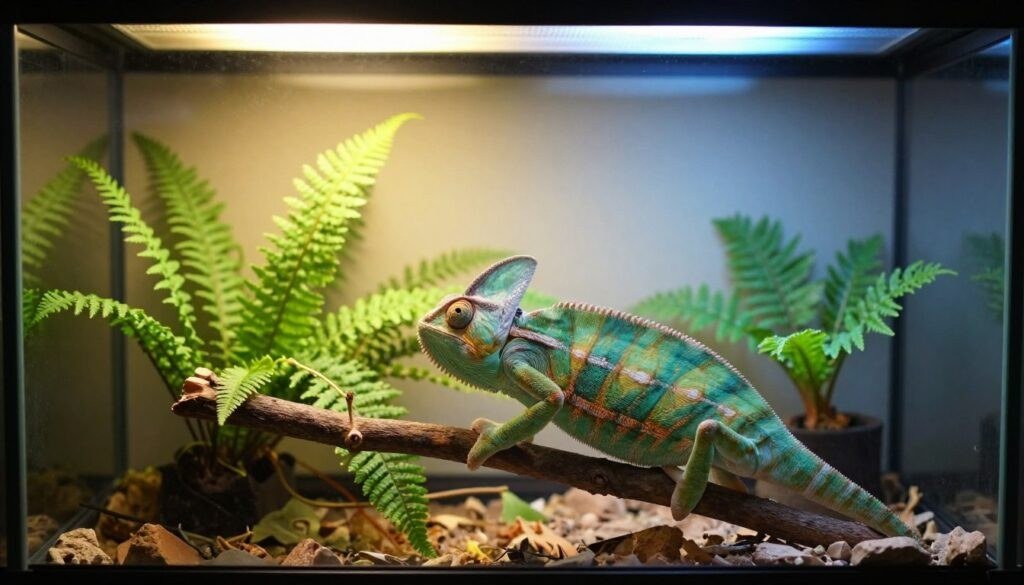
Check the numbers. A veiled chameleon needs a basking spot of 85–95°F (29–35°C) and a cooler side of 70–80°F (21–27°C). Panther chameleons need similar numbers, while Jackson’s chameleons prefer it cooler, with a basking spot of 80–85°F (27–29°C). Night temperatures can drop to 65–70°F (18–21°C).
If the chameleon is still brown at midday, the basking spot may be too cool, the bulb may be too weak, or the bulb may be too far from the branch. Measure the basking surface with a digital thermometer or an infrared gun. A bulb that still glows can be putting out far less heat than it did when new.
Fix it by moving the basking branch closer to the lamp, replacing an old bulb, or adding a slightly stronger bulb on a thermostat. Never use a bulb without a thermostat, and never let the chameleon touch the bulb — burns are a common injury in chameleons that climb too close to a hot lamp.
You can work out the right gradient with our reptile temperature gradient calculator. If the chameleon turns green within an hour of fixing the heat, cold was the cause.
Cause 2: Stress — the most common cause of all-day brown
Stress is the most common cause of a chameleon that stays brown all day. Chameleons are solitary, shy animals that stress easily, and they show it in their skin before they show it in any other way.
The usual stress triggers are over-handling, a enclosure placed where people walk past all day, a mirror or another chameleon in view, a dog or cat staring at the tank, or a recent move. A chameleon that turns brown every time you approach is telling you it feels threatened.
Look at the body language as well as the colour. A stressed chameleon often flattens its body sideways, puffs out its throat, opens its mouth, or hisses. It may sway from side to side, which is a sign of agitation. A calm chameleon moves slowly and deliberately, with a relaxed grip on its branch.
Male chameleons also turn dark when they see another male, or even their own reflection in glass. In the wild, males defend a territory, and a dark, puffed-up display is a warning to a rival.
Fix stress by giving the chameleon space. Handle it as little as possible, and never for more than a few minutes at a time. Keep the enclosure in a quiet room, away from televisions and foot traffic. Add dense plants and branches so the chameleon can hide whenever it wants to.
A stressed chameleon that gets space usually brightens up within a day or two. If it stays brown for a week despite a quiet setup, the cause is probably not stress alone, and you should check the other causes in this list.
Cause 3: About to shed — patchy brown and dull skin
A chameleon that is about to shed often turns dull and brownish first. The old skin loosens, goes pale or grey, and the bright colours underneath are hidden until the shed comes off. This is normal, and it is easy to recognise once you know the pattern.
Look for the signs: patchy brown or grey areas, skin that looks dry or papery, and a chameleon that is eating less and hiding more. Chameleons shed in patches, not in one piece like a snake, so the brown areas may appear on the head, the back, or the tail at different times.
Shedding takes a few days from start to finish. The chameleon may rub against branches to help the old skin come off. Do not pull shed skin off yourself — it tears easily, and pulling can injure the new skin underneath.
Help the shed by raising the humidity. Veiled and panther chameleons need 50–70% humidity during the day, rising to 80–100% at night. Mist the enclosure two or three times a day during a shed, and make sure the drip system is running so the chameleon can drink.
If the shed stays stuck for more than a week, or skin stays stuck around the eyes, the toes, or the casque — the helmet-like crest on a veiled chameleon’s head — see a reptile vet. Stuck shed can cut off blood flow and cause infection. You can check the right numbers with our reptile humidity calculator.
Cause 4: Dehydration — sunken eyes and dry skin
A dehydrated chameleon often turns dull brown or grey, and its eyes look sunken. Dehydration is common in pet chameleons, because most of them will not drink from a bowl. They drink water droplets off leaves, and they need regular misting or a drip system to stay hydrated.
Check the signs. A dehydrated chameleon has sunken eyes, dry and wrinkled skin, and a casque that looks shrunken. Its droppings may have a yellow or orange urate — the white, chalky part of the pee — instead of a clean white one. It may also sit with its eyes closed during the day.
The fix is water, not a bath. Mist the enclosure heavily two or three times a day, so the leaves are wet when the chameleon wakes up. Run a drip system for several hours a day, so water falls slowly onto the leaves. A chameleon that is thirsty will often drink as soon as it sees moving water.
Do not rely on a water bowl. A few chameleons learn to drink from a dish, but most will not, and a bowl of still water does nothing for a dehydrated chameleon. Live plants help too, because they hold water droplets on their leaves and raise the humidity.
If the chameleon is very dehydrated — sunken eyes, limp body, not drinking at all — see a reptile vet. A vet can give fluids safely. Do not try to force water into a chameleon’s mouth, because it can inhale the water into its lungs.
Cause 5: Illness — when brown means a vet visit
A chameleon that stays brown all day, stops eating, and looks dull and tired may be ill. Colour change is one of the earliest signs of illness in chameleons, and it often appears before any other symptom.
The most common illnesses behind persistent brown are respiratory infections, parasites, and metabolic bone disease. A chameleon with a respiratory infection may breathe with its mouth open, make a wheezing sound, or hold its head up to breathe. It may also have bubbles or discharge around the mouth and nose.
Metabolic bone disease, often called MBD, comes from too little calcium, too little vitamin D3, or too little UVB light. A chameleon with MBD may have a soft or swollen jaw, bent limbs, trembling, or a casque that looks bent or folded. Its grip may weaken, and it may fall from its branches.
Parasites can also cause a chameleon to turn brown and stop eating. A chameleon with parasites may lose weight, have runny or very smelly droppings, or sit with its eyes closed for hours. A faecal test at the vet will find parasites quickly.
UVB light matters here. Without enough UVB, a chameleon cannot make vitamin D3 or use calcium properly, and its colours fade as its health fails. UVB bulbs fade long before they burn out, so replace them every six months for compact coils and every twelve months for quality T5 tubes, even if they still light up.
The bulb should sit 12–18 inches from the basking spot, with no glass or plastic between the bulb and the chameleon. Check the right setup with our reptile UVB lighting calculator. If your chameleon is brown, not eating, and has any of the signs above, do not wait — see a reptile vet.
Cause 6: Old age and normal species colours
Not all brown is a problem. Some chameleons are naturally browner than others, and older chameleons often fade to duller colours as they age. A chameleon that has always been a little brown, eats well, and moves normally is probably just showing its normal colours.
Species matter. Veiled chameleons are usually bright green with yellow and blue markings when young and healthy, but females and older males can be much browner. Panther chameleons come in many colour forms, and some locales are naturally brown, red, or orange rather than green.
Jackson’s chameleons are usually a duller green with brown tones, and they rarely show the bright colours of a panther chameleon. A Jackson’s that looks brown next to a veiled chameleon’s green is not necessarily sick — it may just be a Jackson’s.
Age matters too. A chameleon over three or four years old may show duller colours and move more slowly. That is normal ageing, as long as the chameleon is still eating, drinking, and holding its grip on the branches.
The key question is change. A chameleon that was bright green last month and is brown now has changed, and the change needs an explanation. A chameleon that has always been brown, and is otherwise healthy, is probably just itself.
How to check the causes in order
When your chameleon turns brown, work through the causes in this order. It takes about twenty minutes, and it saves you from fixing the wrong thing first.
Step 1 — Note the time. Is the chameleon brown in the morning and green by midday? That is warming up, and it is normal. Is it brown all day? That needs a closer look.
Step 2 — Measure the temperatures. Check the basking spot and the cool side with a digital thermometer. The basking spot should be 85–95°F for a veiled chameleon, and the cool side 70–80°F. Fix the heat first, then watch for an hour.
Step 3 — Check the humidity and the water. Mist the enclosure and watch whether the chameleon drinks. Check the eyes: sunken eyes mean dehydration. Run the drip system and check the humidity reading.
Step 4 — Look for shed signs. Check for patchy, grey, papery skin on the head, back, and tail. If the chameleon is shedding, raise the humidity and wait a few days.
Step 5 — Review stress. Ask what changed in the last week: a new enclosure, more handling, a new pet in the room, a mirror, or another chameleon in view. Give the chameleon space and quiet for a few days.
Step 6 — Check for illness signs. Look for open-mouth breathing, wheezing, discharge, a soft jaw, bent limbs, weight loss, or runny droppings. If you see any of these, call a reptile vet rather than waiting.
Keep a simple note of what you see each day: the colour in the morning and the afternoon, whether the chameleon ate, and whether it drank. A short note turns a vague worry into a clear pattern.
When to see a vet: the red-flag checklist
Most brown chameleons are fixed at home by correcting the heat, the humidity, or the stress. But some are ill, and those cases need a vet. Use this checklist — if your chameleon ticks any box, call a reptile vet.
| Sign | How urgent |
|---|---|
| Brown all day for more than a week, with no cause found | Vet within a few days |
| Not eating for more than a week, plus staying brown | Vet within a few days |
| Open-mouth breathing, wheezing, or bubbles around the mouth | Vet today — possible respiratory infection |
| Sunken eyes and not drinking, despite misting and a drip system | Vet today — severe dehydration |
| Soft or swollen jaw, bent limbs, trembling, or falling from branches | Vet today — possible metabolic bone disease |
| Stuck shed on the eyes, toes, or casque for more than a week | Vet within 24 hours |
| Rapid weight loss, or droppings that are runny and very smelly | Vet within 24 hours — possible parasites |
| Swollen body, lethargy, or the chameleon feels limp when handled | Vet today — emergency |
Finding a reptile vet matters. Not every vet treats chameleons, so look for an exotics vet with chameleon experience. The Association of Reptile and Amphibian Veterinarians keeps a find-a-vet directory that lists reptile vets by area. Call ahead and describe the colour pattern and the symptoms, so the clinic can tell you whether to come in the same day.
For more on chameleon care, the VCA Hospitals guide to chameleons covers housing, feeding, and common health problems in plain language. The Merck Veterinary Manual’s reptiles section is a reliable, vet-written reference as well.
How to keep your chameleon bright and healthy
Prevention is mostly routine. Keep the basking spot at the right temperature, mist the enclosure two or three times a day, and run a drip system so the chameleon can drink. Replace UVB bulbs on schedule, even if they still light up, and check the temperatures every week.
Give the chameleon space and cover. Keep the enclosure in a quiet room, add dense live plants and branches, and handle the chameleon as little as possible. A chameleon that can hide whenever it wants to will stress less, and a less stressed chameleon shows brighter colours.
Feed a varied diet of gut-loaded insects — crickets, dubia roaches, and black soldier fly larvae — dusted with calcium at most feedings and a multivitamin twice a month. Offer leafy greens to veiled chameleons, which eat some plant matter as adults. A well-fed chameleon with the right UVB and calcium will keep its colours far better than one that is missing any of those things.
Weigh the chameleon once a month, and write the number down. A steady weight is reassuring, while a steady fall is the earliest warning sign of illness — often before the chameleon looks sick at all.
If your chameleon also stops eating, read our guide on why a chameleon stops eating — the same temperature, stress, and illness problems sit behind both behaviours. Most owners who ask why is my chameleon turning brown find the answer in one of the six causes above, and most of them are fixed within a few days.
Frequently Asked Questions
Why is my chameleon turning white?
A chameleon turning white is usually a different problem from turning brown. White or very pale skin most often means the chameleon is too hot and trying to reflect heat, is about to shed, or is dehydrated. A chameleon that turns pale in the afternoon under a strong basking lamp is usually cooling itself down.
White can also mean a shed is coming, because the old skin goes pale before it peels. If your chameleon is turning white rather than brown, read our guide on why a chameleon turns white, which covers the pale-colour causes in detail.
Do chameleons change color when they sleep?
Yes. Most chameleons darken at night when they sleep, often turning brown, grey, or nearly black. This is normal. The dark colour helps them absorb warmth and stay camouflaged while they rest, and the bright colours return in the morning as they warm up under the basking lamp.
A chameleon that is dark at night and bright during the day is healthy. Worry only if the chameleon stays dark through the day as well, or if the night-time darkening comes with closed eyes during the day, no appetite, or weight loss.
Do chameleons change color to match their surroundings?
Mostly, no. This is the most common myth about chameleons. A chameleon does not change colour to match the branch it sits on, the way an octopus matches a rock. Its resting colours already blend with leaves and bark, so it does not need to copy its background.
Chameleons change colour mainly to control their temperature and to communicate. Dark colours absorb heat when the chameleon is cold, and light colours reflect heat when it is hot. Bright colours signal mood, dominance, or readiness to mate, while dark colours signal stress, fear, or submission.
Camouflage is a side effect of the system, not its main job. A chameleon that turns brown on a green branch is not failing to camouflage — it is telling you it is cold or stressed.
How long does it take a chameleon to change color?
It depends on the cause. A chameleon reacting to a sudden fright or a rival can change colour in seconds, flashing from green to dark brown or black almost at once. A chameleon warming up in the morning changes more slowly, over minutes to an hour, as its body temperature rises.
A chameleon that has slowly turned brown over a week needs a setup check more than one that flashed dark the moment you picked it up.
If your chameleon is turning brown and the steps in this guide have not helped within a week, do not wait longer — a reptile vet can find the cause quickly, and most brown-chameleon problems are very fixable once the setup is right.