Why Does My Horse Kick the Stall Wall?
It is two in the morning, and the whole yard is awake. Bang. Bang. Bang. Your horse is kicking the stable wall again, and the noise echoes down the barn aisle. The wall is dented, the paint is gone, and you are worried about the horse’s legs. Stall kicking is noisy, destructive, and surprisingly common — and it is almost always fixable once you know what is driving it.
So why does my horse kick the stall wall? Most often it is boredom, frustration, or a learned habit. A horse that is stabled for long hours with little to do, a horse that kicks at feed time because it has learned that kicking brings food faster, or a horse in pain — from gastric ulcers to a sore hock — can all kick the wall. This guide explains how to tell which one you have, and how to stop it in the right order.
Direct answer: A horse usually kicks the stall wall because it is bored, frustrated, or has learned that kicking gets results. The most common pattern is feed-time kicking, where the horse has learned that banging the door brings its food sooner. Boredom from long hours in the stable, too little forage, and pain such as gastric ulcers are the other main causes. The fix is to change the routine so kicking no longer pays, give the horse more forage and turnout, and rule out pain with your vet. Never punish the horse for kicking — punishment almost always makes it worse.
Why Does My Horse Kick the Stall Wall? The Main Reasons
Kicking is not one problem. A horse that kicks at feed time is doing something very different from a horse that kicks all night for no clear reason. Find the row that matches your horse in the table below, then read the section that follows for the full detail.
| What you see | Most likely reason | Fix first |
|---|---|---|
| Kicks the door with a front leg, only at feed time | Learned habit — kicking brings food faster | Change the feeding routine so kicking never pays |
| Kicks the walls with hind legs, mostly at night | Boredom and confinement | More turnout, more forage, more to do |
| Starts kicking suddenly, seems uncomfortable, off its feed | Pain — gastric ulcers or a sore leg | Call the vet; do not assume it is a habit |
| Kicks at the wall next to one particular horse | Conflict with the neighbour | Move the horse or change the neighbour |
| Kicks only when the stable is busy or noisy | Stress and frustration at being shut in | More turnout and a calmer routine |
| Mare kicks a lot in spring, otherwise calm | Seasonal behaviour — in season | Talk to your vet about management options |
| Kicks for a few minutes, then settles and eats | Anticipation — excitement before food or turnout | Feed the quiet horse first, vary the routine |
Keep this table in mind as you read on. The rest of the article explains each row, so you can watch your horse and work out which one you are dealing with.
Door Banging or Wall Kicking: They Are Not the Same Problem
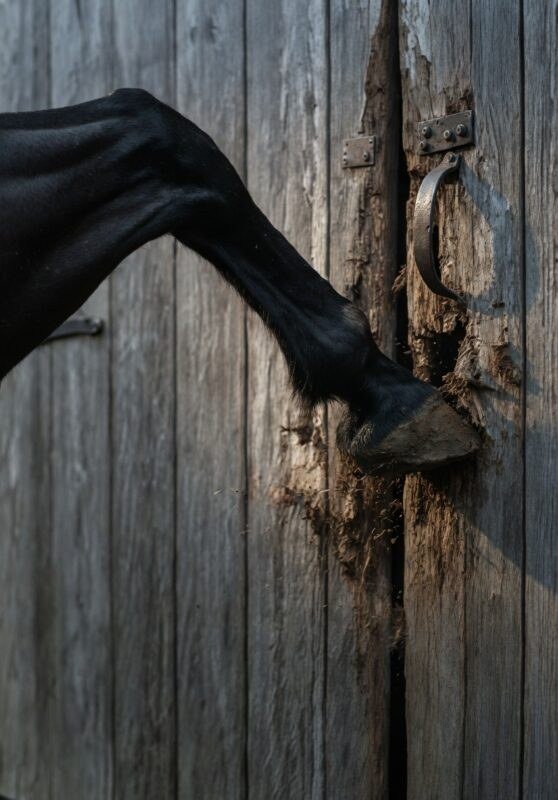
Owners use one word, kicking, for two very different behaviours. The first is door banging. The horse stands at the stable door and hits it with a foreleg, usually one leg, in a steady rhythm. It is loud, it is usually worst at feed time, and it is almost always a learned behaviour. The horse has worked out that banging the door makes things happen.
The second is wall kicking. The horse turns its quarters to the wall and kicks backwards with one or both hind legs. This is more dangerous, because the hind legs are powerful and the horse can injure its hocks, its feet, and the stable itself. Wall kicking is more often linked to boredom, frustration, or pain than to feeding, and it is more often a night-time habit, when the yard is quiet and the horse has nothing to do.
Telling the two apart matters, because the fixes are different. A door banger needs a change in the feeding routine. A wall kicker needs a change in its whole day — more turnout, more forage, more company, and a pain check. If you treat a wall kicker like a door banger, you will only fix the noise, not the cause.
Watch your horse for a few days and write down what you see. Note the time of day, which legs it uses, whether it kicks at the door or the walls, and what happens just before and just after. A horse that kicks only in the hour before feeding is telling you something different from a horse that kicks at two in the morning. That short log is the most useful thing you can show your vet or trainer.
The Reward Loop: Why Shouting and Feeding Make It Worse
Here is the hard truth about stall kicking. Almost every reaction you give makes it worse. When your horse kicks the door and you shout at it to stop, you have just given it attention. When you throw in a haynet to quiet it down, you have just given it food. When you turn it out early because the noise is driving you mad, you have just given it freedom. In the horse’s mind, kicking works. So it kicks again, louder and sooner.
Horses learn from what happens straight after a behaviour. If kicking is always followed by something the horse wants, the horse will kick more. This is true even when the thing you give is a punishment. A shout, a bang on the wall, or a spray of water is still attention, and attention is better than being ignored. That is why punishment so often fails with stall kickers. The horse does not learn to stop. It learns to kick when you are not there, or to kick harder to get the same reaction.
The way out of the loop is to break the link between kicking and reward. That means the horse must never get food, attention, or turnout as a result of kicking. It is hard to do, and it takes everyone on the yard working together, because one person who feeds the kicking horse early can undo a week of good work. But it is the only fix that lasts. A horse that learns kicking gets it nothing will stop kicking.
Expect it to get worse before it gets better. When a behaviour that used to work suddenly stops working, the horse tries harder. It kicks louder, longer, and more often for a few days. This is normal, and it is a sign the plan is working, not failing. If you give in during this phase, you will have taught the horse that kicking harder is the answer, and the problem will be worse than before. Hold the line, and the kicking usually fades within one to two weeks.
Boredom and Confinement: The Most Common Cause
Horses are built to move and graze. In the wild, a horse spends most of the day walking and eating, covering many miles. A stabled horse that is fed twice a day finishes its hay in a few hours and then has nothing to do for the rest of the day and night. That is a recipe for kicking, weaving, cribbing, and every other stable vice.
The fix starts with time out of the stable. A horse that is turned out for most of the day rarely kicks at night, because it is tired and content. If full turnout is not possible, even a few extra hours in the field, or a larger paddock with a companion, can make a big difference. A horse that can see and touch other horses is far less likely to kick than a horse shut in alone.
Forage is the second fix. A horse that always has hay in front of it has something to do, and a full gut is a calm gut. Use small-holed haynets to make the hay last longer, and spread the hay in more than one place so the horse has to move around the stable to eat. Soaking hay can also help, because it takes longer to eat and is lower in sugar. If you are not sure how much hay your horse needs, our horse hay calculator works out the daily amount from its weight and workload.
Think about the stable itself. A small, dark stable with solid walls and no view is the worst place for a bored horse. A larger stable, a window it can look out of, a stable with bars it can see through, or a stable next to a calm companion can all help. If your horse’s stable is small, our horse stall size calculator shows the minimum size for its height, and our horse pasture size calculator can help you work out how much turnout space you have. Horses that go without forage for long gaps are also more likely to develop stable vices, and our guide to how long a horse can go without hay explains why those gaps matter.
Pain and Discomfort: The Causes to Rule Out First
Not every kicker is bored. Some are in pain, and pain must be ruled out before you treat the kicking as a habit. The most common painful cause is gastric ulcers. Horses with ulcers often kick at the walls, especially after eating grain, and they may also be girthy, off their feed, or dull in their coat. Ulcers are common in stabled horses, and they are easy to miss, because the signs are often vague.
Leg pain is another cause. A horse with a sore hock, a bruised foot, or a strained tendon may kick at the wall because it is uncomfortable standing still, or because the leg hurts and it is trying to shift its weight. If the kicking started suddenly in a horse that never kicked before, or if the horse is lame, stiff, or swollen, call your vet. A sudden new behaviour in an old horse is a vet visit, not a training problem.
Neighbour trouble is a common cause that owners overlook. A horse that kicks at one particular wall may be trying to drive away the horse on the other side. Horses that dislike each other, or a gelding next to a mare in season, can spend all night threatening each other through the wall. Moving one of the horses, or putting a calm horse next to the kicker, often solves the problem overnight.
Mares in season can kick more in spring. The hormones of the breeding season make some mares restless, irritable, and more likely to kick at walls and doors. If your mare only kicks in spring and is calm the rest of the year, talk to your vet about management options. This is a seasonal pattern, not a bad habit, and it needs a different answer.
Finally, consider box rest. A horse that is confined to its stable because of an injury is under enormous stress. It is in pain, it cannot move, and it is bored. Kicking on box rest is common, and it can undo the healing of the injury. If your horse is on box rest, ask your vet about safe ways to keep it occupied — slow feeders, toys, and short hand-walks if the injury allows. A horse that lies down more than usual on box rest may also be in pain, and our guide to why a horse lies down more than usual explains the warning signs to watch for.
The Fix, in Order: A Six-Step Plan
Fix stall kicking in this order, and do not skip steps. Each step builds on the one before it, and jumping ahead to punishment or gadgets before fixing the routine will not work.
Step one is the vet check. Rule out ulcers, leg pain, and any other discomfort. This is the step owners skip most often, and it is the one that matters most. A horse in pain cannot learn a new habit, because the pain is still there.
Step two is more turnout. Get the horse out of the stable as much as you can. Even two extra hours a day helps. A horse that is out in the field with a friend, grazing and moving, is a horse that is not kicking a wall.
Step three is more forage. Keep hay in front of the horse for as much of the day as possible. Use small-holed nets, spread the hay around, and consider a third hay meal late at night so the horse has something to eat in the small hours, when kicking is worst.
Step four is the feeding routine. This is the key step for door bangers. Feed the quiet horse first, not the kicking one. If the horse kicks, wait. Stand quietly until it stops, even if that takes a few minutes, and only then bring the feed. Never bring food to a kicking horse. If you can, take the horse out of the stable before feed is prepared, and bring it back once the food is already in the manger. That way there is nothing to kick for.
Step five is to stop rewarding the kicking. Agree with everyone on the yard that nobody shouts at, feeds, or turns out the horse because it kicked. Ignore the kicking completely, as long as it is safe to do so, and reward the horse when it stands quietly. Catch it being good. Walk past and give it a quiet word or a small treat when it is standing calmly, so it learns that quiet brings rewards and kicking brings nothing.
Step six is the stable itself. Give the horse a view, a companion it can see and touch, and enough space to lie down and roll. A horse that can see other horses is calmer than a horse shut in alone. If the horse kicks at one neighbour, move it. If it kicks at night, leave a light on, or leave the top door open with a stall guard across so it can see out.
Protecting the Horse and the Stable While You Fix It
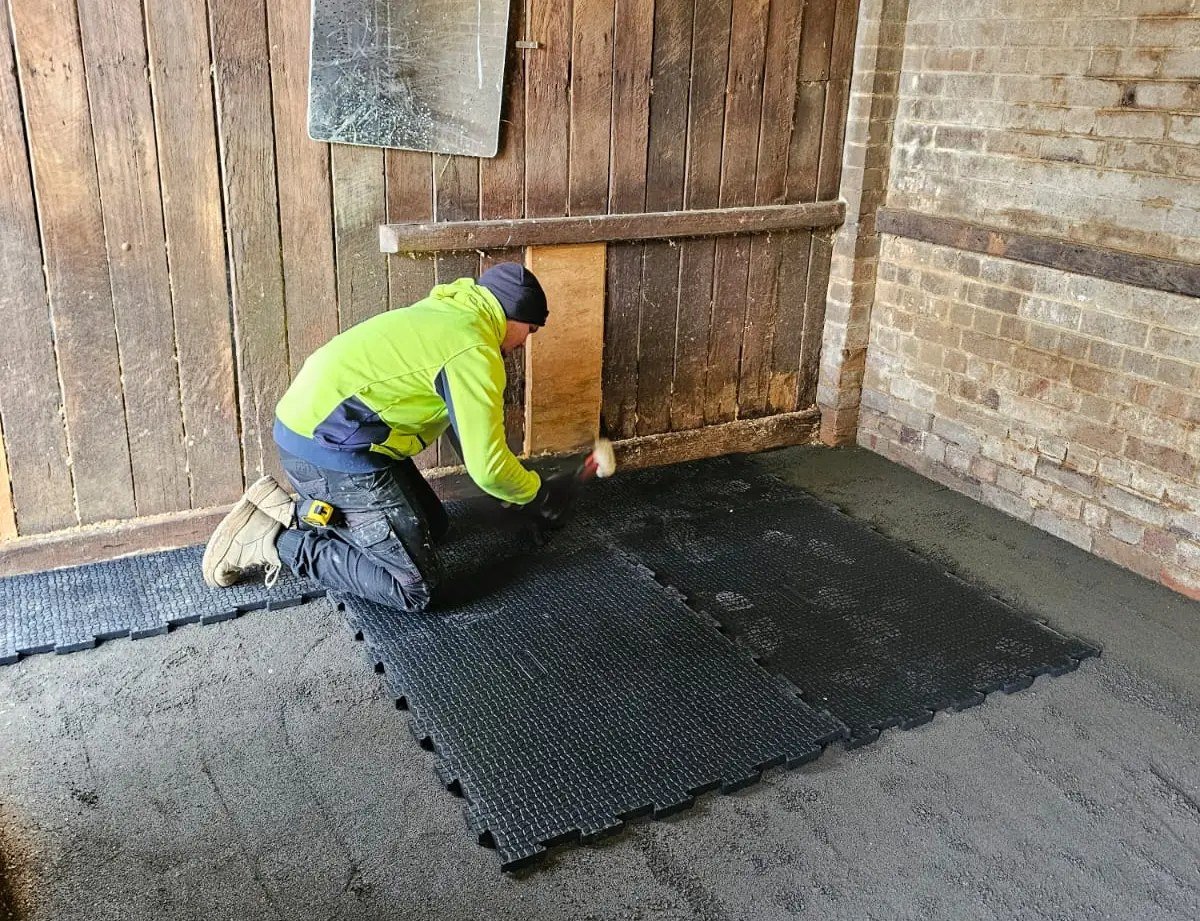
Fixing the habit takes time, and in the meantime you need to protect the horse’s legs and your stable. The simplest fix is padding. Fix thick rubber matting or heavy carpet to the inside of the door and the walls the horse kicks. This deadens the noise, which removes part of the reward, and it cushions the blow, so the horse is less likely to injure itself.
Old tyres work well too. Hang a tyre on the wall or door where the horse kicks, and it will absorb the impact and muffle the sound. Make sure the tyre is fixed firmly and cannot slip or trap a hoof. A tyre stuffed with straw or newspaper and wrapped in tape is soft, quiet, and safe.
Check the horse’s legs every day while it is still kicking. Look for swelling around the hocks, cuts on the feet, and lost shoes. A horse that kicks hard can bruise the bone inside the leg, and that kind of injury does not always show on the outside. If the legs are hot, swollen, or the horse is lame, call your vet. Do not wait for it to get better on its own.
If the horse kicks one wall only, you can also try changing the stable. A different stable, with a different neighbour and a different view, sometimes breaks the habit on its own. Horses are creatures of habit, and a change of scene can reset the pattern. It does not always work, but it is cheap and easy to try.
When to Call the Vet
Call your vet straight away if the kicking started suddenly, if the horse is lame, swollen, or off its feed, or if it has any signs of colic. A horse that kicks and then rolls, paws, or looks at its belly may be in pain, not just bored, and colic can come on fast.
Call the vet the same week if the horse has been kicking for a long time and you have not yet ruled out ulcers or leg pain. Your vet can scope for ulcers, check the legs, and talk through the feeding and management changes that will help. A vet visit for a kicking horse is not a waste of money. It is the step that turns a guessing game into a plan.
Call a professional trainer or equine behaviourist if the horse is dangerous, if the kicking has been going on for years, or if you have tried the six-step plan for a month with no improvement. An experienced trainer can watch the horse, spot what is triggering it, and help you change the routine in ways that are hard to see from inside the problem.
Frequently Asked Questions
Is stall kicking contagious — will my other horses copy it?
Probably not, and the evidence is reassuring. Horses do not usually learn to kick by watching another horse kick. What does happen is that several horses in the same yard develop kicking at the same time, because they share the same problem: long hours stabled, too little forage, or a stressful feeding routine. It looks like copying, but it is really the same management causing the same behaviour in different horses.
Fix the management for the whole yard — more turnout, more forage, calmer feeding — and the other horses are unlikely to start. That said, a young horse stabled next to a confirmed kicker for months may pick up the habit, so it is still worth separating them while you fix the problem.
Do calming supplements stop stall kicking?
Usually not, and they can be a waste of money. Most calming supplements are marketed for horses that are anxious, but there is little good evidence that they change a learned behaviour like kicking. A supplement cannot fix boredom, it cannot fill a forage gap, and it cannot undo a reward loop that has been running for months. Some owners report a small effect, but that is most likely because they changed the routine at the same time as starting the supplement. Spend the money on more hay, a bigger turnout, or a vet check for ulcers instead. If your horse is genuinely anxious, talk to your vet, who can advise on proven options rather than a tub of powder.
Do kicking chains work for horses?
Sometimes, for a while, and with real drawbacks. A kicking chain is a strap fitted above the hock with a short chain that hits the leg when the horse kicks. Many horses stop kicking while the chain is on, because the chain makes kicking uncomfortable. But the habit usually comes straight back as soon as the chain comes off, because the cause — boredom, frustration, or pain — is still there.
Chains can also rub the leg raw, cause swelling, and injure the hock if they are fitted wrongly or left on too long. They are a sticking plaster, not a fix. Use them only as a short-term measure while you change the routine, and only if your vet or farrier agrees they are safe for your horse. A horse that needs a chain for months needs a different stable routine, not a heavier chain.
Why does my horse kick the trailer walls too?
Because a trailer is a small, moving stable, and the same frustrations apply. A horse that kicks in the stable often kicks in the trailer for the same reasons: confinement, boredom, stress, and the habit itself. Some horses kick in the trailer because they are unbalanced or frightened by the movement, and some kick because they want to get out.
The fix is similar — more practice with short, calm journeys, a haynet to keep the horse busy, and a check that the trailer is big enough and the horse is travelling well. Never travel a horse that kicks violently in the trailer without first talking to your vet and an experienced transporter, because a kicking horse can damage the trailer, injure itself, and cause an accident on the road.
Stall kicking is a message, not a character flaw. Your horse is telling you that something about its day is wrong — too little movement, too little forage, too much waiting, or something that hurts. Listen to the message, fix the routine in order, and the kicking usually fades.
For the forage side of the fix, see our guide to how long a horse can go without hay, and for the stable itself, our horse stall size calculator and horse pasture size calculator help you check whether your horse has the space it needs. A vet’s practical guide to stall kickers and trailer kickers is available from Novick DVM, and the Merck Veterinary Manual’s page on behavioral problems of horses explains how stable vices develop in the first place.