Why Does My Rabbit Grunt When I Pick Him Up?
You reach into the pen to pick up your rabbit. The moment your hands close around its body, it lets out a low, harsh grunt. It is not a cute sound. It sounds annoyed, maybe even angry. You freeze, wondering whether your rabbit hates you — or whether something is wrong.
Direct answer: Your rabbit grunts when you pick it up because it feels unsafe in the air. Rabbits are prey animals, and being lifted off the ground is frightening for them. A grunt is a warning that says “put me down.” It is usually not anger and not illness — it is your rabbit asking for a safer, better-supported hold, or for more trust first.
That one sentence explains most grunting. But there are different kinds of grunts, and they do not all mean the same thing. A grunt when you lift your rabbit is different from a grunt when you clean its cage, and both are different from the happy honking sound some rabbits make at feeding time. Learning to hear the difference is the fastest way to stop the grunting and build trust.
This guide explains what each rabbit sound means, why being picked up triggers grunting, how to lift your rabbit safely, and how to build a bond so your rabbit stops dreading the lift. It also covers the one thing you must never ignore: the risk of a spine injury if a rabbit kicks free while unsupported.
Why does my rabbit grunt when I pick him up?
Your rabbit grunts when you pick it up because lifting is one of the scariest things that can happen to a prey animal. In the wild, the only time a rabbit leaves the ground is when a predator has caught it. Its brain is wired to treat being lifted as danger, even when the hands belong to someone it loves. The grunt is its way of saying so.
The second reason is physical. A rabbit’s body is built for running, not for being carried. Its hind legs are powerful, and its spine is delicate. When its back end dangles free, the rabbit feels unsupported and unstable. It may kick out with its back legs, and that kick is strong enough to break its own back. The grunt often comes with that feeling of losing support.
The third reason is trust. A rabbit that is new to your home, or a rabbit that has not been handled gently, has no reason to trust being lifted. It may be fine with you sitting on the floor beside it, but the moment your hands go under its body, it panics. This is normal, and it can be fixed with patience. It cannot be fixed by picking the rabbit up more often and hoping it gets used to it.
Hormones can add to the problem. An unspayed female or an unneutered male is more likely to grunt, especially during the teenage months from about three to six months old. Hormones make rabbits more territorial and more reactive. They also make the rabbit more likely to grunt when you reach into its space, not just when you lift it.
Pain is the least common cause, but it matters most. A rabbit with a sore back, sore feet, or an injury will grunt when you touch the sore spot. If your rabbit used to accept being picked up and suddenly starts grunting, or if it grunts and also stops eating, sits hunched, or hides more than usual, call your vet. A sudden change in behaviour is always worth checking.
Grunt, honk, growl or squeak: what is your rabbit saying?
Rabbits make more sounds than most people expect. They are quiet animals, but they are not silent. The sounds form a small language, and each one means something different. The table below is a decoder you can use the next time your rabbit makes a noise.
| Sound | What it sounds like | What it usually means | What you should do |
|---|---|---|---|
| Grunt | Short, deep, harsh, often repeated | Warning — annoyed, scared, or territorial | Stop what you are doing and give space |
| Honk or hum | Soft, low buzzing, like a tiny goose | Excitement or courtship, often while circling your feet | Enjoy it — it is a happy sound, common at feeding time |
| Growl | Low, rumbling, longer than a grunt | Strong warning — back off now | Leave the rabbit alone; do not reach in again |
| Tooth purring | Soft, gentle grinding of the teeth | Contentment — the rabbit version of a cat’s purr | Keep doing what you are doing |
| Loud tooth grinding | Hard, loud crunching | Pain — very different from soft purring | Call a vet the same day |
| Squeak or scream | High, sharp, loud | Fear or sudden pain — an emergency sound | Check at once; call a vet if it does not settle |
| Thump | A hard stamp of a back foot | Alarm or annoyance — a warning to other rabbits | Look for what scared it; check for danger |
The most important confusion to clear up is grunt versus honk. They sound similar to a new owner, but they mean opposite things. A grunt is harsh and unhappy. A honk is soft and excited. A rabbit that honks while circling your feet at dinner time is happy to see you. A rabbit that grunts when you reach for it is telling you to stop.
Body language settles the question when the sound alone does not. A grunting rabbit usually has its ears pinned flat, its body stiff, and its eyes wide. It may lunge forward, stamp a foot, or turn its back on you. A honking rabbit looks relaxed. Its body is loose, its ears are up, and it may be circling or binkying — jumping and twisting in the air with joy. For more on the thump, which often comes with grunting, see our guide to why your rabbit thumps at night.
The squeak is the one sound you should never ignore. Rabbits almost never scream. A high-pitched scream means the rabbit is in severe pain or terror. If your rabbit screams, check it at once for injury, and call your vet if it does not calm down quickly. It is not a sound a healthy, safe rabbit makes.
The pick-up problem: why lifting scares rabbits
To understand the grunt, you need to see the world the way a rabbit sees it. Rabbits are prey animals. Their whole body is built around one job: not being eaten. They have eyes on the sides of their heads, so they can see danger coming from almost any direction. They have powerful back legs for a fast escape. And they have a light, fragile spine that lets them twist and turn at speed.
Being lifted breaks all of that. A rabbit in the air cannot run. It cannot see the ground. Its feet find nothing solid, and its back end swings free. To a rabbit’s brain, that feels exactly like being caught by a predator. The grunt is the warning it gives before it does something more drastic: kicking, scratching, or biting to get free.
The kicking is where the real danger lies. A frightened rabbit can kick hard enough to fracture its own spine. The House Rabbit Society warns about this clearly: a rabbit that struggles while its back end is unsupported can suffer a broken back and end up paralysed in its hind legs. This is not a rare freak accident. It is one of the most common serious injuries in pet rabbits, and it happens because the rabbit was picked up without proper support.
That is why the grunt matters. It is not your rabbit being rude. It is your rabbit telling you, in the only way it can, that it feels unsafe. A rabbit that grunts when lifted is a rabbit that needs a better lift — or needs to be left on the ground until it trusts you more.
Some rabbits never enjoy being held, even with perfect handling. That is normal too. Rabbits are not lap animals the way cats are. Many of the happiest rabbits are the ones that are rarely picked up at all, and instead spend their bonding time on the floor with their owner. A rabbit that flops onto its side beside you, or stretches out flat for a nap, trusts you completely — and it never needed to be held to prove it.
How to pick up a rabbit safely, step by step
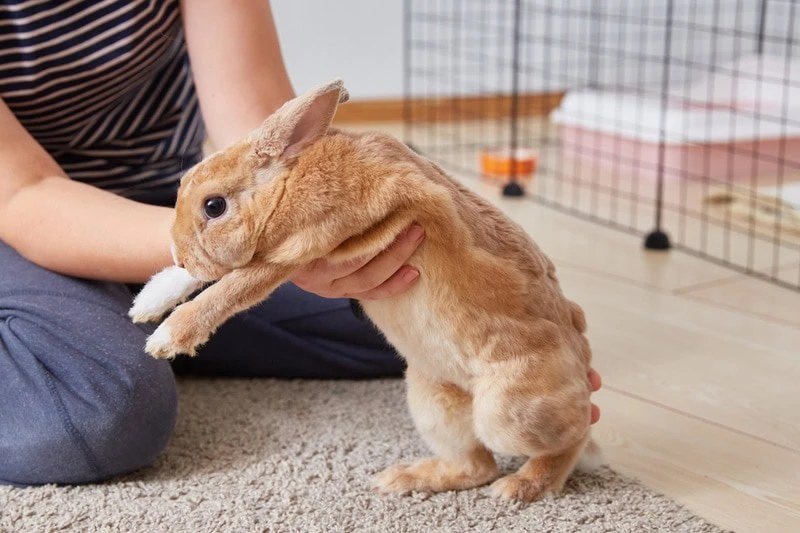
The safe lift has one rule that never changes: support the chest and the hindquarters, always, at the same time. Never lift a rabbit by its ears, its legs, its tail, or its scruff alone. Never let the back end dangle. Hold the rabbit close to your body, not out in the air.
Start on the floor. Sit down in the rabbit’s space, in a quiet room with no obstacles. Let the rabbit come to you. Offer a leafy green and let it eat while you stroke its forehead. Do this for a few days before you try to lift at all. A rabbit that is calm on the floor is much less likely to panic in your hands.
When you are ready, practise the touch first. Gently stroke the areas you will need to touch during a lift: under the chest, behind the back legs, and under the belly. These are the spots rabbits dislike being touched most, because they are vulnerable. If your rabbit startles, go back to stroking its forehead and try again tomorrow. Patience here saves a lot of grunting later.
For the lift itself, kneel beside the rabbit rather than standing over it. Slide one hand under its chest, with your fingers around its front legs. Slide the other hand under its hindquarters, cupping the rump and back legs. Draw the rabbit into your chest in one smooth movement, keeping its back end tucked against your body. Hold it firmly but gently, with its head slightly higher than its rump and its hind feet resting on your arm or hand.
Keep the lift short and predictable. Pick the rabbit up, do what you need to do, and put it back down within a minute or two. When you put it down, squat low first, so the rabbit does not have far to drop. A rabbit that is dropped from standing height can be badly hurt. Never let a rabbit jump out of your arms from height.
Children under seven should not pick up a rabbit at all. Their hands are too small to support the rabbit properly, and they are more likely to drop it. Children can bond with a rabbit perfectly well on the floor, petting it while it sits in their lap. An older child can learn the safe lift, but only with an adult guiding their hands.
Building trust so the grunting fades
Stopping the grunting is not about the lift. It is about the relationship. A rabbit that trusts you will still not love being picked up, but it will tolerate it calmly, without grunting or struggling. Building that trust takes weeks, not days, and it happens on the floor, not in the air.
The single best move is to get down to your rabbit’s level. Sit or lie on the floor in its space, stay still, and let curiosity do the work. A rabbit that is not being loomed over will come and investigate you on its own. Every voluntary approach is a small deposit of trust. Do not reach out and grab. Let the rabbit sniff your hand, climb on your leg, or nudge you for attention.
Use food as a bridge. Rabbits love leafy greens, and a rabbit that eats from your hand is a rabbit that is starting to trust you. Offer a piece of romaine, parsley, or a dandelion leaf, and let the rabbit take it from you. Over time, you can offer the treat a little closer to your body, so the rabbit has to come to you for it. Never chase a rabbit with food, and never use food to lure it into a corner where it feels trapped.
Keep a routine. Rabbits feel safe when they know what comes next. Feed at the same times, clean at the same times, and handle at the same times. A rabbit that can predict your behaviour is a rabbit that can relax around you. Sudden changes — a new cage location, a new pet in the house, a loud party — can set trust back by weeks.
Do not punish grunting. Never shout at a grunting rabbit, tap its nose, or pick it up anyway to show it who is in charge. That teaches the rabbit that you are a threat, and the grunting will get worse. The right response to a grunt is to back off, give the rabbit space, and try again later with a calmer approach. A rabbit that learns grunting works will use it less, not more, because it no longer needs to escalate.
Food and water matter for trust too. A rabbit that is hungry or thirsty is a stressed rabbit, and a stressed rabbit grunts more. Make sure hay is always available, offer fresh water daily, and keep portions right for your rabbit’s size. The rabbit food calculator and the rabbit calorie calculator can help you work out daily amounts, and the rabbit water intake calculator shows how much water your rabbit should drink. For more on everyday rabbit habits, see our guide to why your rabbit digs in the litter box.
When grunting means something is wrong
Most grunting is communication, not illness. But there are times when a grunt is a warning about health, and those times matter. The key is change. A rabbit that has always grunted when picked up is probably just telling you it dislikes being lifted. A rabbit that suddenly starts grunting when it never did before is telling you something has changed.
Pain is the first thing to rule out. Rabbits hide pain well, because in the wild a sick rabbit is an easy target. Grunting can be one of the few signs you get. Watch for other clues: the rabbit eats less, or stops eating altogether. It sits hunched, with its fur puffed up. It grinds its teeth loudly — not the soft purring grind of a content rabbit, but a hard, loud crunch. It hides more, or it stops moving around its space. Any of these, with new grunting, means a vet visit the same day.
Respiratory problems can also cause grunting sounds. A rabbit with a stuffy nose, sneezing, or noisy breathing may grunt as it breathes, not as it communicates. If the grunt happens even when nobody is touching the rabbit, or if you can hear snuffling and see discharge around the nose, that is a health problem, not a behaviour problem. Rabbits cannot breathe through their mouths, so a blocked nose is serious for them.
Hormones are a common cause of new grunting in young rabbits. A rabbit that hits puberty at three to six months old may suddenly become territorial, start grunting at everyone, and even spray urine. This is normal for an unspayed or unneutered rabbit, and it often settles after spaying or neutering. If your rabbit is over four months old and the grunting started suddenly, ask your vet about the timing of the operation.
Finally, remember that a grunt can be a learned habit. If grunting has always worked — if it always makes you put the rabbit down — your rabbit will keep using it. That is not a problem. It is good communication. The fix is not to stop the grunt, but to make the lift so calm and well supported that the rabbit does not feel it needs to warn you.
For a solid, plain-language overview of rabbit body language, the University of California’s Rabbits: From the Animal’s Point of View explains licking, thumping, and grinding in simple terms, and the Merck Veterinary Manual’s rodents section covers rabbit health problems in depth.
Frequently asked questions
Why does my rabbit grunt at other rabbits?
Grunting at another rabbit is usually about territory or hierarchy. Rabbits are social, but they are also territorial. A rabbit may grunt when a new rabbit enters its space, when a bonded partner gets too close to its favourite spot, or during the early days of bonding. It is the rabbit version of saying “this is mine” or “back off.” If you are bonding two rabbits, expect some grunting in the first meetings. Keep the meetings short, on neutral ground, and separate the rabbits if the grunting turns into chasing or fighting.
Why does my rabbit grunt when I clean its cage?
Your rabbit sees its cage as its territory, and cleaning feels like an invasion. You are moving its things, changing its smells, and reaching into its safe space. Many rabbits grunt, lunge, or stamp when an owner cleans. The fix is simple: take the rabbit out of the cage first, let it run in a pen or a safe room, and clean while it is busy elsewhere. Put it back when the cage is done. Most rabbits stop grunting about cleaning once they are no longer in the cage while it happens.
Does neutering stop a rabbit from grunting?
It often helps a lot, but it is not a magic switch. Neutering or spaying removes the hormones that drive territorial grunting, circling, and spraying. Most owners see a clear drop in grunting within a few weeks of the operation. But a rabbit that grunts because it hates being picked up will still grunt after neutering — that grunt is about fear, not hormones. Neutering fixes the hormonal grunting. Trust and safe handling fix the rest.
Why does my rabbit grunt and lunge at me?
A grunt with a lunge is a stronger warning than a grunt alone. It means your rabbit feels cornered or threatened, and it is ready to defend itself. The most common cause is reaching into the cage from above, which looks like a predator swooping down. Try approaching from the side, at floor level, and let the rabbit come to you instead. If the lunging happens every time you reach in, stop reaching in. Sit on the floor, offer a treat, and rebuild trust from scratch. Never punish a lunging rabbit — it will only make the fear worse.
Do baby rabbits grunt?
Baby rabbits rarely grunt. Kits under eight weeks old are usually quiet, and they rely on freezing or hiding when they feel scared. Grunting starts as rabbits grow up, and it is most common in teenagers going through puberty. If a very young rabbit is grunting, it is more likely to be in pain or very frightened than to be showing normal behaviour. Check that it is eating, drinking, and moving normally, and call your vet if anything seems off.